Thursday, 24 February 2022

January 2022 - A typically Dark Day for the Survey

 Thursday 27th January 2022 was overcast as usual but initially there was no rain and no wind. The young hedge on the river bank was full of birds. The location provides shelter down on the banks and amongst the dense stems of Hawthorn and Hazel together with the brown leaves of the Hornbeams, with a young Oak retaining its brown leaves close by.

The landscape was now at its wildest; what could be wilder than an old Oak more than two hundred years old, habitat for thousands of creatures (mammals, insects and birds, fungi and lichens).


The tree has withstood storms and floods, hot summers and freezing winters, it's only adversary being a type of mammal, sometimes called human.
Its essential root protection, dense ground cover, mostly Brambles Hollies and Ivies forms an important extension to the wildlife habitat provided by its branches and bark. Soon the first spring flowers, Lesser Celandine then Wood Anemone will appear at its roots attracting the first pollinating insects.
Birdsong, muted by dense leaf cover in the summer, today echoed along the river, some quite remarkable its volume and intensity close up, often with another bird answering from across the river. Robins are masters of this and today 40 were counted, most singing loudly, all guarding their own territories, easily seen perched on prominent branches, never moving far off. Unlike the Robins, Blue Ts were constantly moving about it the trees, especially Willows, selecting buds here and there which they would open by carefully removing the outer brown husks. It was good to see so many (75) in such ideal conditions along the whole length of the river. Great Ts were also seen, in fewer numbers (23) and singing loudly with their individual variations on the 'teeecher' theme, most moving amongst the river bank roots and low vegetation, remaining less visible. With them, the Wrens (11) were mostly seen on or near the river banks singing very short songs.
Other birds seen in large numbers were House Sparrows, in their individual colonies, amounting to over 100 individuals in total, some singing, even in the rain later in the morning. Blackbirds were now seen mostly foraging on the muddy grass and river banks (23), the autumn's meagre supply of berries and fruits having long since been plucked. Only 3 Song Thrushes were visible, in the same areas as the Blackbirds although most were probably unseen within roots of hedges, as were the Dunnocks, only 2 were heard singing then seen in undergrowth. Goldfinches (19) were seen in small groups, some 
 singing and others following each other into a hedge. There are still seeds on the Dock plants and some thistles which they are eating as winter rations.
Starlings were very active, chasing in small groups or in one large group of about 30 on the very top of an old Oak, the total today was 47. The characters of this area are the Carrion Crows (7) which are permanent residents and keep an eye out for trouble but always tolerate visiting birds, apart from the Magpies which are opportunists. This year they have been active extracting very small insects from under the balls of moss they find, mainly on nearby rooftops. They spot a clump of moss and fling it expertly off the roof onto the ground below, collecting insects left behind. More than usual (10) were seen today, chasing in the Oaks. A single Pied Wagtail was seen foraging on the grass. Woodpigeons can usually find food anywhere and today 47 were seen in various places on the grassed areas or ivy bushes. In the old Oaks Nuthatch calls could be heard from a tree then the bird moved to another branch and could easily be seen. In all 5 individuals were seen each in a different Oak or Ash. Probably most started preparing nest holes last month.
The weather was not suitable for birds which use thermals such as Buzzards but 2 Jackdaws, 70 Herring Gulls,  and 63 Black-headed Gulls in a their exclusive separate group were present.

Lastly a Little Egret was seen near a drainage basin close to the river. It suddenly went up into a small low tree, waited a few minutes then dropped back down, into the shallow river where the water was not so muddy. It was very interesting to note that two Moorhen accompanied the Egret and followed it's foraging using slow careful step on the river bed closely, hoping perhaps that it would disturb some small creatures for them to catch.


Saturday, 22 January 2022

Survey for the Warmest New Year's Eve - 2021


December 31st 2021 was the warmest New Year's Eve, with a SSW breeze, cloudy with intermittent drizzle. It was easy to choose a typically dark and mild day to do a survey for December, probably the dullest since 1956. Comparing the weather with the previous survey, for November 2021, it was about 10 degrees C warmer but bird numbers and activities show the advance of winter rather than the comparative temperatures.

The birdsong was very loud with most birds defending chosen territories. Signs of spring were already showing with Hazel trees full of catkins. There were plenty of midges and other insects - good news for birds, with new leaf buds on fruit trees and many others. If the weather turns cold the buds will grow very slowly.  Berries were scarce compared to 2020 and those left were very small leaving the birds no choice of insects or berries - it will have to be insects, rather than rose hips and sloes.


Hazel catkins on a fine day. Catkins were merging into the misty drizzle on 31st however.
Perhaps the only fruits available were the now mature Ivy berries which had grown ripe slowly in shady areas, now at last ready to be plucked by larger birds:


Growing amongst mature ivy leaves the ripe berries can be found from ground level to the highest branches that are strong enough to support the weight of several Woodpigeons.

The loudest bird song today came from Robins (47) almost all very visible, perched where their song and appearance became unmissable, echoing along the banks. They had been singing since well before dawn.

Blackbirds (18) were very active, chasing and calling but with no developed song yet. It was very good to see and hear Song Thrushes now - all singing - not yet giving full songs but seemingly answering each other (6).  Blue ts (58) were also very active closely following each other amongst the bare branches, collecting insects, not in large roaming flocks but in small groups. Great ts were chasing and preening mostly in separate areas lower down in thickets in a variety of locations (more than 20).
 Two Dunnocks were visible in brambles at the side of the path. Three or more Long-tailed ts were calling softly from a thicket. Wrens were not numerous yet, with only four seen in different places making short flights and even shorter songs. Three Goldcrests were active in a conifer, tiny fast movements giving them away in the dark shadows. Six Goldfinches were seen in a group on the top-most branches of an old Oak adjacent to another Oak where nine Starlings were perched together all facing south whilst more were perching on other tree tops - usually a sign that they will all take off to form a larger group and pick up more on their flight (25 total), destination unknown. They took no notice of a single Nuthatch dashing away from the Oak, calling.


The river bank and meanders, forming a very important habitat for many wildlife species in every season of the year.

 There were about the same number of House Sparrows in various locations as there were last month (November) - not unusual as they are quite static in their habits (64) but it was good to hear a large group singing together in amongst the brambles, with others preening in the new hedge after bathing in the river shallows. This was just as there was a glimmer of light from the sun, before dark clouds moved across again. A total of 25 Woodpigeons were seen in various places with five on the new playing field. They were vastly outnumbered by Herring Gulls (more then 100) which had moved in and split up to check various locations, with most flying around the School. Black- headed Gulls (5) were present in the area too, leaving one of their flock on sentinel duty perched on one of the goalposts of the playing field. More will join it to forage on the grass when all is quiet. They very rarely mix with the noisy Herring Gulls. Three Magpies were in a tree, one shouting at a Carrion Crow which was perched on an oak. (total 4) whilst two Jackdaws called to each other in flight. A Common Buzzard was seen perched on an old Oak surveying the ground near groundworks - then the star of the day appeared in a tree over the river. A bright male Kestrel. It suddenly dropped down from its perch onto the river bank and then flew up and away, followed closely by a Carrion Crow. The Kestrel had probably caught a small mammal such as a Bank Vole, hence the chasing Crow. Raptors are doing well during the mild weather, with many small mammals still active and quite visible to birds perched on high branches watching for the slightest movement of grasses, earth and leaves on calm days or in sheltered hollows.


Friday, 21 January 2022

A Dark December - Full of Life

 This is a brief report on the month of December 2021 with reports of notable species only.

December was indeed a dark month with overcast weather dominating and very few clear days, however there was much activity along the river.

The first winer migrant Blackcap (male) appeared on 3rd December, eating berries remaining in places where other birds had given up trying to reach them. This is on time - the first winter Blackcaps in 2020 having been seen first on 6th December and on 9th December in 2018 although not seen in December 2019.

The first Redwing (5) were seen along the river bank thickets on 4th December, being watched by a local Sparrowhawk.

Many Goldfinches flying together and a calling Green Woodpecker were seen on 13th December and on 14th there were some fine views of a Little Egret along the river watching for fish. The local Sparrowhawk was on its observation tree and two Mistle Thrushes were singing loudly from trees upstream.

On 16th December approximately 80 Black-Headed Gulls were evenly spaced on the playing field  together with a small close group of about 30 Starlings. The Sparrowhawk and Mistle thrushes (2) were seen again.

Always a joyful sign, the first singing Songthrushes were heard this winter on 17th after a silent autumn.

A Little Egret was seen again on a bend in the river on 19th and the Song Thrushes continued their singing. One of the two Little Egrets was seen just downstream 'paddling' on the river bed on the Arun where it is quite shallow on 22nd, a frosty morning. More Song Thrushes were singing too.


Where mature Oaks lose their leaves in winter, young Oaks keep their brown leaves all winter and then lose them in spring when they are replaced with fresh green leaves. This is a good example of a 'self-sown' oak already several years old, retaining it's leaves. The acorn had probably been part of a cache stored by a squirrel or Jay, close to a mature oak.


Wednesday, 22 December 2021

Little Egrets settle in for the winter - November survey

 Wednesday 24th November 2021 was a cold day with a cloudy sky but bright as the cloud layer was thin and there was no wind. The ground was quite dry as there had been no rain the previous day but a slight frost. The river was low, with fallen Oak leaves floating on the surface. The young Oaks retain their leaves which were turning a subtle shade of brown - no stunning golden colours as these leaves will last on the trees until the late spring. The old Oaks still retained plenty of leaves, brown and gold, ready to fall in the next gale. New nettle growth had halted, the strong stems falling across the banks forming structure for winter habitat for small mammals and insects. The fruit trees had shown very different characteristics throughout the year and one young tree still had fresh green leaves, a second set after the first leaves disappeared during bad weather in the summer.

Looking at the very old trees along the river became easier and it was interesting to observe how younger trees had established themselves at the foot of each of the old trees, with stems emerging from spaces between the old roots. They would invariably be completely different trees, smaller, as found in old hedgerows. Old Oaks and other old trees harboured Hawthorn, Hazel, Blackthorn and Spindle for example, all easily distinguished from their protective tree. Spindle is a good example and suddenly shows itself in the winter by producing vivid red and pink fruits often on thin branches against a huge old live tree trunk. The presence of a Spindle tree is often a sign of ancient woodland or old species-rich hedgerows which is certainly possible in our location. The berries have bright orange seeds which do not usually last long on the tree which is often closely guarded by a Robin. 


Spindle berries on a small bush at the foot of an old tree,
probably part of an ancient hedgerow near the river Arun.

Looking up from such a tree I noticed a brilliant white bird flying across along the river. It was easily identified by its trailing legs, beak colour (blue-black) and brilliance and in an area where at least one had been seen in previous years. It was a Little Egret. They have appeared at about the same time of year each year, even during major  bridge construction works. The trigger for its short-range migration always being the first frosts of the winter. Another sighting about an hour later later was of two Little Egrets flying together upstream, almost certainly a pair. They only have a short flight up from the Sussex coast, not a real migration but it's a good sign that they are still present after being becoming extinct as a result of human misuse. They survived in Northern France and gradually established a colony on the south coast of England when the fashion for outrageous designs in hats abated.

They were the highlight of this November Survey but the other birds seen (no butterflies! not even a Red Admiral) were reassuring after a very strange year weather-wise. Twenty-six Blackbirds were seen, most foraging on the ground or uttering alarm-calls from the hedges and a single Redwing. No Song-Thrushes!
There were 23 Robins most giving loud outbursts of song with a pair occasionally answering each other.
Two Dunnock were seen on a path, and only two wrens,  many more probably present but invisible.
Large numbers of Goldfinches have been seen on other days but only four visible today. No Greenfinches of Chaffinches seen - as is often the case these days. A single Bullfinch was present in a thicket and at least 60 House Sparrows with thirty at least in the bramble hedge, some taking the last of the dried-up blackberries and others in Hawthorn hedges.
A single Goldcrest was seen very busy in a pine tree and a single Great-Spotted Woodpecker was  pecking at the bark of an Oak tree then calling. A Green Woodpecker was calling from a grassed area. Nuthatches have been quiet but 4 were seen with one calling. With visibility improving as the leaves fall, Blue t numbers are increasing again with 32 seen today and 12 Great ts fast-foraging on mulched ground around newly planted trees. Five Long-tailed ts were visible high in the trees.
Two groups of Starlings were visible, 21 in total, and 32 wood pigeons in various places, eating ivy berries being the most popular activity at present with bathing in the river a close second. 

Ivy berries, a feast for early winter

Three Carrion-Crows, seven Jackdaws, one rook, 17 Magpies, 34 Herring Gulls and 12 Back-headed Gulls were present with the Black Headed Gulls trying to land on the football field. They are courageous and persistent and will win in the end! 
Finally a female Sparrowhawk, now established on site, was seen flying over its territory.


Tuesday, 30 November 2021

The Day of the Green Woodpeckers - survey for 26th October 2021

 Tuesday 26th October was semi-cloudy, and damp, continuing the pattern of weather for the whole of October this year. October started with cloud and rain becoming even darker after the first week with still and misty weather, even foggy, certainly not fresh and breezy. By the second week the sun had hardly appeared but Common Darter and Migrant Hawker dragonflies were seen and a Brown Hairstreak butterfly was spotted dropping down into a Blackthorn bush alongside the river during a sunny interval. The signs of autumn are late this year.


A Migrant Hawker dragonfly waits patiently on a Bramble with ripe Blackberries
in the sun - maybe a Southern Hawker, as it wasn't small.
On Tuesday 26th, the ground remained free of the usual carpets of fallen leaves, some trees were still green, with only Hazels showing yellowing leaves and Ash tree leaves fell almost unnoticed. Areas of mud were covered in small holes, signs of birds such as blackbirds foraging. Other small birds foraged largely unseen in the dense tree canopies, given away only by their intermittent contact calls.
Blue ts (21) and Great ts (8) were visible when they descended to fly across to the next tree, not hurrying as insects were plentiful, especially over the river banks and water or high in the honeydew on tree leaves in the tree canopies where 3 Long-tailed ts were following each other. Wrens (12) were seen again after the summer and now heard again too, They are always present in good numbers but not easily detectable during the summer months. Just one Dunnock was seen in the undergrowth but remained quiet. It was good to see 10 Goldfinches in a small flock flying across to feed on the bountiful seed heads of Teasel, Thistle and Dock plants. A single Bullfinch called from the Willows but there was no sign of either Greenfinches or Chaffinches. House Sparrows (65) made up for the absence, but they are Red Listed Birds, as are the Starlings , with falling populations. There were 45 starlings, some catching aerial insects in the low cloud above the river, others flying in small groups.
Sixteen Blackbirds were seen, most on the ground, quiet apart from the occasional alarm call but no Song thrushes, migrant Fieldfare or Redwing were seen.
Robins (33) were present in good numbers having finished moulting, now ready to defend their territories. Some were practising their winter songs.
The most notable bird of the day was the Green Woodpecker, possibly 3 individuals yaffling' loudly in several different locations indicating the onset of rain. It's not called the Rainbird for nothing! They have been calling almost every day recently with alerts increasing just before 21st October when prolonged rainfall events caused some natural short-lived 'water out of bank' incidents. They nest in trees in the same areas as Great Spotted Woodpeckers, but feed on ants and other ground-based insects. Nuthatches favour the same habitat as the Great Spotted woodpeckers, with 4 seen today. in different old oak trees,  with pairs establishing their winter territories.
A Grey Heron flew across, getting away from noisy Herring Gulls (total 23) whilst Carrion Crows (14),  a single Jackdaw  and 2 Rooks flew at a higher altitude in different directions, some Crows landing in the Oaks joining some of the 30 Woodpigeons resting on the branches or others feeding on the grass.
Also present in the same area were 9 Magpies in separate groups of two or three.
Another highlight of the day was a kestrel flying apart from the other birds, hovering, surveying an area of grasses and scrub then suddenly dropping down out of sight.


Sunday, 24 October 2021

Still Summertime for the Mighty Oaks -September survey

 Some autumn changes have been rapid but the Oaks are notably slow to change this year. The day of the survey, 29th September 2021 was cold at first warming up later. Some hedges held abundant Hawthorn berries, but most vegetation remaining green with Oaks standing strong with no brown leaves and no acorns, The lack of acorns has been explained as being caused by  torrential rain on the Oak flowers earlier in the year. The effects of the recent gales could be seen from the Ash leaves scattered on the ground and the fast running river but leaving most other trees untouched.

There were still strong-flying insects about such as four Red Admiral butterflies, seven Large White butterflies, a Comma butterfly and a Small Copper butterfly; Brown Hawker, Migrant  Hawkers and some active Common Darter dragonflies about in the sun together with numerous small insects in amongst the grasses and remaining flowers, Craneflies were very visible.


Small Copper butterfly and Hoverfly on Fleabane flowers

Most flowering plants had gone to seed, with Thistle and Knapweed attracting the birds, together with Dock.
The most numerous birds seen today were House Sparrows (54) in groups in the hedgerows, Blue Ts (32) and Great Ts (16). Earlier in the week there had been a large 'Roaming Flock' of small birds ranging along the riverbank thickets answering the question: "where have all the small birds gone?" Robins, now becoming more obvious and therefore appearing more numerous, do not normally flock together but defend their chosen territories, usually heard first and then seen (27 today). Three Dunnock, also non-flocking were seen along the verge of a pathway. Four Chiffchaff were present along a hedge merging now and again with groups of other small birds and a single Blackcap heard calling not far away. Blackbirds were now reappearing and 8 were seen, one together with three Songthrushes which have been quite scarce over the late summer. No sign of the migrant thrushes such as Fieldfare or Redwing here yet.
Nine Starling were seen, most in an audible group.
Seven Magpies, one Jay, two Jackdaws, and two Carrion Crows were seen in the air at various times
with the clouds gradually thickening, not a suitable time for basking although 28 Woodpigeons were seen amongst the dense leaves of the Oaks along the banks. and a pair of Collared Doves amongst old Ivy branches. Distant calls revealed a Grey Heron in the air and a Buzzard was seen banking north in the wind then turning south. Seven Herring Gulls flew in all directions over the school and not far away a Great Spotted Woodpecker flew across into an Oak.
The smallest birds seen today were three silent wrens, a Long-Tailed T,  one Goldcrest in a conifer and a single Goldfinch on its way across to join a group hidden in a thicket.
Lastly a Sparrowhawk was seen in the air dashing along a conifer tree margin. House Sparrows had already dropped silently down into the safety of a bramble patch.

Will the survey  for the end of October see autumn's touch on the Oaks?


Sunday, 26 September 2021

All change on the riverside - the survey for 29th August 2021

 It seemed as if only a few days ago there were very few birds to be seen and heard and most wildlife was seen by crawling around amongst the grasses at grasshopper height - but now, at the end of August, looking up to the sky could again be rewarding.

The 29th August 2021was fine and sunny, not much wind with the blue sky sparsely scattered with cloud. Immediately, on looking up through the branches of an old oak, a large roaming flock (or is it roving?) of BlueTs, mixing with a few Chiffchaffs, Robins, and Great Ts was visible and audible, the crowd flowing into the tree seemed never ending, the vast tree canopy accepting more and more without any emerging. Sudddenly a Nuthatch gave loud protesting warning calls looking down at an oblivious dog-walker. The Nuthatch was unmoved by the flocks around it however. Most of the birds were juveniles, indicating a successful late breeding season. Field Maples were full of seeds but not ready to spiral down from the branches, Oaks held few acorns in contrast to the previous year. Some Blackthorn trees already held plenty of fruits. There was a strong scent of mint from some large clumps of flowering wild mint growing tall as most other flowering plants have done this year.


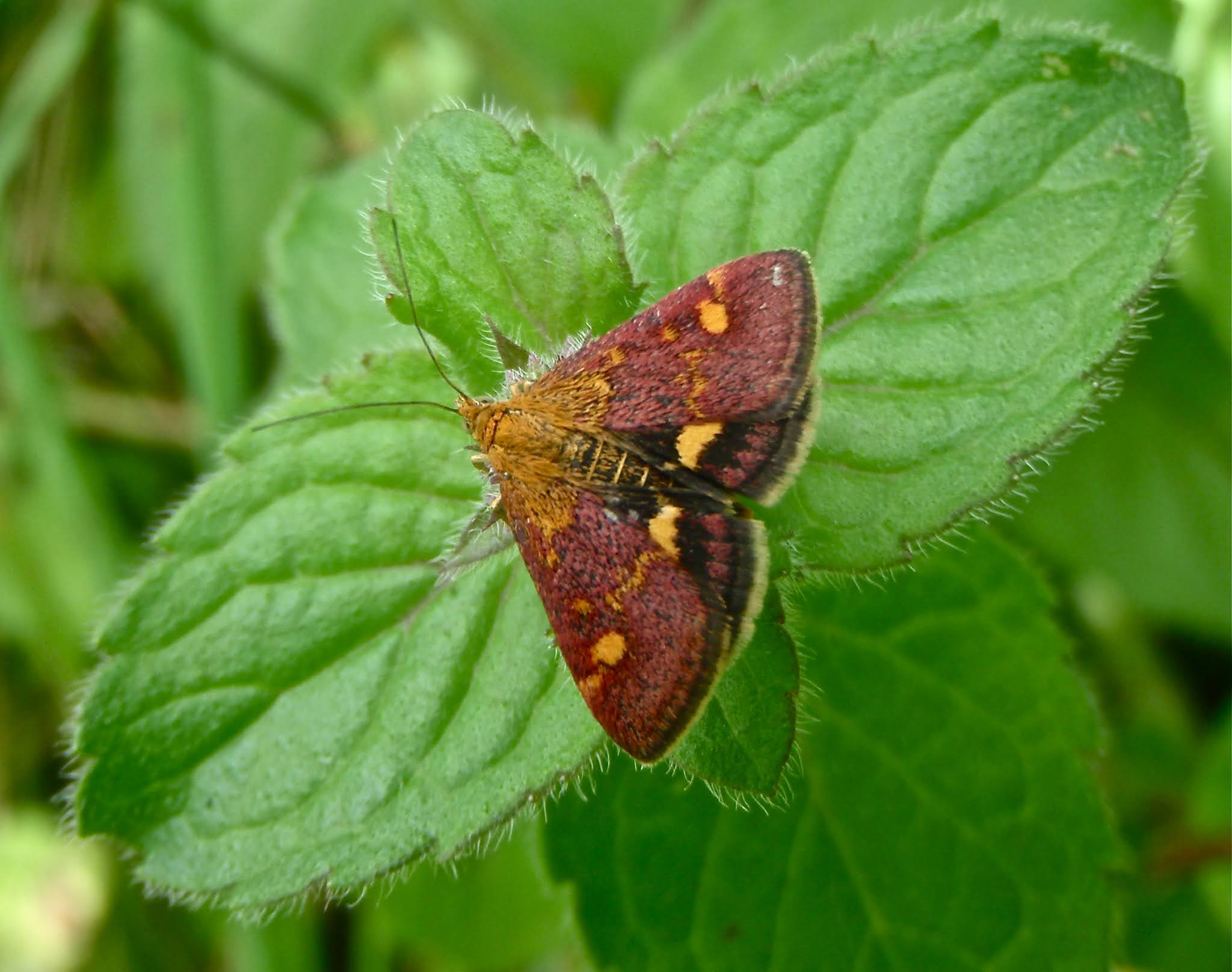
The Mint Moth (Pyrausta aureate) flies at night and in bright sunshine, the male sitting on the Mint leaves. Fortunately this beautiful small moth is still quite common, the caterpillars having a choice of Mint, Majorum, Thyme and Clary mostly growing in amongst waterside vegetation.  

Climbing Ivy was already full of flower buds which will attract late summer insects, especially bees and late butterflies. Fleabane was still flowering strongly and there were now plenty of Dog Rose hips changing colour to vivid red as were the Guelder Rose berries and Hawthorn berries at various stages of ripening.

Hoverflies have been numerous this year and this one is the biggest on the riverside:
Volucello inanis or zonaria? This one is very large - sometimes known as the Hornet Mimic which is unfortunate as it's harmless. This one is a male (not much of a gap between the eyes).


Back to the birds -

Chiffchaffs (5) were flying with the other small birds, mixing with the flock and identified by their characteristic contact calls. One was calling to it's young. Robins were now 'chinking' a prelude to their winter song, each individual taking up its own territory, occasionally making very loud calls from close range usually along a path (25). Visible House Sparrows were increasing in number (60) although many were still preferring dense bramble patches to the more open hedgerows. Blue ts were the most numerous birds in the roaming flock (78) most still 'yellow cheeked' young indicating a late start this year. Great ts were more elusive with only 7 seen.
Goldfinches mostly kept to themselves using the very top of the tree canopy (only 4 visible). The formidable singers of the banks, the wrens were also still few in number, most visible but silent (6).
The Blackbirds seen (only 10) were obviously still feeding young, or showing the last signs of moult, with none 'sunning'. A single Dunnock called and a Goldcrest flew into a conifer and out on the sunlit side. No buzzards were seen but there were signs of a typical Sparrowhawk kill with a pile of wood pigeon feathers on a path verge. Across the field a Kestrel flew down from where it had been hovering but it's prey was not visible. The Stars of the Day, at least in numbers, were the Starlings (88), with 40 flying in a group (quite a rare sight here) and others in smaller groups all heading north. In a copse with plenty of Ivy, whistles and calls came for a traditional roost. A tapping Great Spotted Woodpecker was busy very close to a tree where in the spring several young were raised, near a path but well hidden.
Corvids were quite scarce with 4 Carrion Crows, 2 rooks flying across, a single Jay,  and 7 Magpies. Our guardians, the Woodpigeons were distributed evenly along the river, berry-hunting and chasing (29).
Finally it was good to see and hear the Nuthatches in the oaks (5) including 3 juveniles.

Back to insects:
Butterflies were still numerous, but mostly Large Whites, a few Small Whites and Green-veined Whites along the banks and verges and Speckled Woods in the dappled shade under the trees and some very bright and fresh  Red Admirals. Two Brimstone butterflies were also flying along hedges. Many types of bees and Hoverflies were amongst the flowering plants.
Small Meadow Grasshoppers were numerous together with small 'grass moths'.


 Common Darter female (Sympetrum striolatum) basking on a gravel path
They are far more visible when flying!

Common Darter dragonflies were numerous along the tree-lined river margin and basking on a nearby path with several strong-flying Southern hawkers hunting insects in the sun along hedgerows.