Sunday, 26 September 2021

All change on the riverside - the survey for 29th August 2021

 It seemed as if only a few days ago there were very few birds to be seen and heard and most wildlife was seen by crawling around amongst the grasses at grasshopper height - but now, at the end of August, looking up to the sky could again be rewarding.

The 29th August 2021was fine and sunny, not much wind with the blue sky sparsely scattered with cloud. Immediately, on looking up through the branches of an old oak, a large roaming flock (or is it roving?) of BlueTs, mixing with a few Chiffchaffs, Robins, and Great Ts was visible and audible, the crowd flowing into the tree seemed never ending, the vast tree canopy accepting more and more without any emerging. Sudddenly a Nuthatch gave loud protesting warning calls looking down at an oblivious dog-walker. The Nuthatch was unmoved by the flocks around it however. Most of the birds were juveniles, indicating a successful late breeding season. Field Maples were full of seeds but not ready to spiral down from the branches, Oaks held few acorns in contrast to the previous year. Some Blackthorn trees already held plenty of fruits. There was a strong scent of mint from some large clumps of flowering wild mint growing tall as most other flowering plants have done this year.


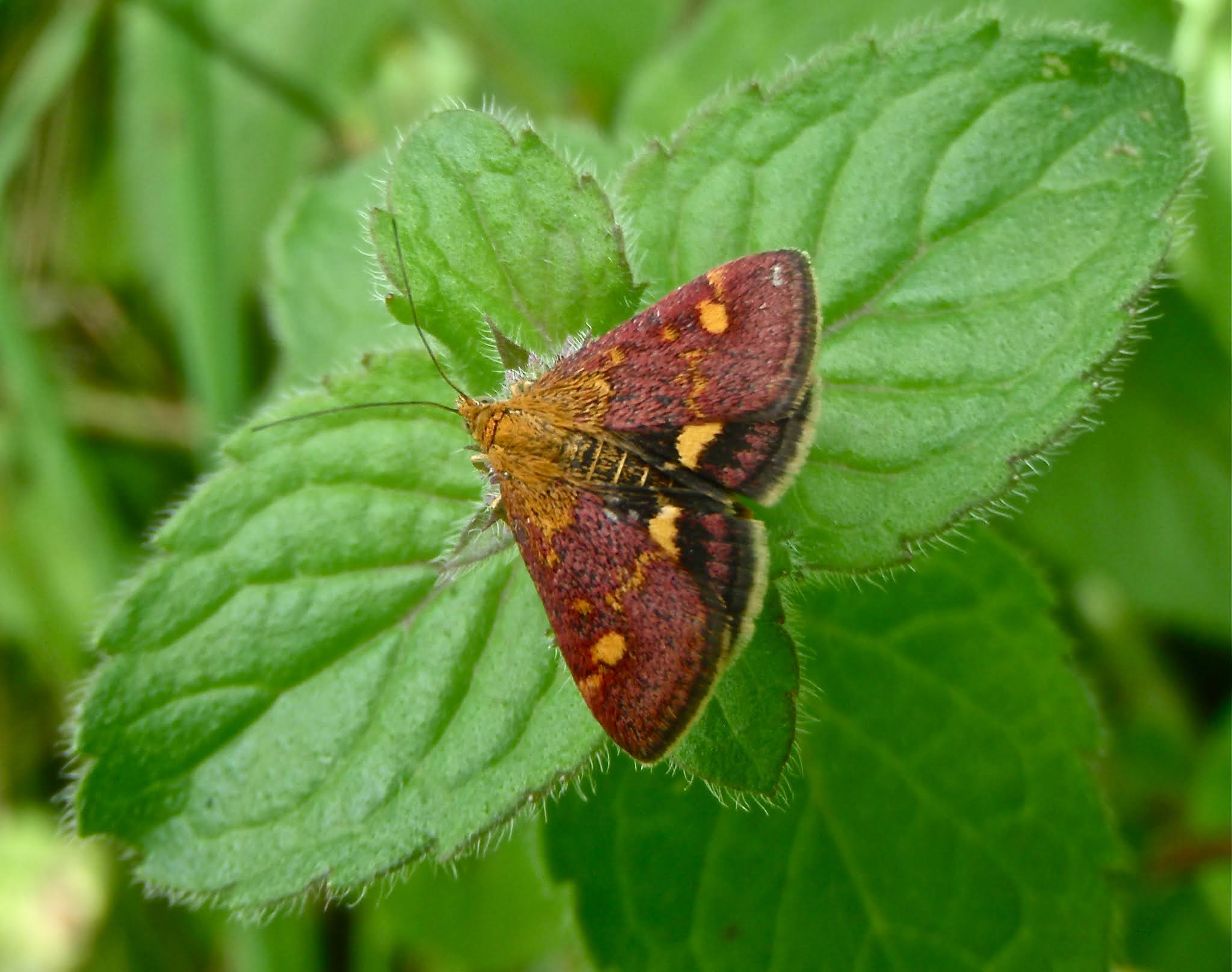
The Mint Moth (Pyrausta aureate) flies at night and in bright sunshine, the male sitting on the Mint leaves. Fortunately this beautiful small moth is still quite common, the caterpillars having a choice of Mint, Majorum, Thyme and Clary mostly growing in amongst waterside vegetation.  

Climbing Ivy was already full of flower buds which will attract late summer insects, especially bees and late butterflies. Fleabane was still flowering strongly and there were now plenty of Dog Rose hips changing colour to vivid red as were the Guelder Rose berries and Hawthorn berries at various stages of ripening.

Hoverflies have been numerous this year and this one is the biggest on the riverside:
Volucello inanis or zonaria? This one is very large - sometimes known as the Hornet Mimic which is unfortunate as it's harmless. This one is a male (not much of a gap between the eyes).


Back to the birds -

Chiffchaffs (5) were flying with the other small birds, mixing with the flock and identified by their characteristic contact calls. One was calling to it's young. Robins were now 'chinking' a prelude to their winter song, each individual taking up its own territory, occasionally making very loud calls from close range usually along a path (25). Visible House Sparrows were increasing in number (60) although many were still preferring dense bramble patches to the more open hedgerows. Blue ts were the most numerous birds in the roaming flock (78) most still 'yellow cheeked' young indicating a late start this year. Great ts were more elusive with only 7 seen.
Goldfinches mostly kept to themselves using the very top of the tree canopy (only 4 visible). The formidable singers of the banks, the wrens were also still few in number, most visible but silent (6).
The Blackbirds seen (only 10) were obviously still feeding young, or showing the last signs of moult, with none 'sunning'. A single Dunnock called and a Goldcrest flew into a conifer and out on the sunlit side. No buzzards were seen but there were signs of a typical Sparrowhawk kill with a pile of wood pigeon feathers on a path verge. Across the field a Kestrel flew down from where it had been hovering but it's prey was not visible. The Stars of the Day, at least in numbers, were the Starlings (88), with 40 flying in a group (quite a rare sight here) and others in smaller groups all heading north. In a copse with plenty of Ivy, whistles and calls came for a traditional roost. A tapping Great Spotted Woodpecker was busy very close to a tree where in the spring several young were raised, near a path but well hidden.
Corvids were quite scarce with 4 Carrion Crows, 2 rooks flying across, a single Jay,  and 7 Magpies. Our guardians, the Woodpigeons were distributed evenly along the river, berry-hunting and chasing (29).
Finally it was good to see and hear the Nuthatches in the oaks (5) including 3 juveniles.

Back to insects:
Butterflies were still numerous, but mostly Large Whites, a few Small Whites and Green-veined Whites along the banks and verges and Speckled Woods in the dappled shade under the trees and some very bright and fresh  Red Admirals. Two Brimstone butterflies were also flying along hedges. Many types of bees and Hoverflies were amongst the flowering plants.
Small Meadow Grasshoppers were numerous together with small 'grass moths'.


 Common Darter female (Sympetrum striolatum) basking on a gravel path
They are far more visible when flying!

Common Darter dragonflies were numerous along the tree-lined river margin and basking on a nearby path with several strong-flying Southern hawkers hunting insects in the sun along hedgerows.


Saturday, 28 August 2021

Gatekeepers and Goldfinches - the survey for July 29th 2021

 The survey for 29th July 29th 2021 revealed butterflies and dragonflies outnumbering birds, not unusual for high summer. This is of course what is seen and heard which is not indicative of what is actually present along the river.

It was windy and sunny, with a few clouds scudding across, The breeze was cool, from the south-west and the ground damp underfoot, with large puddles and good numbers of insects over the water. Grasses going to seed have been delayed this year due to the cold spring but Goldfinches were now happy with seedheads appearing, at least in sunny areas. The river was quite high with mud indicating that levels had been at least 0.5 meters higher. Comparing the presence of fruit now more visible on the trees, it was clear that some had been exposed to freezing winds, hail and late frosts when in blossom whilst most had escaped and were producing strong fruits. This depends each year on the timing of the different varieties coming into blossom and the location of the trees on banks and slopes. As with the the fruit trees, there are different varieties of Bramble and each hedge or clump was at a different stage of producing blossom and fruits. with instant attention from bees and butterflies. There was a good selection of grasses and wild flowers, with Knapweed, Thistles, Meadowsweet, Fleabane, Willowherbs, Vetch, Clovers, Seneecio jacobaea, Bird's Foot Trefoil and many more.

Fleabane has done exceptionally well this year, suddenly flowering after a few hot and damp days:


A Hoverfly on rain-battered Fleabane which attracts many butterflies.

This time the survey begins with butterflies: over 100 Gatekeepers were seen, chasing, being chased by other  species, along hedges and over grasses, nectaring on many of the wild flowers, rather late this year.
One Brimstone female was present and over 30 Large White and 4 Small White butterflies were seen, most in flight.
Two Comma butterflies were present in different areas, and only two Meadow Browns but 9 Ringlets in damper  areas. Two Holly Blues and one Small Blue were flying near one of the ponds with a single Speckled Wood in the shade. Four Red Admiral butterflies were on thistles near one of the drainage basins, one of them chased off by an aggressive  Gatekeeper.


Above - a female Meadow Brown butterfly in a faded condition having survived torrential rain. wind and sun. The upper sides are usually darker when young.  The low number seen may be due to the Meadow Brown butterfly sometimes roosting in the tops of trees and being exposed to this summer's bad weather.

Note that there were several Marbled White butterflies in the same area in mid July first seen here last summer 2020.   It's good to observe that they have reappeared this year!

Next, Dragonflies:
One strong-flying Brown Hawker, a Large Red Damselfly and three Migrant Hawkers were present
and very active.
The most numerous by far were the Banded Demoiselle Damselflies, many in the shelter of the steep  Arun river banks typically in the area shown in the photo on the previous post.
It was interesting to see several males clinging upside-down on different levels on a single reed peering onto the water surface below. More were perched on a tree log, coming and going, dashing out for passing insects.

Grasshoppers:
Largely unseen unless disturbed were hundreds of small Meadow Grasshoppers low down in the thick layers of the grasses on the river bank meadow, jumping to the top then falling back down under cover.
Bees of many types, Bumblebees and Honey bees were numerous as were Hoverflies.

Birds
Most numerous by far were the Goldfinches, more than 60, which were heard then seen in several groups, some flying across and landing in trees and thickets, where  they would sing together, juveniles included.  Along the river, Blue Ts (19 )and Great Ts (5) were moving amongst the trees mostly selecting insects as they went, a few calling. A call from a single Willow warbler was heard (not the song) and more than 20 Chiffchaffs were heard calling and most seen, making continuous contact with others. Perhaps they were forming flocks before migrating, although some will be overwintering here locally.
They are usually the first migrant birds to arrive here in the spring. A single Whitethroat was seen amongst the branches of a young tree.
Blackbirds and Song Thrushes had been late to commence their spring song this year but made up for in volume but have been very quiet during their moult season, only uttering alarm calls. Only 13 Blackbirds were seen and no song thrushes.
One or two were 'sunning' on the bramble verge while some were obviously still feeding young.
Usually the most numerous of birds heard singing along the river - the wrens were remaining very quiet - only 6 were heard or seen. Even fewer Robins were counted - three, they have not left but are in hiding still.
Three Blackcaps were visible in the thickets over the Arun where they are usually seen when they first arrive in the spring and are heard singing. They will probably leave soon, to be replaced with 'winter Blackcaps'-it is still thought that the birds that are seen here in the winter are not summer migrants which have decided to remain rather than migrate.
We have all seen large flocks of House Sparrows about but only 23 were seen today, quite vocal, but well hidden in the hedges. Starling numbers can vary a lot but 6 were counted and only three Herring Gulls seen flying across. 27 Woodpigeons were scattered in old oak trees and on the grass under them . There were 4 Magpies, 5 (moulting) Carrion Crows and one Jay in the same trees.
Finally a single Great Spotted woodpecker and two calling Nuthatches were seen.
There were signs of early plundering of Hawthorn berries and Hazel nuts neither being fully ripe at the time, but very plentiful.


Friday, 27 August 2021

More about Dragonflies and their habitat

 In the previous post the dragonflies described were Damselflies which are usually more commonly seen in late spring and mid summer whereas Dragonflies are more often seen later in the summer and into early autumn. The Damselflies in this area frequent slow moving rivers or slow-moving meandering sections, usually with plenty of green aquatic plants, green banks bordering green grassy areas. The most important features of their habitat are old and new branches dipping into or crossing the river water, slowing it down and providing warm sunlit surfaces to perch on - large old fallen branches are perfect for both damselflies and dragonflies, with hedges providing the ' hanging ' dragonflies with lookout locations. There are many suitable places  for river dwellers and fewer locations for pond dwellers unless the drainage basins retain water during the summer.

A perfect example of Dragonfly and Damselfly river habitat with sunlit perches - the fallen branches connecting the steep bank with the river. When the sun is at its highest the area can be quite crowded with active Odonata whilst the grassland and wild flowers at the top of the banks supports many butterflies in the height of summer flying together with exploring Odonata.

Other Odonata prefer ponds but as this area has no natural marshland and bog the ponds are restricted to 'created' ponds and drainage basins with planting to encourage wildlife.

It is here that we find the Skimmers - Dragonflies such as the Black-tailed Slimmer (Orthetrum cancellatum) in habitat with broad-leafed plants and usually stoney paths nearby. On hot days leafy perches are preferred! This Black-tailed Skimmer can just be seen flying low over a broad leaf at the top left, it's shadow more visible on the leaf below, wings outspread. 

In semi-shade this pond does not usually dry out and harbours frogs which translocate to many other areas nearby via vegetation and long grasses, escaping the attention of Grey Herons which also frequent the area. This Dragonfly also frequents the area of the river (see above) , coming back again and again to the same perch whilst hunting. The presence of butterflies can attract it to marginal grasses where it will catch and eat them. They will eat many types of insect, even Damselflies.

Often overlooked, unlike butterflies, Odonata are very fragile and their presence is completely missed in even slightly cloudy weather which leads to their habitat being lost to river and pond clearance work, summer mowing of wild grasses and plants, draining damp areas and allowing drainage basins to dry out.

The habitat that supports them is also vital for the survival of many other species. Complete colonies of these Odonata species can be destroyed in a few minutes, not just for that year but permanently. They will survive normal flooding after torrential rainfall but not the work of a machine such as a digger.

The river supplies its own diversity with meanders, shallows, slow flows, fast areas, clear water and muddy water, a variety of aquatic plants, a stoney bed and a soft muddy bed, steep banks and grassy banks, marginal trees old and young, sun and shade.


Monday, 16 August 2021

Dragonflies and their Habitat here

 Exceptionally erratic weather this summer (and it's not over yet) meant that the first sightings of some species were delayed or made in slightly different locations. As usual the first dragonflies to be seen however were the Beautiful Demoiselle damselflies in May (see the post for the survey of 27th May 2021). The sightings of Beautiful Demoiselle damselflies was followed almost immediately by the Banded Demoiselle damselflies : 

Here is a male Banded Demoiselle perched on a leaf with an excellent view over the river.

It is a spectacular electric blue with translucent wings marked with a black 'thumb print' which identifies it wherever it is seen.


Males are often seen in groups flying and chasing just above the river surface or perched on fallen branches, plants and twigs but occasionally fly off overland,  whilst the metallic green females spend most time away from the water  unless ovipositing (depositing eggs) on floating plants.

Here is a female Banded Demoiselle damselfly moving on a Nettle leaf   29th July 2021


The females have greenish wings unlike the female Beautiful Demoiselle damselfly which has dark brown wings:

 see below for an example which captures what you would see if you spotted a female Beautiful Demoiselle in flight!


(A photo of the male on a Dock leaf is on the post for the Survey for 27th May 2021).

What do you see in common on all these photos?

A variety of lush green vegetation which is essential for the survival of dragonflies and damselflies - both aquatic and bank/field plants. These are essential  for the whole life-cycle of these insects, providing climbing stems and shelter for dragonflies when in larva form in the river and their emergence from the water, then providing platforms for watching for passing insects, then for ovipositing.

In bad weather the plants will be used for shelter, in common with most other insects such as butterflies, grasshoppers and moths.

NB Damselflies are in appearance more fragile than 'Dragonflies', perching with wings held closed over the back in most. rather than held out at right angles to the back. Both wings, from and back are the same basic shape and the eyes are separated (see first photo on this post -  male Banded Demoiselle). 

Dragonflies (common name for all Odonata) but separated by the name Anisoptera (unequal wings) from the Damselflies Zygoptera (equal wings) have a sturdier heavier body shape and powerful flight, wings held out from body when perching, with hind wings a different shape from front wings.

More on habitats and dragonflies in the next post.....


Sunday, 25 July 2021

Summer on its way - the survey for 23rd June 2021

 Wednesday 23rd June was fine from the start, a glimpse of summer after the dense cloud and rain of the past few days and probably just a glitch in the general trend...The rain and warmth had caused amazing growth, vegetation growing twice s tall as usual. Oaks were now in full leaf. Hazels had produced huge leaves and new branches extending outwards and upwards, even wild flowers such as buttercups followed the pattern, reaching for the sky, was the sun still there? Flowering wild Roses (Rosa canine) are always a sign that all's well and summer has arrived, but this year their flowering was brilliant but  short-lived:

6th June 2021 Bumblebee on wild rose.  and below, also 6th June -  Red Clovers and Buttercups:


A dense mix of natural ground cover, thankfully unmown, which would attract a good diversity of insects now that the weather had improved. Hoverflies and bees most prevalent as the sun became hot.

The numbers of birds in full song on 23rd June was a surprise but they were responding to the brightness of the sun and the length of the day. House sparrows were again most numerous  in various hedgerows and brambles (70) and goldfinches (13) were also singing but much less visible in the thickets.
The prevailing weather had suited blackbirds(23) and song thrushes (9) with perfect conditions for foraging for invertebrates in soft layers of damp leaf-litter in the undergrowth. The variations in the songs of the song thrushes was unprecedented, some being very close and loud, the presence of a human was not tempering their calls - they were not identifying me as a  human threat. Chiffchaffs were the next most prolific singers, their song cannot be compared with the thrushes but it is nevertheless affective as are their contact calls. Thirteen were identified. Willow warblers have a distinctive song and three were heard today, with 4 garden warblers singing. These were spread out along the river course mostly in dense damp habitat near the willows. There were 12 unmistakable blackcaps - all singing too, also in willows and mixed thickets, and 2 common whitethroats nesting in bramble shrubs with a probable lesser whitethroat in taller vegetation.
Wrens (18) were singing but the actual number is probably higher, with those nesting unseen. Three Dunnock were visible along the paths. Fewer robins are seen and heard at this time of the year with 12 today most singing. 

Delayed broods of Blue ts (15) and Great ts (7) were doing well with adults still feeding fledged young in some locations. Two goldcrests were seen flying across to a dense conifer.Twenty wood pigeons were seen in various places, some up from bathing in the river and just one collared dove. Two nuthatches were present but keeping low profiles as usual this summer. Only 4 starlings were present - most still nesting - we have yet to hear the noisy calls of the fledged young.There were 8 herring gulls in the air,  eleven carrion-crows, two silent magpies and a single jay in the trees.
A kingfisher was seen flying fast and low over the river Arun and a Cetti's warbler was heard not far from where the first one for this location was heard (loudly) and seen last spring  - but not as close up this year.

A common buzzard was heard calling, then appeared directly above me. Two more buzzards joined it, all three flying closely together, the group being chased by a carrion-crow. The crow soon dropped away and the buzzards drifted south with the northerly breeze.

It was very good to see an adult male grey wagtail which flew out from the steep river bank (Arun) to land on a partially submerged branch across the river where it could be seen catching flies with the female of the pair just upstream. A grey bird with striking black and white tail feathers flew low across the bankside nettles above them - this was one of the fledged juveniles, still being fed by the adults.

Butterflies seen were:
Meadow Browns - fresh, not yet faded, flying low over the tall grasses, Ringlet, several, Large Skipper, Small Skippers, Large White.

Dragonflies seen:
Banded Demoiselle damselfly, Large Red damselfly, White-legged damselfly, Azure damselfly, Black-tailed Skimmer, Broad-bodied Chaser.

Reptiles seen:
A surprise - a fine Grass Snake in a small pond - it was snatching at insects on the surface of the water and in the air,  it's head and body showing the distinctive Natrix natrix markings. It was possibly watching the movements of dragonfly perched and flying to and from a broad leaf.

There will be a separate post on the dragonflies soon.


Friday, 25 June 2021

Damseldflies First - the Survey for 27th May 2021


Summer seemed to be approaching with even small changes very noticeable today 27th May, after a long winter-like spring. It was a fine clear morning with May blossom now visible everywhere, and some just going over to be replaced by adjacent trees coming into leaf in the full sun. There was no wind just a thin layer of high cloud and numerous pollinating insects. Cow Parsley was growing very fast now forming shelter for young birds  newly fledged. Birdsong was echoing along the river which was flowing well after having been quite high after previous rain. Fresh new growth has rapidly displaced the Wild Garlic, with nettles springing up,  promising good conditions for most butterflies. Buttercups were flowering everywhere too, attracting more pollinating insects,  growing tall for easy access to red and white clovers this year. Bright green Oak leaves were unfurling in the sun and even a sapling, browsed by deer was casting out new shoots. Wild Honeysuckle was full of new shoots too.

Birdsong was loud and wild with no control over volume. The variety and mix of sounds and songs seems magnified this year - perhaps young birds last year learnt how to adjust their songs to the ambient sounds in those confusing times but their continuous song did not detract from what could be seen on the river below:

The first sighting of Damselflies and Dragonflies in a quiet sunlit part of the river where conditions were just right for their emergence. This will be covered in a separate post.


A male Beautiful Demoiselle Damselfly perched on a Dock leaf in the midday sun, watching out for passing insects. They have dark translucent wings and an electric blue/green body.


Clinging to the edge of the Dock leaf - Just to get a better view.
The same Beautiful Demoiselle damselfly male showing the shadow
cast in full sun through the layers of wings.

There were good numbers of both Beautiful Demoiselles and Banded Demoiselle damselflies in this area 
mostly low down above the water but some ranging further afield over the long grasses on the bank.
There were also Large Red Damselflies, usually the first to be seen in the spring.  The surrounding land is almost as important as the aquatic environment for dragonflies. When Banded Demoiselle damselflies leave the river they can often be found some distance away. flying over the long grasses-  but when the weather turns cloudy and it starts to rain they simply drop down under the shelter provided by vegetation, and re-emerge as soon as the sun appears, as do butterflies. A a sufficiently tall layer of mixed grasses and wild flowers is required.

Back to the birds present:
Over eighty very vocal house sparrows were seen in their usual hedges- and being a warm dry day dust bathing on several of the paths. Robins were less numerous (18) but nesting continues with first broods of young well fledged and assuming their adult plumage.Wrens (25) were especially vocal all along the river as usual, fortunately not affected by higher water levels after the rain. 5 Dunnock were seen, four singing, their numbers increasing slightly from year to year. Blue ts (15) and great ts (8) were clearly occupied in nesting which was most likely delayed this spring). and two goldcrests were seen in a conifer.

Blackbirds(33) and song thrushes (9) have dominated the soundscape this spring giving louder and more prolonged song cycles than previously.They appear more confident and more numerous too.There has been no lack of available food along the banks with invertebrates thriving amongst the vegetation and the  river provided the required  damp conditions and mud even during weeks when there was no rain.
Carrion crows (7), woodpigeons (25 ) starlings (36)magpies (7) jackdaws (2)  were present with starling numbers improving, possibly due to the proliferation of invertebrates.
Good numbers of goldfinches ( 42) were present, most singing in small groups or flying over.

On to the warblers, mostly spring migrants:
Providing a continuous background chorus whatever other birds were doing, made it a memorable day with only a glimpse of a sparrowhawk dashing into some brambles. The Cetti's warbler was still present this year but had chosen to establish a territory further away across the river probably whilst the weather was still cold.
Blackcaps (18) were present and still visible in the Willows and Hazels in various places with about ten singing. Chiffchaffs (18) could certainly still be heard but some not singing were nesting. Two willow warblers were heard and five common whitethroats were seen and heard near where they were nesting in bramble patches along the length of the riverside. There were three Sedge warblers too singing their characteristic song in different areas.
A swallow was seen flying low over Basin 5
Finally heard but not seen, the quacking of a mallard duck down on the river.


Here is a female Orange-tip butterfly perched on fresh Bramble leaves.
Orange-tips have been numerous this year, all flying in their own areas they are not seen in large crowds.
The females do not have the characteristic bright orange tips to their wings but have mottled hind wings as do the males - visible when the wings are closed. Garlic Mustard has been flourishing along the verges and hedgerows and is one of the main food plants of the Orange-tip caterpillar. The other plant is the Cuckooflower which flowers earlier and was more extensive this year.
More  Butterflies seen this day :
Orange tip, Green-veined White, Brimstone, Red Admiral. 


Thursday, 24 June 2021

A Wild Start to May 2021

 This May  was more like March, with rain, hail and wind but blossom appeared as soon as there were warm and sunny intervals. Some flowers however did not survive the elements after two or three attempts at flowering. There was very little shelter from other trees.most of which had yet to come into leaf. 

What a change from last year.... 


Fruit tree on the river bank fully in blossom
attracting bees. 11th May 2021

Tuesday 11th May started fine  and warm but breezy from the south with some varieties of fruit trees suddenly in blossom. A buzzard was circling overhead with blackbirds, whitethroats, blackcaps chiffchaffs, willow warbler, goldfinches, robins, wrens, dunnock, song thrushes and a mistle thrush all singing and most quite easy to see through the bare branches of Oaks, Maples, Ash and Willows low and high.


The bank with a leaning fruit tree in blossom and daisies in the background
and Hawthorn in a sunlit location - one of the first trees to come into leaf and 
then come into blossom:


Close up  - May flowers awaiting insects on 11th.

The following days became dark again with drizzle and rain but with the welcome sight of swifts flying under the clouds, catching insects.

Even the early butterflies disappeared for a while:


This Peacock butterfly was the first seen -here  on 4th April 2021
warming up in the sun on a warm bed of straw - last year's  dry long grasses.

See the next post for the May Survey on 27th May 2021...