Sunday, 30 June 2019

Migrant Warblers and Resident Wrens along the river

The wildlife survey for June was on Friday 28th June 2019, a fine day with some high light clouds.  The last rain fell two days before and the ground was still damp in the shade. Conditions have been perfect for growth in all respects, with abundant riverside vegetation, wild flowers, some new to the area, springing up and signs of many birds starting on second broods with warblers and wrens especially vocal, singing loudly from perches amongst the dense leaves of trees and shrubs overhanging the banks. Meadow Brown butterflies are everywhere skimming the grasses and bees throng the flowering brambles.


Flowering Lesser Stitchwort on the embankment

The first impression on listening was the more or less continuous background calling of young starlings, flying across in groups of about 15, following adults, foraging on grassy areas and in trees with a total of around 80 birds along the riverside. This is a good sign as starlings have been declining in numbers for years as have house sparrows. It's incredible that many areas have no house sparrows at all now, whereas here there are thriving colonies around every corner, today mostly chattering in dense low vegetation such as hawthorn hedges and bramble patches - more than 90 were present.
15 wrens were singing along the banks whilst 16 blackbirds were more easily seen,some singing, others  foraging on the grass or 'sunning' out in the open, getting as hot as possible, part of their preening process.  Song thrushes prefer the cool shade and damp earth, and five were singing out of a total of 8 seen. Robins were either hidden away, moulting or nesting, they can have raise three broods in a summer. Only one was heard singing a short song, the others were silent, with only seven seen in total today.  Four dunnocks were seen, all low on the river banks and a single greenfinch was seen lit up by the sun in a conifer where goldcrests can usually be heard and seen, but today they were heard in riverside oaks quite a distance away (2). Two chaffinches were seen and heard in an open area with trees whilst a group (about 20) of goldfinches sang together from an old maple.
Larger birds were seen in the canopies, with 5 jackdaws, seven carrion crows, one collared dove near its nest,  only 17 woodpigeons and the noisiest birds, the magpies (7) caused a row in a conifer.
Above the canopy, 8 herring gulls were seen gliding, silent today as no raptors were in the area….
except for a sharp fast- flying sparrowhawk low over a pond.
Our resident birds, the blue tits, (15), great tits (7) and long-tailed tits
(4) (were all present but keeping a low profile, with young quietly following adults or foraging together whilst adults raise second broods. They keep to dense vegetation and fly fast and erratically between one thicket and another. A green woodpecker called across the river and two great-spotted woodpeckers were seen chasing in the pine trees, disturbed by a distant mower. Further along, in the very old oaks it was good to see a large family of nuthatches, about 7 flying short distances from tree to tree, branch to branch - the young calling loudly. At several other locations, all in old trees, more nuthatches were seen and heard, making a total of 13. This is a large number, indicating successful breeding!  More broods will be raised this summer.
Leaving the most interesting birds until last, it was very good to hear far more migrant warblers singing along the river than usual, with sustained song from whitethroats (5 singing), garden warblers (4 singing), chiffchaffs (2 singing) and a record number of blackcaps, mostly in the willows, (9 singing).
The song from the blackcaps was particularly loud!
Conditions have been good for them this year - on arrival in this country earlier in the spring, conditions were good, with insects plentiful along the sheltered meanders of the river allowing them to feed up after their long journeys.

Insects!  and spiders too…
Hoverflies, in large numbers appeared early and since then , with the warmer weather, many summer butterflies have suddenly filled the grassland areas that have been allowed to grow, full of wild flowers attracting bees after the blossom finished.Today the most numerous butterflies were the Meadow Brown butterflies, with Painted Lady, Ringlet, Large White, Large Skipper, Small Skipper and Red Admiral,  Common Blue and Speckled Wood.
Bumble bees and Honeybees were numerous too, now having switched from feeding on willow catkins to Bramble flowers, suddenly appearing in sunny patches.
It is worth noting that there are new ants nests forming in the same areas where the ground is dry - all good for the increasing diversity here.


Friday, 31 May 2019

Bees Winning the Battle

The last day in May - time for a short summary of a magnificent month on the riverside.

It was good to see rapid growth, quite startling towards the end of May with most plants springing ahead in the warm sunshine and no heavy rain to batter down fragile new shoots. We do need much more rain however as the ground is becoming dry, the heavy clay cracking in places. One result of this however is the creation of numerous hideaways for many species of insect, amphibians, small birds and  mammals, provided that they are hidden amongst tall grasses. Some species of bee have been found to make very good use of such spaces. The lush growth on the banks and verges has created the perfect nesting habitat for song thrush, blackbirds, wrens, great tits, dunnocks and other small birds, all great singers too, which have been contributing to the very impressive Dawn Chorus each morning.
The large increase in amounts of blossom and catkins produced by plants along the river has attracted more bees and other emerging insects to forage amongst them, overcoming the extremes faced last year with poor spring weather and summer heat and drought. Hopefully we will have a more varied summer this year. more growth and less destruction. 
Just cutting down a few branches of flowering Rosa canina or any other flowering plant will deprive bees of a major source of sustenance and cutting a hedgerow during the spring, summer and autumn will cause mass destruction, not just for nesting birds but for bees and many other insects and small mammals. Such habitat is also valuable in winter, providing shelter for many species and should only be subject to 'trimming' in long rotation, not every year.

The latest event for encouraging bees has been the sudden flowering of Rosa canina - dog rose. Cascades of the single flowers are now lining the footpaths and buzzing hedgerows.


A heavily laden bumblebee moves round, gathering pollen as it feeds on a single Rosa canina flower.

Earlier in May some of the first Clovers appeared on the verges:

Large Red Clover flowers


and some smaller wild flowers, just as important:

Greater Stitchwort, another early summer flower.

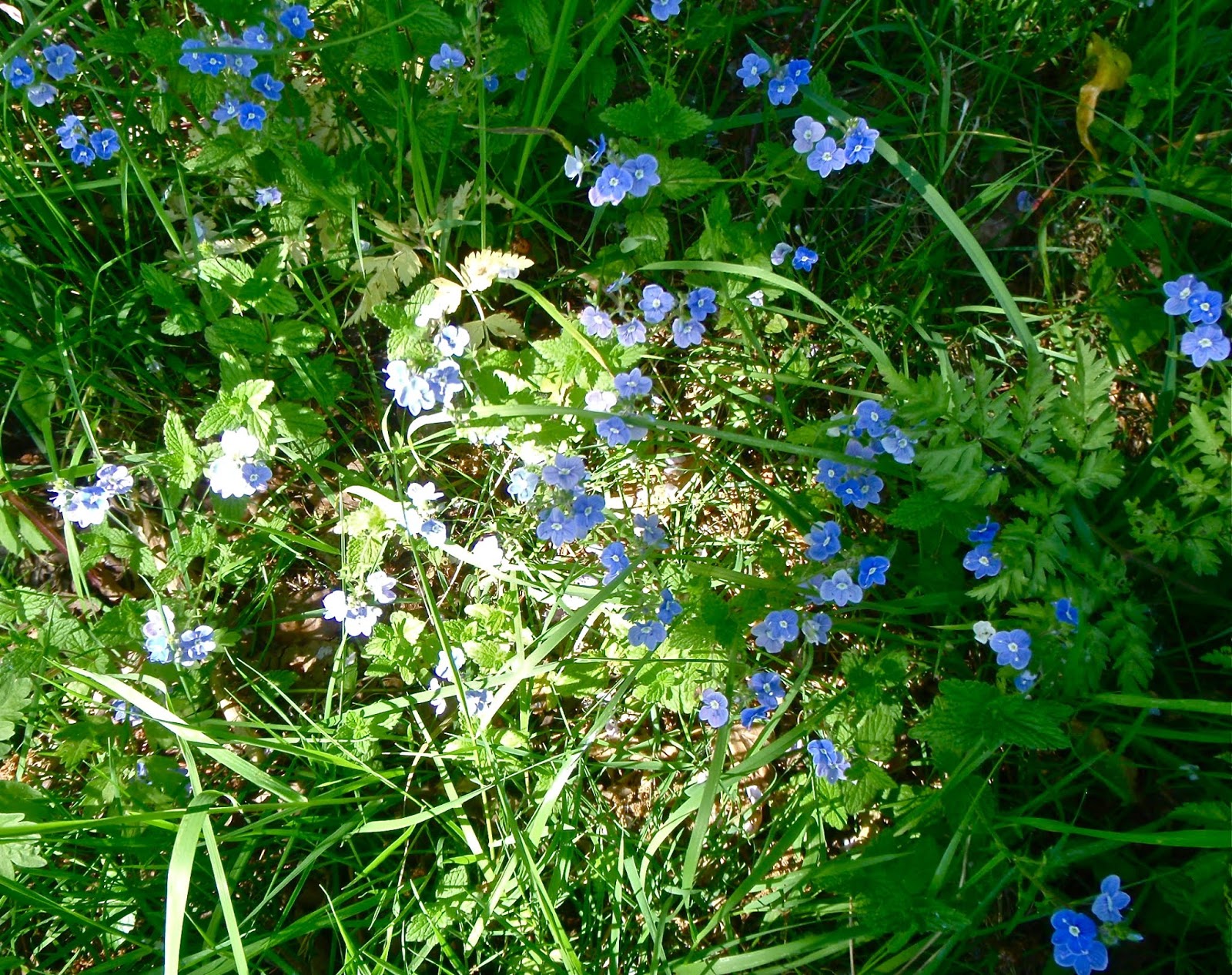
Germander speedwell (Veronica chamoedrys)

 Common daisies cover the grass like snow, in strong May sunlight.
Just leave them to grow!


Wednesday, 29 May 2019

The Greenest May

Much has happened during May 2019 with the river warming up. Damselflies and Dragonflies have appeared later than last year, but are now emerging into the sun.


This Large Red Damselfly male on 24th May was shifting from place to place but returning to the same sunlit leaf on the river bank. Flies of all kinds were numerous over the water  and foraging was easy.

The survey this month was made on Tuesday 21st May 2019, a fine day after overcast weather. There was no rain and not much wind and very bright clear sunshine. Dandelions along verges and banks were mostly in seed now with 'clocks' sending flying seed in all directions, some of it taken by house sparrows as it drifted past. Cow Parsley was growing prolifically along the banks and under hedge margins in semi-shade:


 The young green  Cow Parsley shoots emerging from the winter layers of fallen leaves are always one of the first signs of spring and the flowers herald summer. The Oaks are now in full leaf and ash trees in leaf at last. Fruit trees have tiny fruits following on from the blossom and bramble flowers are just appearing in the sun. Soon they will be full of bees. This acceleration of growth means that birds have more hiding places and associated aphids and caterpillars to pluck for their young, perfect timing.
A continuous chorus of small birds singing and calling filled the air but today singing blackbirds were the loudest. Thirty-nine were present along the riverside, many singing, whilst others gave alarm calls or soft contact calls to their young, finding their way through the under storey of Cow Parsley and ivy.
Less obvious but always present were the calls and 'songs' of House Sparrows, juveniles increasing the usual numbers present in colonies totalling well over one hundred.  Most of these prefer insects to seed at this time of the year. Starlings were seen flying over in a new flock of about thirty with many noisy juveniles scattered amongst branches in other places totalling more than forty. Another common bird was seen in fewer than usual numbers, the wood pigeon but this was only due to many nesting or foraging in fields beyond the river  (22). Magpies were even more scarce, for the same reason. As usual the more delicate collared doves were hiding, just one pair being seen and heard.
The songs of robins were short and subdued, with 19 visible including 2 juveniles silently exploring in the undergrowth, the habitat of the dunnock too. Eight were seen, some had been bathing in the river, on an island of twigs. Song thrushes were at different stages, some giving short songs with just one singing a full song, the rest were foraging, collecting food for young in their low under-storey nests, six in total.   Nuthatches, as usual whilst nesting, avoid attracting attention - but two were seen in the oaks today.
Wrens (20) are so numerous that they can be seen and heard at different stages too, all along the river banks.
Their songs and alarm calls could be heard in many different places, three were singing from very prominent tree-top perches whilst others were singing close to nest sites, low down - but the total effect was for their songs to echo along the river banks. 
Blue tits (26) and great tits (9) were active amongst the thickets, foraging for insects, the great tits preferring to search amongst tall grasses on the ground of on the river banks. Two coal tits flew fast into a tall hedge, making their way down, probably to a low nest.


Buttercups take over from Dandelions, and grow tall, attracting numerous insects.

Whilst most wildlife activity is taking place at a low level in undergrowth on the banks, in hedgerows and roots,  loud calls from above distract the observer. A carrion crow calling loudly from a tree top made me look up, as the calls were too strange to be just crows. It was a common buzzard, very close, flying up from the tree over the river, chased by aggressive crows. It has possibly flown too close to a crows nest, but it retreated. Further down the river a different buzzard war also being mobbed by crows circling in the sky. Later a buzzard was seen flying very low over a drainage basin - again followed by a crow (two or maybe three individuals). As for the carrion crows, a total of 8 were seen and a single jackdaw.
A grey heron was seen to fly up out of the river in a stretch with high banks where it had been fishing or catching frogs and 4 Herring gulls were seen flying across whilst a single male mallard paddled upstream.
The star of the river today was a fine grey wagtail  which shot along the river, skimming the surface near it's nest site, very low down.
High calls alerted me to a single goldcrest near some conifers, with two more seen close by (3)
Back at tree level, 4 chaffinches and a single greenfinch were seen in the branches amongst dense leaves. 20 goldfinches were heard and then seen in a thicket, with some anonymous-looking juveniles amongst the group. A family group of 7 long-tailed tits flew forging along the willows, where a blackcap was singing. Elsewhere along the river, more blackcaps were seen and heard, 12 in total, some very quietly sub-singing, but one or two were in full voice.
Chiffchaffs (15) were singing in most places along the riverside trees and seen easily too. Others were contact-calling, probably juveniles.The singing of these migrant warblers was enhanced by two garden warblers in different places and nesting common whitethroats (11) in more open scrub, now only giving short songs.
Finally at the end of the survey, a fine pair of Bullfinches were seen in a thicket on the river, very close to each other. These are resident birds which remain in pairs all the year round, seldom separated by more than a few meters.

Last but not least, insects are the key to our survival - especially bees of which there were large numbers today, thronging the newly opening Bramble flowers and Rosa canina in special places warmed by the sun. Bumblebees, Honeybees, White-tailed, Buff-tailed and Red-tailed bees to name a few.

Butterflies present were Speckled Wood, Green-veined White, Red Admiral, Orange-tip and Holly Blue accompanied by many Hoverflies.


Tuesday, 30 April 2019

The Last Day of April

Tuesday 30th April 2019 - there could hardly have been a better example of an April day here -
and near perfect for a survey, no wind, sun with small cumulous clouds drifting across the blue sky, hardly any noise apart from the sound of a distant garden mower for a few minutes. Birdsong dominated the soundscape.
The morning started cool, with Hawthorn and fruit tree blossom now fully in flower and grassed areas covered in Daisies and Dandelions whilst Wild Garlic still covered the shady woodland and river bank areas and Cow Parsley now growing tall along the hedges.
It is proving to be the best spring for Cuckooflower and Garlic Mustard on banks, with many new plants springing up in new locations, last year's seed from old plants having germinated well.
Holly Blue butterflies together with Orange-tips have dominated the banks and are still most numerous. Both species are very restless, Organge-tips ranging ceaselessly along the vegetation and Holly Blues ranging everywhere, high and low:


Holly Blue butterfly  - Celastrina argiolus -  on very small young bramble leaf - the butterfly is very small too.

Orange-tip butterflies have been numerous too but evasive. Below is a female probably investigating a suitable site for depositing an egg. The males are very easily identified with their bright orange wing tips but females lack the orange and can be confused with other white butterflies at a glance. The most obvious sign is that both males and females have patterned underwings - a mix of yellow and black appearing mottled green, seen when they perch closed on stalks - a form of camouflage


The Orange-tip female Anthocharis  cardamines is in the centre facing one of the flowers of the White Dead Nettle plant.
Like the Garlic Mustard plant, the leaves look rather like a common nettle but do not sting.
The first Orange-tip butterflies appeared here on Thursday 18th April 2019 - the same day as they were first seen downstream (Arun) at Pulborough. The first Holly Blues were seen on 15th April 2019.
(my observations - others may have seen them before this!)

It was easy to be distracted by many spring 'firsts' along the river but here is the result of the survey on 30th April:
House sparrows, more that 100 in total all along the riverside, in hedgerows, thickets, clumps of brambles and down on the river, bathing. Easy to locate by their song or chatter. Some were even sand-bathing along the dry path. Their numbers are increasing now, with fledged young following the adults from roof nests to the river banks. The constant background sound of house sparrows was drowned out by several other species, blackbirds numbering 48 were very active, with some singing long songs whilst other males chased each other or foraged, collecting food for young in the nest. Some song thrushes (10) were singing the loudest and most continuous song, most choosing Ash trees, not yet in leaf, to perch on, so that their song travels far and clear along the river rather than being muffled. Others were well advanced with nesting, seen carrying food for nestlings low and far into the undergrowth.
 Some robins were still singing whilst others were silently collecting food (total 14). Most are nesting, which accounts for the lower numbers. Wrens seemed to be singing as usual, with 33 seen all along the banks, making their songs echo. At this stage they were choosing prominent perches for maximum effect. Three dunnocks were seen chasing but none were heard singing today. Goldfinches were also quiet with only short songs heard from around 10 in a thicket. Once the young are fledged they'll form a larger group and forage, roost and sing together. There were only two chaffinches seen in the trees today. A single goldcrest darted into a conifer where it disappeared, probably into its nest on an outer branch.
About 30 woodpigeons were active too, many searching out choice buds which are always at the ends of thin branches. Bouncing woodpigeons were a common sight. Four calling collared doves were occupying trees with dense leaf cover.
Blue and great tits (22 and 13) were less visible now that nesting is occupying almost the whole population; keeping out of sight whilst visiting nests is a priority and flight distances are as short as possible, although great tits are always more adventurous and visible when selecting choice insect food for their young. Long-tailed tits (28) have already successfully raised young and several family groups were seen in different areas following each other through the willows, oak, brambles and blackthorn.

 The loudest song, apart from the resident birds, was the song of the chiffchaff, usually the first migrant warbler to arrive here in the spring (14), Almost all were singing loudly, pausing now and then to snatch insects from blossom and fresh leaves. Easily overlooked as well camouflaged with dull green-brown plumage, they make up for it in persistent song, definitely unmistakable.


One of the young fruit trees in blossom, with clumps of cuckooflower nearby attracting early pollinators such as bees and hoverflies. Seed heads on last year's wild grasses were still attracting finches in the same area.

Common whitethroats (8)  - migrant warblers, arrived some time ago and have settled in their usual territories, singing and displaying whilst blackcaps (15) have chosen territories all along the river and could be heard singing from treetop perches and amongst the river willows. The large 'clouds' of summer insects over the river always attract them when feeding young and later fruits and berries are eaten whilst the birds are preparing to leave for their winter habitats in the autumn. Amongst the singing warblers a singing garden warbler was heard but remained elusive.
In the air above the river, two house martins were seen over a drainage basin and three common buzzards circled over to the north, two displaying. Crows were few in number, (5) one seen carrying a heavy object, probably part of a packed lunch. It was very good to see more than 50 starlings in small groups fly-catching over the river. They are skilled in this but need just the right calm weather conditions where insects are trapped between low cloud and the warm river. Overhead 8 herring gulls flew across, above three jackdaws from the woods. Seven magpies in twos and threes chased into trees and three nesting nuthatches were seen, unusually silent. A Jay sneaked quietly behind a hedge and a loud raucous call came from a grey heron fishing down on the river bed which was disturbed by a carrion crow.
On the river itself, several groups of mallard were seen in different places on the river, with a pair flying up then down again (a total of 10). These are not tame, and instantly paddle or fly away when encountered.

Butterflies:
In addition to the Holly Blue and Orange-tips, several Speckled Woods were seen, with a single Peacock, Green-veined White and Comma 
Hoverflies were seen in good numbers, with a few St Marks flies, bumblebees and large numbers of midges over the river - all a very good sign!


A Red-tailed Bumblebee Bombus lapidarius on one of the thousands of dandelions covering the grass.


Saturday, 27 April 2019

More April 'Firsts' the second half of April

Monday 15th April - a fine day and another first - Holly Blue butterflies were seen ranging along the south-facing embankment. These were the first of many to be seen this month, in common with many other locations in Sussex. In early summer these butterflies seek Holly leaves on which to lay their eggs but those in the late summer prefer Ivy. Both plants are quite abundant here and of course are extremely good for many species of wildlife, providing food in the form of berries and evergreen shelter over the winter.
A calling common buzzard, a darting sparrowhawk, many blue tits, wrens, blackbirds, song thrush, bullfinch, chiffchaffs, two jackdaws and numerous house sparrows were seen as well.

Another 'first' was seen on 18th April - whilst watching Holly Blue butterflies along the bank, several Orange-tip butterflies appeared. These are also early butterflies but not usually so numerous. Like the Holly Blues, this year they have appeared in large numbers in other Sussex locations as well. 
This year their caterpillar food plants, Cuckooflower (or Lady's Smock) and Garlic Mustard have flowered early and prolifically, the Cuckooflower many weeks earlier than the Garlick Mustard.  The flowering Garlic Mustard over the past few days is now covering the river banks  (27th) and Orange-tips are still numerous.


Garlic Mustard (Alliaria petiolata (Brassicaceae) has leaves 
rather like nettles but smell of garlic when crushed.


Wild Garlic, which is also prolific along the riverbanks under trees at present, has wide fleshy leaves and white flowers but fills the air with the smell of garlic! This has no attraction for the butterflies:


Flowering Wild Garlic or Ramsoms (Allium ursinum). This dies down once trees are in leaf and the woodland floor is in shade, like Bluebells.

The Easter weekend was very warm and Oaks were rapidly coming into leaf but Ash trees were not as advanced - it's certainly Oak before Ash this spring. The Ash tree branches are full of large dark leaf buds but were not yet coming into leaf.


New Oak leaves (left), late Blackthorn blossom (middle) 
and new green leaves of Rosa canina (Dog Rose) 
Brilliant habitat for wildlife.

The next 'firsts' were the fruit trees all coming into blossom, although all being different some were much more advanced than others. Buzzards continued to appear overhead with the same small birds as previously mentioned still singing although with more evidence that many were collecting food for young in the nest.

April hasn't finished yet - a full survey will appear soon…


April 'Firsts' - the first half of April

April this year started off cool with traditional April showers, remaining mostly overcast with occasional drizzle until around the 10th of the month. It was good to observe the sudden bursts of blossom and trees coming into leaf almost overnight with something new every day.
Birdsong has been remarkable this month, with winter migrants well away and settled in their summer breeding lands and new summer migrants arriving in good numbers on favourable winds. They soon filled their chosen habitat with loud song.  By the 5th April migrant blackcaps and whitethroats were joining the resident song thrushes, blackbirds, great tits, wrens and robins in loud song. 
On 6th April two lively common buzzards were flying in circles together, displaying. A nuthatch was calling from an oak with numerous house sparrows chattering in the hedges below- all together with what was now the daily chorus of those mentioned on 5th.


Hawthorn blossom in bud - unlike Blackthorn, the Hawthorn 
leaves appear first whilst the blossom follows once leaves are fully 
open.


The Hawthorn blossom buds on this plant had already opened
(photos both at same time and date) in a less shady area.

April 8th 2019 was a special day, although damp, windless, misty and overcast. There was still much Blackthorn blossom cascading over the river banks but now with previously bare patches filled by fresh green foliage - mainly Hawthorn leaves without blossom yet, and very young Cow Parsley springing up. Many birds were very active and singing, adjusting the volume to intermittent background noise from the south site.
First there was a fine view of a male bullfinch, perched typically on Blackthorn in blossom. A female bullfinch flew across and into the thicket behind. Whilst looking down onto the river, a kingfisher whizzed along just above the surface, between the steep mud sides of the bank.  Looking up, a kestrel was seen attempting to hover, wings flapping fast as there was no breeze to provide lift. A small group of goldfinches flew across into the tops of the Ash trees, leaving another group singing in a Blackthorn thicket. Common Whitethroats, Blackcaps, Chiffchaffs were singing whilst several blackbirds and two song thrushes foraged on the damp grass. A nuthatch was calling, warning off a carrion crow and two wood pigeons.  Robins were very visible and singing loudly with wrens clearly nest-building under the banks. A pair of coal tits were seen in the same area on 10th.

Friday 12th - the first Swallows were seen here, flying low over the riverside in erratic flight, making sudden turns, hunting insects. In addition, three common buzzards were seen overhead and later a grey heron heading for a pond. The usual inhabitants  - wrens, song thrushes, dunnocks,  robins, blue and great tits were also seen.


Sunday, 31 March 2019

Migrant Blackcaps Arrive in the Willows

A full survey was done on Monday 25th March 2019, a partially sunny but cool day, with a NNW breeze, becoming warmer later. The river was now running almost clear with young nettles appearing with flowering Dandelion on the banks. The last of the bare Blackthorns were full of buds.  Other trees such as various willow species held catkins. There were patches of new Cuckooflower together with White dead-nettle and more Wood anemone and Celandine flowers appearing.
Despite disruption and noise due to ongoing construction work in several places, wildlife activity was very visible and audible along the river.


Willow catkins are exceptionally prolific this year, like the Blackthorn blossom.
Bees, including Bumblebees have been crowding around the catkins and some bees have become weighed down with pollen, gathered from catkins such as the ones on the twig on the left.
The ones on the right have yet to open.

The first sighting was of a Mallard pair dozing out of general sight under the river bank in the sun and sheltered from the breeze. House sparrows were very fast-flying today, chasing each other in small groups across the river, diving into brambles and the base of hedges, far less static than usual (more than 100 total!) A sudden disturbance in a thicket - and a sparrowhawk flew out after another unsuccessful ambush-  but it's a very persistent and patient bird.  Wood pigeons were unusually active too, some calling and flapping wings, others in groups, feeding together on specific areas of grass, under specific trees.  Singing robins (16) were mostly very visible, some sharing the hedges with house sparrows. One very loud-singing robin was working its way gradually higher and higher in a still leafless Lombardy poplar tree, choosing a perch and singing then flying up a few meters higher to sing again and so on. There were other robins close by and the added height gave it an advantage. Ten carrion crows were seen in various places and two pairs of calling jackdaws flew over, aiming for their nests some distance off, whilst about nine herring gulls assembled over the school field, being the first of the gulls to claim cast-aside contents of lunch boxes. Directly overhead a common buzzard was circling over the river and later a different buzzard was seen and heard calling over the river (2).
There were no black-headed gulls amongst them - most of these have clearly left for the coast.  Eight magpies were seen in various places - being early nesters, they were seeking food for their young in the nest.  

Blue tits and great tits (29 and 15) have started nesting, which halves the numbers seen at this time of the year, as one of the pair will be on the nest most of the time for the next few weeks. Despite the path alterations and noisy road surfacing there were good numbers of small birds foraging for insects for their young in the Blackthorn close to the bridge and on the stones of the bridge itself.
 No long-tailed tits were seen today - as they usually nest close to easily accessible sources of food for their young and their nests are carefully hidden. A goldcrest was seen rapidly moving amongst dense conifer branches, but in profile against the sun.

Blackbirds and song thrushes were seen in good numbers, (19 and 6) possibly also foraging for their early nestlings, but  finding the best food out along the shady hedge margins where the earth is damp. Some were heard singing too. As soon as the sun lit up the banks however, some blackbirds took the opportunity for 'sunning', spreading out wings and tails on the dry fallen leaves of the river bank. Goldfinches (about 12) and chaffinches (2) were singing but could not compete with the wrens (23) which outnumbered all another bird species apart from the house sparrows as usual.  As the male wren usually builds several nests for the female to choose from, the bird probably sings to advertise  each one until a decision is made…Dunnocks were also singing (5) amongst the same type of habitat, mossy roots and banks.
Four nuthatches in different locations were heard and seen calling but these calls were alarm or cautionary call warning off intruders.


A bountiful year for early blossom such as the Blackthorn,
brightening the riverside long before any other flowers appear and this year lasting many weeks.

Summer migrants, the chiffchaffs (4) were heard calling their unmistakable song in several places and it was good to hear blackcaps (4) singing again, softly at first amongst the Willows over the water.
Several butterflies were seen but none were basking. These were Comma butterflies and just one Small Tortoiseshell, on the warm river bank vegetation close Cuckooflowers - but no Orange-tip butterflies have been seen yet.