Tuesday, 30 August 2016

The Riverside at Night

Last night, August 29th 2016, prompted by the sighting at midday the previous day of a Daubenton's bat happily foraging for insects over the river - not in broad daylight - but in deep, murky gloom  - I decided to check on the riverside wildlife at night. It was a clear warm night, quite dry and no wind to rattle the leaves. Certainly at this time of the year the river comes to life at night..
Common pipistrelle (Pipistrellus pipistrellus) are usually one of the earliest species to venture out to forage after sunset - often with the western sky still light. This evening several were detected and seen around the very old oaks on the river at the edge of a hedge which they use as a 'flyway'. The sky rapidly became dark and several Soprano pipistrelles (Pipistrellus pygmaus) were detected amongst the others. They are very slightly smaller but can be detected by the higher frequency of their echolocation calls and the call rapidity. Pipistrelles usually fly quite low and can come very close, giving the impression that they are on a collision course with the observer! A single Noctule (Nyctalus noctula) was detected away from the trees, hunting far higher up - and another high flyer was probably a Serotine bat (Eptesicus serotinus) closer to the trees - with a slightly higher frequency than the low frequency call of the Noctule. Walking along the river towards the area where the 'midday' bat was seen revealed the presence of bats certainly identifiable as Daubentons bats (Myotis daubentonii).
These bats were in the deep shadows unlit by path lighting filtering through onto the river.
Good numbers of bats were present along this section of the river and another survey will be done after rain as soon as possible whilst the weather is still warm and insects are plentiful.

Moths are a common prey of bats - therefore vegetation with night scented flowering plants attracting moths will also attract bats.
Honeysuckle (Lonicera periclymenum) or woodbine is a good example, sustaining long-tongued bees during the day and attracting moths during the night.


Honeysuckle in flower attracting bees - and moths at night - in turn attracting bats…


Same Honeysuckle plant pollinated by bees and moths, now a mass of red berries attracting birds.
August/September

Sunday, 28 August 2016

Day into Night - a morning in August

Today, 28th August 2016 there was a distinct change in the weather, with a freshening breeze and dark clouds alternating with lighter clouds and glimpses of sun. I did not expect to see butterflies or dragonflies around in the gloom, with most areas swept by an unusually strong south west wind.
After a hot and humid spell with no rain for a week it was a welcome change on the riverside.


One wild plant which is seldom affected by lack of rain here, Purple Loosestrife, usually thrives with its roots in or very close to water - on the edge of a pond or a river bank.

The weak sun didn't last long and dark rainclouds drifted in. The river was clear and flowing well but very low with plants in good condition, the long grass still green with wild flowers such as Musk Mallow, Purple Loosestrife, Knapweed, other thistles and Bird's foot Trefoil still present. The latter has done very well this year, establishing good-sized clumps attracting insects. Blackthorn leaves are turning now and some are falling, leaving good-sized fruits. Some Hazel leaves are also turning yellow now but there is a good crop of hazelnuts on most trees, even some on the young trees. Even the young oak planted where the ancient oak fell, has some acorns this year. The old Field Maples are covered in winged seeds ready to 'fly' soon and Hawthorn haws are turning red , those not yet plundered by squirrels. Rose hips too are turning red, the older Rosa canina climbing high into the canopy, providing easy to forage fruits for the winter birds.


Hazel nuts ripening unseen on a young Hazel tree on the river bank.
Most are plundered by hungry grey squirrels well before they ripen!

Robins (17)  were starting to sing now, mostly still quiet, short songs, from birds quite close together, no sign of urgent territorial disputes and loud competition yet, with many birds still not bothering to sing at all but sometimes utter high contact calls or alarm signals. Most were staying put under the canopies of old trees, in cover from possible downpours. Blue tits (32) an great tits (8) were active under the dense canopies of the old trees, collecting insects, mostly very quiet, not easily visible. Blackbirds (8) were even more elusive. hiding in the shadows of the thickets, only giving themselves away with alarm calls, certainly no singing. Even wrens (6) were scarcely seen today and then only when they started to sing or gave alarm calls from under the tree roots on the banks, with one dunnock seen 
lurking in the dark.
Distinctive calls above came from a group of long-tailed tits amongst the leaves, at least 3 visible but probably more, following each other in the heights and  a high-pitched call from a treecreeper was heard but not seen. Heavier birds such as chaffinches remained hidden too, with abundant food in the trees there was no need for them to forage on the ground where they could have been seen. Only one was heard. The sounds of goldfinches in several places along the river course was most welcome, their singing a reassurance that all was well and sources of food plentiful. At least 50 were present, in smaller groups either flying, singing, across from one old field maple to another, singing from blackthorn thickets, their brilliant colouring, shining out from the darkness and more on the margins of seed-rich dry patches of plants. There were so many that a bullfinch flying across went almost unnoticed - but settled in the back of a hawthorn to call.
The weather has been perfect for house sparrows, birds that love the dry dusty ground, feeding on dry dusty seeds and perching in the sun preening their dry dusty feathers, although they need water too, so the shallow river and its 'sandbanks' are ideal for refreshment. A Blackthorn thicket on a bend in the river held several house sparrows preening and singing, easily visible and other groups were seen together elsewhere, at least 50 individuals. Looking more carefully at the sparrows in the Blackthorn, other small shapes appeared to moving around in the shady background. Three were juvenile blackcaps, their movements giving them away, working lower down amongst the branches, and focussing further behind them, two blackbirds moved like shadows, then several goldfinches could be seen too, starting to sing, whilst a different bird, small and fast moving busily foraged all over the same thicket - a chiffchaff.  On such a windy day the birds have sought out a sheltered corner and share the space available whereas on calm days they will spread out everywhere along the river. 
It was windy on the wild field but low down amongst the long grasses and amongst the young willows there was plenty of shelter and warmth - a whitethroat was seen flying into one from the riverside thicket - it will be off south soon and only return in late spring next year. Plenty of wild flowers are still flourishing here with the dominant scent now given by Water Mint (Mentha aquatic) - attracting many bees and other insects, growing in damp areas. Nearby the Fleabane is still flowering well.

 Bumblebee (Bombus pascuorum) on Water Mint

A green woodpecker was heard yaffling briefly in the distance and herring gulls (26) gathered overhead as it became darker with rainclouds approaching. Looking down on the shallow shady river it was so dark that a young moorhen was almost invisible, paddling downstream just making ripples in the water. As I was looking at it  - a bright splash of yellow moved on the bank - it was a fine grey wagtail tail-wagging it's way downstream walking on the shallow mud. foraging for insects at the waters edge, undisturbed amongst the roots under the steep banks. Could it still be collecting food for young? They do have second late broods as do not fly offat the end of summer. Suddenly a second grey wagtail flew very low across the river from the opposite bank and they both disappeared around the meander. Further along a great-spotted woodpecker gave a very short call from an old oak, whilst two rooks flew across over a conifer where a goldcrest arrived probably unaware of the much larger bird perched on the top - a young uncertain crow, looking out for the other 5 (total 6) along the bank where numbers of wood pigeons had gathered too, on the fence and banks of the drainage basin - about 50 were seen in various locations. A noisy jay hid amongst branches with 3 angry magpies not far away and three nuthatches called loudly from the old oaks.

The sky had become even darker as I returned to the river bank where I had seen the grey wagtails - now the oaks looked black and the water too and the rooted banks. Looking down, I saw something flying rapidly straight under along low over the water then turn rapidly and fly back then back and forth several times, appearing to catch flies here and there, small and brown with characteristic flight - not of a bird but a bat!
It was a Daubenton's Bat (Myotis daubentonii) which I have detected before on this stretch of the river but at night, not at midday!
They catch small aquatic invertebrates close to the surface of the water.
 It probably flew from it's roost to do some foraging as it had become so dark.


Green acorns on an oak - there may be a bonanza this year

Finally, on my way back I heard calls immediately above - it was a House Martin, flying alone under the low cloud, catching insects just before it started to rain.


Sunday, 31 July 2016

Red Kite Day - the end of July

Today, Sunday 31st July 2016 was remarkable, being a fine day, all day, although with more cloud moving in later. Knowing that most birds are still moulting and staying quiet, under cover until they are equipped with new flight feathers, it was a good time, around mid morning, to concentrate on butterflies again. However, whilst surveying the butterflies amongst the grasses, I looked up to see a magnificent Red Kite flying directly overhead, not very high up, its distinct markings and wing shape easily seen.
It glided leisurely around, circling over the river for some time, then slowly entered a glide that took it downstream along the river course until it was out of sight.
This was one of very few birds seen today - so back to butterflies:
Gatekeepers were out in force, they have an advantage over the earlier butterflies as have not been vulnerable to the torrential rain and lack of sun.


A male Gatekeeper butterfly on one of its favourite plants, the Bramble
Today they were to be seen almost everywhere in the sun, amongst the grasses on the field, along the river banks amongst the nettles and brambles and low along hedgerows. The males are quite territorial and will chase any other insect flying along their section of a hedgerow or bank. They are easily distinguishable from other butterflies such as the Meadow Brown (see previous post) when perched showing their distinct brown and orange markings and clear double eye spot. Their flight is rapid and erratic and they seldom perch for long. 
They are however vulnerable whilst in the caterpillar stage as they overwinter in this form low down amongst grasses.
The larger Meadow Brown butterflies were about today too but in fewer numbers, and Speckled Woods were more numerous today but keeping cool in areas with dappled shade. The only other 'orange' butterfly seen today was a Comma butterfly.
 Brambles were attracting many types of bees and Large and Small White butterflies which were ranging the riverside, some being chased by aggressive Gatekeepers.  Green-Veined Whites were numerous - these being the Summer Brood individuals which fly from July to September.  Other butterflies seen were Common Blue and Red Admiral together with strong flying Brown Hawker dragonflies and heavyweight Southern Hawker dragonflies.

A bee almost completely covered in pollen on a Musk Mallow flower
at the river bank

This is the quietest time of the year for birds - but knowing that they are still present although not seen or heard makes one look forward tremendously to the arrival of early autumn when they will 'reappear' as the leaves start to fall - and will be joined later by winter migrants.
Three blackbirds were seen, two giving alarm calls and a single male foraging on the grass. Twenty blue-tits were counted, mostly vocal young, and only six young great tits also calling, amongst the thistles on the bank. House sparrow numbers were reduced  (- a few adults with young fledgelings calling (47) - with continuing good conditions many more will fledge later in the summer, joining already large colonies or starting new colonies close by. They prefer to stay close to their original home territory and are tolerated by older birds rather than being chased out to find new territories.
Just a single wren was heard - an alarm call from a bird well out of sight, low on the river bank. For the first time this year there were more dunnocks (3) heard and seen than wrens, with two young dunnocks heard and one adult seen collecting food under the base of a hedge.  Very high thin calls came from at least two young treecreepers in an oak whilst a very loud jay was calling
nearby, hidden in the dense canopy. Whitethroats (summer migrants) were still very present  along the river bushes but only one was seen, whilst the other more common migrant warbler - the chiffchaff, was showing well in a Hazel giving contact calls (hweeeet) which were answered by a second bird with a third heard calling in the distance. Four migrant warblers favouring the Willow and Blackthorn along the river, blackcaps, one adult male and at least two juveniles bordering an area of richly-fruiting brambles were seen and heard, with another - alarm-calling in a river bank willow.  
It was at least good to hear and see more than 30 goldfinches, many singing from favourite old Field Maples on the banks with easy access to plentiful supplies of seeds from wild grasses and flowers.
Sightings of our resident birds were scarce - they do not have spend time feeding up in preparation for a long journey - only three robins were seen, one singing a very short snatch of song from a Blackthorn, the other two silently collecting food on the edge of a wooded path whilst a song thrush flew low across a shady bank. Just one vocal magpie was seen today, the rest hiding in the shade.
Out beyond the trees, three carrion crows were watching from a fence, flying down onto a grassy slope to join wood pigeons (24) drinking in the scrape and river nearby - and others keeping watch from old oaks (24 total). Herring gulls (14) were flying lazily across when a  common buzzard (2) appeared, sailing quite fast out of the crowd. Calls were then heard directly above - another buzzard, warning off the gulls.

Summer wild meadow warmed by the sun - splendid foraging for all, a mixture of all the scents to attract bees, shelter for nesting warblers, a myriad of insects, patrolled by dragonflies, butterflies,  hoverflies, grasshoppers and crickets….

A great spotted woodpecker called out a warning from the oak canopy over the river,  triggering  very noisy calls from three juvenile green woodpeckers, not quite a full 'yaffle'  yet but doing well!
The young remain for some time near their nest area in the old trees close to their source of food - ants.
Ants' nests soon appear as soon as the earth dries out in the wild fields, pushing mounds of bare earth up through the wild flowers, easily spotted by the green woodpeckers. Alternatively they can forage on ants in the shorter grasses.
It was also good to hear a nuthatch calling further along the river downstream after a long quiet spell
whilst the young are raised and fledge to fend for themselves.


Friday, 29 July 2016

Meadowsweet and Meadow Browns in July

July started with more overcast days - becoming warmer and more humid. On Monday 4th July a cormorant was seen flying along the river course, heading south. The day was sunny at first, with the chance of finding butterflies. Sure enough, the first Ringlets were seen on the damp banks, very active, chasing each other amongst the grasses and chasing Meadow Brown butterflies too. Other butterflies found were Red Admirals and Speckled Woods, with good numbers of damselflies, both Beautiful Demoiselles and Banded Demoiselles. Bees were covering a flowering Bramble bush tangles up with flowering arching Rosa canina branches. 
In the wild field, tall grasses were giving way to a sudden proliferation of Meadowsweet growing fast and flowing in large areas:


Meadowsweet (Filipendula ulmaria) in the wild field alongside the river, and important
boggy floodplain, this year flowering naturally, as it used to.


Wednesday, 27 July 2016

Azure damselflies under a blue sky

    Tuesday 28th June 2016 began as a fine day - maybe the only chance for weeks to come to see more butterflies and dragonflies after a series of overcast days since 19th June and very little sun since the last full record on 6th June (see previous blogs). Hence another full record - just in case…

The sun was hazy with rain forecast for later and indeed the clouds soon appeared. Grasses were dying down slightly now and mud on the riverbank vegetation indicated the recent high level of the river after  torrential rain in the thunderstorms with spectacular lightening strikes of the evening of the 22nd June - a forecast of things to come!
Plenty of wild flowers were forging ahead  - Lesser Stitchwort appearing from the long grass, spires of Purple Loosestrife, Bird's foot Trefoil, Periwinkle, ground ivy, White clover and Rosa canina but above all a spectacular increase in Meadowsweet both on the river banks and large amounts flourishing in the wild field in the soggy ground. Walking along the field, the shoulder high flowers gave a sweet scent to the air.


Azure damselfly male on pond vegetation, one of several drifting from leaf to leaf in the sun - they seem to drift in the air rather than fly and prefer small sheltered ponds with plenty of vegetation.

Nearby a Banded Demoiselle male flew across the path - quite different - these are more aggressive and are strong flyers, exploring large areas away from the river. Two female Beautiful Demoiselle dragonflies were also seen, near the larger pond.
Many small moths were flying up from the long grasses which provide shelter for both moths and butterflies during heavy rain. They drop down the stems of grasses, as low as possible and close up, waiting for the sun to reappear. It was good to see so many Meadow Brown butterflies today as everyone is reporting a very bad year for butterflies in general so far.


Here is a Meadow Brown butterfly nectaring on a Bramble flower on the river bank. They prefer long meadow grasses and can be seen flying low amongst the vegetation.

Many birds were still very vocal, song thrushes (10) singing strongly - most will have second broods as the damp conditions have provided plenty of food for adults to feed their young. The birds nest low down in dense undergrowth here and the adults can often be seen carrying food just across the river or from the grass into the hedgerows. Wrens (13) too were very active and singing loudly, maintaining their territories along the river bank. and a single dunnock was seen foraging under a mossy root. Blackbirds (17) could be heard in full song, their voices echoing along the banks whilst young blue tits could be heard calling from branches, asking to be fed by their parents which could be seen foraging in the willows close by (14). Young yellow-faced great tits were seen in a conifer with adults foraging in the adjacent Willows (7) and a single goldcrest  was very active in the same conifer.  Only three robins were seen today, one of them a speckled young robin - they are still on the riverside but most are hiding and moulting - soon the numbers of birds seen and heard will be greatly reduced as most will be undergoing their seasonal moult to gain fresh strong feathers for the winter, or in the case of migrants for their long journeys to their southern wintering grounds. 
Unruly young magpies (4) were seen chasing each other in the trees whilst a green woodpecker flew quietly across, silent at this time of the year. House sparrows can always be heard, all year round here in their sparrow hedges, fortunately uncut  this summer - about 20 in this one colony and many more in other hedgerows and bramble thickets further along, impossible to count.  Only one chaffinch was seen and no greenfinches.
Goldfinches (40) are doing very well this year, most singing together in groups in the field maples, oaks and thickets, the young still to acquire their characteristic red faces (adult plumage).
Woodpigeons (17) and carrion crows (5) were foraging on the grass, with more flying in to the damp 'scrape', now with plenty of vegetation around it ,whilst a few herring gulls flew overhead and a jay could be heard cursing in the old oak on the bank nearby.
Warblers were still singing, with five loud chiffchaffs in various locations and five blackcaps, three males singing very loudly in different Willows along the river course, one very close to me. One garden warbler was singing too, also in a Willow and last but not least, three common whitethroats were seen, again one pair in and out of the long grass and bushes and one singing in a thicket.

Back to the spectacular insects on the river: to summarise:
Meadow Brown butterflies were numerous,  Speckled Wood butterfies, Small Skippers, Small Tortoiseshell butterflies and a fresh and brilliant Comma butterfly.
 Azure damselflies at least 5, Beautiful Demoiselle damselflies - 3 males, 1 female and 1 immature (one chased by a Meadow Brown butterfly)
several Banded Demoiselle damselflies males chasing and two females. 
The most important was a fine close -up view of an immature White-legged damselfly (Platycnemis pennipes) warming up on a hazel leaf on the river bank, in the sun.


Hedge Woundwort (Stachys sylvatica)


Saturday, 23 July 2016

A look back to the June Deluges

Just over a month ago, on 19th June 2016 after a series of overcast, humid days, hoping for some sightings of summer butterflies, I was rewarded instead, on traversing the wild meadow where bramble shoots had tangled themselves across the natural foot track overnight - I saw a common whitethroat darting in and out of a bush and a second one collecting food close by. They were obviously a pair with young to feed, silently. Earlier in the month several had been heard singing in different locations
along the riverside bramble bushes where they return each year. 
A few Meadow Brown butterflies were seen but bees were more numerous, being able to withstand the heavy rain over the past few days.


Tree Bumblebee (Bombus hypnorum) on a bramble leaf in a moment of rare sunlight.
A new species to arrive in the UK in recent times - seen first in the South East, it reached
Scotland only 2 or 3 years ago.

Brambles in flower are probably the most important source of sustenance for bees and many other insects over the long summer months and then when they fruit, provide food for birds in the autumn.


White-tailed Bumblebee (Bombus lucorum) feeding on a Bramble flower, collecting pollen on the way.

All bees love Brambles:
This is a Communal Mining bee joining the bonanza:


Communal Mining Bee (Andrena carantonica - scotia)
Apparently this bee is a solitary bee despite its name!


Large clumps of unusually tall Common Bird's Foot Trefoil are now forging ahead
on the fields and grassy banks, like the Lesser Stitchwort growing up through
the grasses. Eventually the grasses will dry out and die down - leaving the meadow
flowers more visible - but this year we'll have to wait…

In addition to the Meadow Brown butterflies this day, 19th June, several damselflies were seen - Large Red damselflies over the river, Beautiful Demoiselle damselflies on riverbank nettles and Banded Demoiselle damselflies over the brambles.
Four blackbirds, four song thrushes and four wrens were seen. two chaffinches, a great spotted woodpecker, ten starlings and two blackcaps were were also seen but only one blue tit.
House sparrows were singing in the hedgerow - about 20.
This was just a quick check on a warm sunny and humid day.


Monday, 27 June 2016

Beautiful Beetles and others

The riverside here has a good diversity of insects - and we hope to increase the diversity.  Native insects in general are beneficial and essential to the ecology - the country as a whole is suffering a huge decline, especially of pollinating insects such as bees - but we should not forget the beetles!


This is a male Flower Beetle - Oedemera nobilis (or thick legged beetle if you are looking at a male)
on a river bank Bramble flower (June 2016)

On 17th June 2016 it was overcast with more rain, warm and humid but with glimpses of sun now and again. A rather puzzling white butterfly was seen on the riverbank vegetation - it clearly had no spots on its wings and continued basking with wings spread - preventing me from seeing its outer wings. Usually it's the other way round, where butterflies remain closed.. In shape and size it was similar to a Green-veined White but having only seen these with black spots, one on each wing, I discounted it and also discounted the possibility of it being a female Orange tip or a Large or Small White.
A butterfly expert however, immediately identified it as a Spring brood male Green-veined White
which was good, as Green-veined Whites (spring brood) have been very scarce this year.


Spring brood male Green-veined White
on Cleavers - no - it wasn't stuck and swiftly flew off!

Moving on from the river bank into the wild field, the grasses were outpacing any other plants in the continuously damp weather, but hiding amongst the grasses were substantial clumps of Lesser Stitchwort:


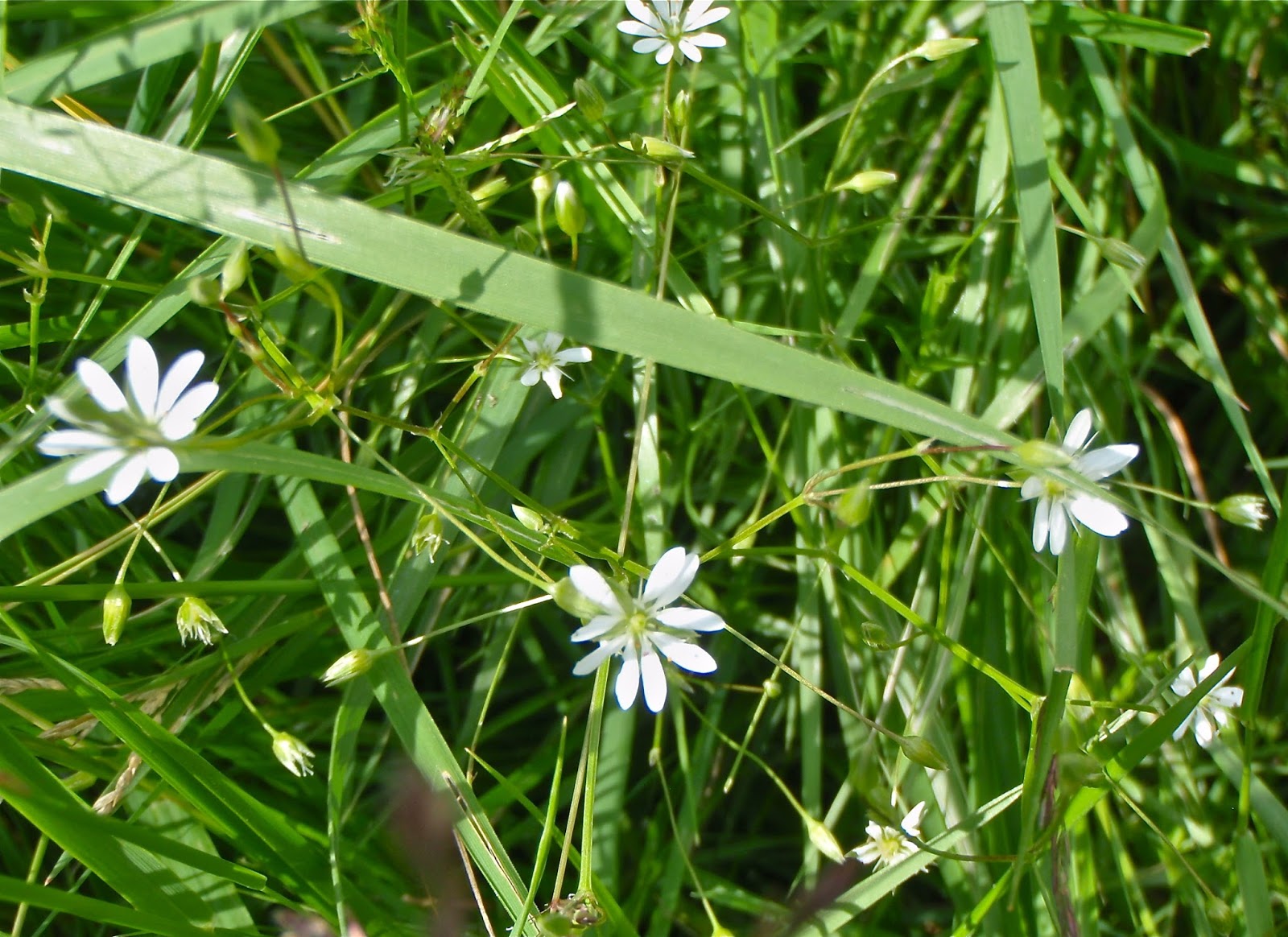
Lesser Stichwort (Stellaria graminea) growing strongly through the meadow grasses
  
As soon as the sun appeared, bees thronged the flowering plants alongside the stony path - here a Garden Bumblebee attracted to the White Clover moving very fast from flower to flower:


Garden Bumblebee Bombus hortorum on clover