Sunday, 21 February 2021

A Traditional Winter - the Survey for 31st January 2021

 A traditional winter's day here? Not quite, but almost cold enough, the survey for Sunday 31st January 2021 was made on an unexceptional day. Just above freezing all day, reasonably bright with light cloud cover and a light Easterly breeze. The ground was very muddy,  the river itself muddy and fast-running about a meter below the tops of banks. It was very easy now to pick out the Hazel trees amongst all the other species lining the riverside by the catkins. Crab apples were now ripe and attracting many blackbirds. Dried up blackberries offered seed heads to the smaller birds where brambles produced only small dry fruits during the hot summer. Bright Rose hips remained mostly untouched.There was very little new growth visible, just small patches of cow parsley and the green shoots of Wild Garlic in places. A Mistle thrush dominated the bird song high in the tree canopy whilst great.ts were singing their varied songs too.

Young song thrushes were concentrating on foraging in the muddy grass and undergrowth, silent, in groups, perhaps last year's young keeping together whilst adults concentrated on their spring songs.


A blue sky for a few minutes.

Robins were the first birds heard on the riverside (21) and the first birds seen at dawn and the last seen at dusk.Wood piigeons were easily seen too but far less active on the branches (44).  Resident and migrant blackbirds were seen in large numbers (34) compared with summer birds, feasting on remaining sloes and crab apples to which crowds were attracted. The most numerous birds as usual were the house sparrows,(more than 100) some taking seeds from the dry brambles and others waiting for the sun to appear on the hedges, jostling for the best positions. 
Singing wrens (14) were seen in various places low down along the banks - like robins they are fierce individuals and do not seek safety in colonies. Large numbers of Blue ts  (80) and Great ts  (34) were active everywhere, the Blue ts having found that willow catkins were appearing on the bare branches.
Nine Dunnock were seen in scrub and on paths, sometimes together with house sparrows, but most were singing today.  Goldfinches (50 approx.) were more visible;e today, foraging in thickets and undergrowth where they could be heard singing together, remaining partially under cover. A single greenfinch was heard - these usually move around foraging in groups but there are never enough to form groups now. A female bullfinch was seen and a male heard nearby - they remain elusive even during winter. A single goldcrest was seen in a conifer.  In the air, a group of starlings (14) were seen flying towards their Ivy roost and there were eight magpies foraging on a new field in the distance ,  sixteen herring gulls flew across and two black-headed gulls arrived on the playing field not far from the territory of a pair of carrion crows. Seven other carrion crows were seen elsewhere (total 9). An unidentified flying goose was seen and heard and a sparrow hawk flew down from the tree canopy.
A great spotted woodpecker was seen high in an ash tree and a green woodpecker was heard calling from the wild filed.
Jays attempts to hide most of the time but give themselves away when they fly. Two were seen in flight, probably a pair. Four nuthatches were calling loudly in different locations - they will become silent as soon as they nest unless under threat.
Six redwing were seen to fly across into a thicket then up again whilst a single Mistle thrush gave a loud burst of song at the top of a tall tree, then its continuing song could be heard over a wide field.
The song thrushes were the stars today with 17 seen and most heard singing with others snatching the last sloes off the blackthorn or foraging in the mud.


Sunday, 31 January 2021

Mid December survey, Robins in full song

 Seizing the chance for a survey on 15th December 2020 -just in case the world became even more busy towards the end of 2020 - was just as well. The sun was out after early rain and cloud.  The sky was alternately overcast and bright blue with no wind, not cold but fortunately for  wildlife, very muddy on the banks.

Young Oaks and Hornbeam retained their brown leaves providing very good shelter for birds and small mammals. Muddy puddles in front of hedges made for good foraging and birdsong was everywhere. The river was fast flowing, high and quite muddy, less than one meter from water out of bank.. the last occurrence being exactly one month ago.

The northernmost Crab Apple tree was still full of bright red fruits, remaining too hard and bitter even for the strong-beaked blackbirds. Hazel catkins were still small, with Alder catkins more advanced. Bramble leaves were yellowing but the lack of frost meant most leaves had not yet fallen. Dog Rose hips were as yet untouched by birds which leave them until the bitter end of winter.


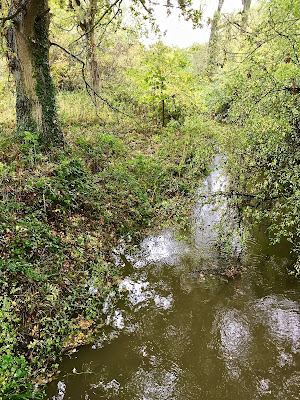
Winter on the river bank with plenty of shelter for wildlife in the dense undergrowth

Thickets,  hedges, bramble banks and bracken clumps provided numerous house sparrow colonies with shelter today (total of about 80 birds). These were the most numerous birds as usual but the good news was that there were at least 33 robins along the banks, most singing loudly. Blue ts were also very numerous and active amongst the branches with some foraging on Dock seeds amongst the grasses (63) together with 20 great ts, with just a few calling, in smaller groups. Seven Long-tailed ts, one group of five in a small Maple tree and two flying across were seen.  Two coal ts, always more elusive, were seen at the southernmost end of the hedgerow and three goldcrests were seen fast-foraging in a deciduous tree, a sapling , close up,  as I was sheltering from a rain shower. Wrens (7) were now more easily found as were starting to give small calls and songs after their autumn silence. Their full numbers won't be known until later when singing from their chosen territories. Dunnocks (3) are always a surprise as they sneak out of cover onto paths then disappear again in a second. As with wrens their song usually gives them away when under cover. Another small elusive bird, a treecreeper, known to be present, was seen on the trunk of an old oak collecting insects from the bark.

Apart from the house sparrows, the only other finches seen were goldfinches (12) clustered in a small thicket, singing quietly. As they usually keep together there's no need for loud song.

Higher in the trees, mostly static but observing all the while, were the wood pigeons (53) single or in small groups - large flocks are very seldom seen here. If they appear to be dozing on a branch, then all's well - but the slightest twitch or head movement signals to other birds to watch out for predators. Carrion crows can be noisy but not without reason. There are just a few resident birds here (7 today). Starlings have a small roost amongst ivy and eight were seen but more remained unseen. Quiet magpies (6) and a pair of silent jays were easily seen in the bare branches.

Good numbers of winter migrant blackbirds  have appeared here this winter adding to our resident blackbirds (21) but it's often difficult to tell who's who. Only one fieldfare was seen in a hedge, perhaps left behind by the rest heading west, and five redwing all feeding on the Blackthorn thickets. Two song thrushes preferred to forage on the grass. In the old oak above was a nuthatch calling persistently - they are very territorial at this time of the year and remain as resident birds all year and longer once established. The year's juveniles did very well resulting in some loud altercations over the available territories. Three more nuthatches were present in various locations.(total 4) . The remaining young have probably left to find territories with old trees further away. Also in territorial competition with the nuthatches were the green woodpeckers (1) and and great-spotted woodpeckers (2).

Gulls were active, with 30 Herring gulls circling around the school and four black headed gulls investigating the field which they sometimes occupy as a flock over the whole winter.

Lastly one low-flying  sparrowhawk and one kestrel were present over the river course.


Tuesday, 8 December 2020

Survey for 26th November 2020 - winter is here

The 26th November was another dark and cloudy day but slowly brightening. We can now see how important hedges are for wildlife. A thin, closely-cropped  decorative hedge with tidied and raked roots is not much use, providing no cover or sustenance for wildlife. A genuine old hedgerow would have been planted for a good reason, always strong and dense enough to prevent a rampaging bull or herd of stock from breaking through and escaping onto a neighbouring farm or disappearing down the lane. Wildlife would take full advantage of these old species-rich hedgerows which would always contain berry and fruit-bearing species and remain year on year. If you can see through a hedge in winter - it's not good enough.

Spindle fruits - an unusual clashing mix of colours - bright pink with bright orange seeds. This occurs in ancient woodlands and old species-rich hedgerows growing at random mixed in with other hedgerow plants.  It's unnoticed until the autumn when the fruits ripen. As with some other fruits birds can cope with the inedible seeds. It's one of the most favoured by robins which claim and guard  'their' bush.

Blackthorn is a good hedgerow example, with an unruly and generous habit sending out shoots in all directions from roots to the very top, swathed in blossom in early spring and bearing sloes in autumn in time to provide sustenance to flocks of winter migrants together with our resident thrushes. 

On 26th, after high water levels on 15th, the river was flowing well but had done no damage. A Blackthorn tree branch had spread itself across the river, an old branch covered with lichen and sloes, presenting no difficulty for most birds trying to reach the fruits. Overhead a typical winter sight, a small flock of pied wagtails flew over heading south whilst house sparrows (about 60) were active in small groups flying across and calling from hedges. Many were just visible under dense bramble picking at seed heads of uneaten blackberries and thistles. Good numbers of robins (26) were now singing loudly, several answering each other along the banks and Hazels. Four Dunnock were seen, two of them on a path and the others into a hedge. It was good to see increasing numbers of wrens now (15) , most visible flying low from undergrowth and banks and a few now singing.

Other small birds, blue ts  (27) and great ts (15) were calling and moving quickly from tree to tree and a single coal t was seen in a hedge. Of the finches, only a single chaffinch was present and again no greenfinches. About 20 goldfinches were active, five flying across in a group and about 15 singing from a thicket together. A bullfinch was heard calling for a second, on the opposite bank and a winter blackcap was present in a thicket nearby. Three goldcrests were seen moving fast amongst the needles of pines further south.

Loud calls came from a great-spotted woodpecker which gave good views perched on a branch directly above whilst eating an unknown item. There were very good views too of a treecreeper creeping up branches of a bare tree. It soon moved aside onto an oak, a far more interesting tree. As usual, nuthatches were present (4), one calling from a maple and the others in various oaks along the river. They seemed to know each other and were probably related.

  Blackbirds,( 41), their numbers augmented by visiting birds from Eastern and Northern Europe, were perched on the Blackthorn or foraging in the dense undergrowth, the migrants probably recognised by their heavier build. Two fieldfare, definitely migrants, were also seen amongst them. Later they were joined by a few redwing (9) also definitely winter migrants, reaching out to grasp and eat sloes as they made their way along the hedges. Song thrushes (5) were more elusive, foraging low, darting into undergrowth and brambles - one gave a very short song from a branch.

Looking up, several carrion crows (13) were scattered in various trees, three in an old oak calling loudly, whilst others selected similarly high lookout perches. The loudest were the jays (5) again appearing very aggressive and unusually visible.   14 herring gulls and only two starlings were seen flying across the river together and  6 magpies flew into trees, strangely silent. A single jackdaw flew across the woods.

The most memorable bird today was a sparrow hawk which suddenly flew out of a thicket across to a tall hedge. It made a level dash into  the  branches and set up many birds including at least 30 wood pigeons which all flew up together whist the smaller birds scattered in all directions. All along the riverside there were about 65 wood pigeons in various places. 

The sparrow hawk was unsuccessful and the birds settled again after a while but then were all set up again by a police helicopter which arrived to hover over the bridge area, circle for some time then disappear. For the second time the birds returned and settled once more. After this the sparrow hawk was seen again (or could have been a second one) this time perched in a tall tree not far away.


Friday, 4 December 2020

November summary - the first frosts and high river water levels

Octobers rain and wind continued into November but with mild temperatures. Wind had caused some minor damage but mostly served to clear leaves from the trees.  Robins were singing strongly on 3rd, with active, silent blackbirds and a few fieldfare seen along the river bank blackthorn thickets. They always appear to be awkward and unaccustomed to foraging amongst the thorns at first. Blue ts, great ts, wrens, house sparrows and dunnocks were present too.

The first frosty morning occurred on 4th but frost quickly disappeared in the sun. A  common buzzard was seen after thermals developed in the afternoon, casually circling whilst being harassed by two carrion crows - it didn't bother to fly away. Robins were again quite numerous as were house sparrows and starlings. The usual dunnocks were visible too. 

Thursday 5th November started under dense fog and mist - with a slight frost. The mist remained for most of the morning. More dunnocks were foraging on the path, robins, carrion crows, herring gulls, blue ts and great ts, blackbirds and nuthatches were present as the mist cleared. It was good to see that new planting, including Hornbeam was being carried out along the new bridge access road. If allowed to grow dense enough it will be used as shelter by small birds as is the existing hawthorn hedge.

By the 9th, more Hornbeam had been planted and the weather had become warmer. Carrion crows, were calling loudly but could not match the local jays. Quiet calls were from a bullfinch - with house sparrows, dunnock, blackbird, many robins, two fieldfare all present, and a green woodpecker was heard calling.


A young mixed hedgerow growing well and now forms habitat for blackbirds and song thrushes, together with small mammals. 

Wednesday 11th was warm but very dark with thick cloud but robins were singing well with good numbers of blue ts, great ts and a family group of long-tailed ts flying across a gap in the trees. A nuthatch called from an old oak. Suddenly a small raptor appeared, flying very fast over the bridge then made a rapid turn out of sight as a group of finches, probably goldfinches flew over. Was this the same raptor seen before - again too small to be a sparrowhawk, It had a greyish back and slim wings which it closed as it  twisted and disappeared fast - merlin? It is possible that it had taken the opportunity to follow its prey down to the river from the fields near the railway line, where an area has been levelled and sown, eventually intended to become playing fields....The birds it hunts will feed in fields elsewhere and it will follow them quickly.

Sunday 15th was memorably for the speed at which the water rose in the river after a very wet and windy couple of days. By Sunday afternoon water was out of bank in places on the riverside  - a normal occurrence here - after all, the whole riverside is formed by the ancient river bed which was split into different channels and streams over the years. By Monday 16th the river level was down again.

There was overnight frost again on Friday 20th but the day warmed up quickly with foraging birds out in force - notably three or more redwing, many blue ts, great ts, blackbirds calling nuthatches (3) carrion crows, wood pigeons, herring gulls, house sparrows and robins all very active. The same birds were seen on 24th when it had become warmer with dunnock, herring gulls harassing a grey heron flying with prey then four redwing along the river thickets,  two songthrushes, one singing a short song, and a foraging goldcrest in an oak.

On 27th several small groups of goldfinches were seen flying quite fast but not being chased, and there were good views of nuthatches,

Our scheduled meet was held on Sunday 29th observing Lockdown 2 rules, each person working independently. Standing on the bridge I saw a little egret fly north across it just above the trees then land on an oak from where it had a good view down onto the clear river. Sitting very still it is hardly noticed despite its gleaming white feathers. Every winter two or three little egrets fly upstream from the coast as soon as it becomes cold and frosty, seeking warmer waters and sheltered perches to watch out for prey. The larger grey herons are with us all year as their traditional heronry is just upstream on the banks of open water. They are picked upon by herring gulls seeking an easy meal if they can grab the grey herons catch.

A full survey for  26th November is coming on the next post.


Thursday, 3 December 2020

Survey at the end of October - dark skies , bright fruits

The 30th October 2020 was probably not the best of days to choose for a survey but was typical for this time of the year.

Very low light levels were expected but misty rain early on cleared somewhat and it became brighter but remained overcast. Healthy Ash leaves had been falling and formed a scattered bright carpet whilst Hazel and Hornbeam leaves were turning colour, most remaining on the trees. Under the oaks fallen acorns had ripened and crunched underfoot. The river was high and fast-flowing, the highest it has been since early this year, and water was visible in the ponds.

Crab apples added to the brilliant reds of Rose hips, the fruits of the many riverside Dog Rose plants, some growing incredibly high, an attraction for overflying birds. Spindle plants now suddenly became more visible with bright pink fruits appearing. Honeysuckle was still flowering on an old fence.


A dark sky fails to darken the riverside landscape here with shining red Guelder Rose berries. Note that the old oak in the background still retains its green leaves. October 30th 2020.

Nuthatches (3) were the first birds to be heard today, calling from the old Oaks, establishing territory.

Next were blackbirds (10), some foraging under a young bank side species-rich hedge. The blackbirds were just giving quiet contact calls rather than loud alarm calls until a magpie approached one.

House sparrows (76) were easily seen and heard, some singing in a hedge and about twenty active in a Blackthorn thicket. Further along there was a another colony at the other end of the long hedge, audible from quite a distance. 

 Goldfinches (7) were quietly singing in a low thicket unaware that a foe had just flown swiftly past, making a rapid change in direction, stooping directly down. The group flew up in a closed group, away from the trees. It was a raptor, too small and swift for a sparrow hawk. Later it was seen again, perched for a while on a tree with its back turned, looking over its shoulder - a Merlin?. It hasn't been seen since, having probably returned to fly low over the fields where there are flocks of small birds to chooses from.

Blue ts (11) and great ts (5) were seen in the trees, fewer than usual but perhaps this was due to the brief presence of the small raptor..as large roaming flocks of ts have been seen in the area on other days.

 A Jay was shrieking from an oak, its call by far the loudest, with another nearby answering back. As I walked under a large oak bough yet another Jay called out, and moved along the branch to give a good view of its very smart plumage.(total 3). Robins (23) were now singing in good form after a long summer. The dark grey skies are no problem for them, their large eyes being perfectly adapted to dark days and nights. Four dunnocks were seen, two in undergrowth and two exploring the footpath surface for insects. Most woodpigeons were out in the fields foraging but there were about 32 seen along the river, some dozing in the trees and the rest foraging groups on the damp grass.

A single magpie and a single herring gull were seen flying over whilst carrion crows(6) were calling from trees or foraging on a field.

Finally a song thrush was singing, just a short song at present.

and a large Bumblebee flew past - they are certainly still flying strongly.


These bright red Crab apples will last all through the 
winter as emergency sustenance for birds when most of the more palatable fruits have been eaten.


Wednesday, 25 November 2020

October 2020 - a summary of autumn wildlife

October  this year has, although variable,  been a typical autumn month, starting cool, bright and breezy with good amounts of rainfall. The river was soon running faster and higher, showing signs that the Millpond at Warnham was being replenished with the water flow spreading out and moving the river bed silt, not just flowing over the shallows. During the first week chiffchaffs were still present and making contact calls in most dense thickets on the banks. The ground became very damps with robins, blue ts, great ts, house sparrows and blackbirds foraging for invertebrates. on the surface. Lower down the ground remained dry. 


Looking upstream the October leaves, turning yellow, lightened the landscape. The foliage of Ash trees and Willows  was extremely bright and remained on the trees until the seasonal gales arrived.

Fine continuous rain during the second week gave way to a fine day on the 9th. After a cold night, bird activity suddenly increased. The first sign was a Water Shrew which had been hunted and caught by a raptor but then suddenly dropped onto the ground when the bird found it completely unpalatable.

Two groups of goldfinches were singing in separate thickets whilst blue ts, great ts, and nuthatches moved quickly through the trees. Robins and a Dunnock were sifting through the layers of earth on the ground  where leaves had blown aside.

Several Speckled Wood butterflies were seen chasing and spiralling as well as Large Whites. Numerous house sparrows were present in a group on the riverbank vegetation but amongst them a stranger - a tree sparrow, clearly seen preening for quite a while in a bare tree. The differences were clear but maybe it was just odd plumage colouring ....no sign of it since then.

It was mid-October before wrens started to sing again. They  had been present but very elusive working their way amongst the mossy roots and tree trunks on the banks. Dunnocks were seen too but favoured pathways rather than muddy slopes., springing out from hedges onto paths where they could see invertebrates crossing. or warming up. A kestrel was seen flying west in a north wind on 14th then on 18th a common buzzard was seen  landing after a cold start to the day. Before then, on 17th, robins, house sparrows, two wrens, a green woodpecker  (on ant-heap  area) , two chiffchaffs chasing, blue ts, great ts, and a calling goldcrest and groups of singing goldfinches were seen in various locations along the banks.

By 24th it had become windy but remained warm.  On 25th October, the day of our meet, we were caught in a hailstorm - a  great spotted woodpecker had been heard calling loudly in the warm sunshine before the deluge, although the green woodpecker, the 'rain bird' was silent. The hail had cooled the atmosphere and the weather was mostly colder, wetter and more windy for the rest of the month,


Crab apple tree weighed down with a huge crop of bright red crab apples 
on 30th October 2020. The branches will spring back much later in the winter when the thrushes have eaten all the fruits. Tasting bitter and very hard, the crab apple of this variety is excellent survival food for our resident thrushes (especially blackbird) and also our winter migrant thrushes feeding up for their journey back to their breeding habitats in eastern and northern Europe in the spring.

The survey for 30th October 2020 follows on the next post.


Sunday, 1 November 2020

September and singing starts

 This full record survey was made on 28th when changes were taking place on the riverside - after the hot summer..

It was an ideal day, with high cloud , sun, not much wind (WNW) and the ground still very dry.The Blackthorn fruits were mixed in with bramble fruits and hazels were alive with singing birds catching the early sun as it had been a cool night. Hazel leaves were turning yellow but not yet falling and the ground was littered with acorns, The leaves of the old oaks were still green but curled, their shapes having been caused by the intense heat and strong winds of previous weeks. Maples were still green but with with clumps of brown winged seeds. Fine grasses on the slopes were full of active insects and amongst the grasses tall anthills could now be seen. 'Sussex anthills' rather than the giant types seen elsewhere in the world, and not usually obvious until grasses die down.

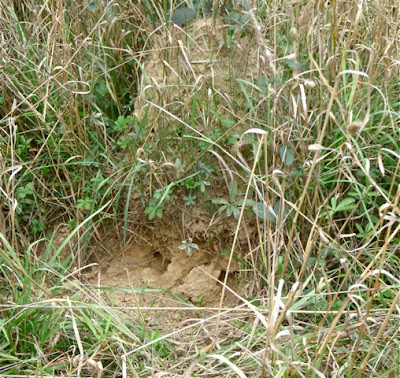
These anthills are important for green woodpeckers which have always occupied the area. They do not migrate but traditionally stay in the same very local area provided their ant food sources are available and there are large trees for them to nest in. nearby. They make or reuse nest holes in large branches or trunks, like great spotted woodpeckers. They are quite often seen flying up from the long grasses where they have been feeding unseen around the bases of the anthills:


This anthill shows where the green woodpecker has been feeding on ants at the base of the hill, unseen, as the 'top' of the narrow hill is just visible near the top of the photo.
In the winter if there is heavy snowfall the green woodpeckers have been seen digging in the snow where drains run under the fields, preventing the ground from freezing,

The good weather prevailed and with it the sounds of the landscape here. Birdsong was dominant after what seemed like a long silent spell during the hot weather. The only other sound was the thud of acorns falling onto the dry ground. Poplars were rapidly losing their leaves and did not contribute to the noise as often happens in windy summer conditions with noisily rustling leaves.
House sparrows (c80) were by far the most numerous bird, preening and singing in the sun in hedge colonies. What a difference from August - robins (32) were seen singing short songs, some loudly others 'chinking' their usual autumn call. Wrens were still few in number (8) most not singing yet. Goldcrests (5) were heard calling and seen fast-foraging directly above me in the old oaks, not far away from the conifers where they nest. Always seen but in small numbers, dunnocks were keeping under the low undergrowth and mossy roots (2).  Blue ts (39) and great ts (12) were very active, swinging from bramble shoots, foraging on twig islands and high up amongst climbing dog rose hips, still often invisible and seen only when they fly out of a thicket and into the next along the river. Moving much faster, chiffchaffs (5) were visiting each twig on a chosen tree and could be heard making contact calls - easily located whilst blackcaps (4) foraged at a slower pace also calling. Both these species are well known to overwinter  here  in small numbers when most migrant warblers leave our shores for warmer climates. These may be birds which migrate here from even colder climates or may be the summer birds staying put. Some  of the blackbirds and song thrushes here over the summer have been migrants which have now left, leaving the resident birds - 19 blackbirds, one or two still moulting, and just one song thrush were seen today
Goldfinches have been present in good numbers feeding on abundant seeds from the hot summer and today there were 22 in several groups, softly calling together from thickets. One female bullfinch was seen perched in the blackthorn. Trees held wood pigeons in small numbers, with others feeding on short grass (22) whilst 3 carrion crows were on their usual field under the tree where they nest. Three magpies were seen flying across near two jackdaws whilst a jay called aggressively from a small tree at another close by (2). A well known old oak, called 'the Heron Tree' stands on the steep river bank overlooking a drainage basin and today a single grey heron was seen heading towards it, leisurely flapping whilst three herring gulls flew north, towards the school, calling. Further south a common buzzard was sailing over the river course. About 25 starlings, some flying in a group and others singing softly from their ivy roost were seen.
Several  nuthatches were present in various trees, one making a horizontal walk along a bough extracting insects from the bark, loudly calling down at me. Another was tapping on the trunk  of an ash tree and others were seen in other trees and heard calling (total 8)- time to sort out territories now that this year's juveniles are grown. A single great-spotted woodpecker was seen then heard tapping - but not drumming. The probable presence of a sparrowhawk was noted as it had left a neat pile of woodpigeon feathers on a footpath.
Insects such as craneflies were very numerous over the ponds and river.
Ten Speckled Wood butterflies were seen in places in semi shade and one Migrant Hawker dragonfly was ranging over the riverbank.