Friday, 11 September 2020

Gatekeepers and Fleabane

The transition from July to August 2020 was remarkable for unrelenting heat. The earth was baking at least on the surface and butterflies reacted by dropping down into the cool shade of the long grasses or into dense hedges during the day, flying earlier in the mornings and in the cool of the evenings in the low sun. 


Fleabane flowered later than most wild flowers here as usual but immediately attracted insects. Here is a Gatekeeper butterfly on a Fleabane flower with a small Hover fly (probably) on a smaller flower.
The broad and bright yellow flowers last well but rain and cooler weather soon encourages them to form round seed heads. The seeds are shaken by the wind and are not winged like the Dandelion and thistles therefore Fleabane is more likely to be found growing in clumps which spread over the years.
The soft leaves provide good protection from rain and sun for insects.
By the third day of August a 10mph north-westerly wind provided cooler temperatures and brought cloud but still no rain.
Young nuthatches were calling from river bank trees - four in different trees, exploring their surroundings. Gatekeepers were of course the most numerous butterflies  but Speckled Woods, Ringlet, Large White, Brimstone, Meadow Brown, Holly Blue and Comma were all present with a Southern Hawker dragonfly ranging along the banks, ignoring them.
In the air a Red Kite was sailing north, wings bent against the wind. Looking at the Red Kite, it was clear that many smaller birds were catching insects directly under the base of a very tall cumulus cloud. They were swifts, house martins and some sand martins, visible for some time, keeping under the cloud.


Sunday, 30 August 2020

July Survey - brightening up after rain

The 28th July - the day of the survey was partially cloudy, brightening after dark clouds moved off. A westerly wind meant that traffic was now audible - we are missing the somewhat strange silence of previous weeks. Recent rainfall was very welcome, with fruits ripening. Bramble bushes were covered in red berries, not yet ripe, with bees on thistles waiting for the sun to appear every few minutes. Butterflies were poised for action too, waiting low down on grass stalks and vegetation, most reappearing within a second of the sun shining. 
Butterflies seen were Ringlets:


Ringlet perching on willow leaf July 2020.
They can be active even in cloudy damp weather when other butterflies would not appear.

Others seen today were:
Large White, Small White, Green-veined White, Holly Blue, Gatekeeper, Meadow Brown, Small Copper, and Comma.

The ground was well soaked and the scents of the wild flowers, grasses and shrubs magnified. Clear water flowed well in the rivers. A Bank Vole was seen running to safe cover under brambles.

Few birds alerted others to their presence, remaining silent when moulting  - but nevertheless some gave away their presence. About 60 house sparrows were present in various hedges and bramble patches and amongst Blackthorn and a total of 34 wood pigeons were counted some feeding on the grass and others  calling from possible nest sites.
It was interesting to find some blue tits eating fruits from the trees where they usually forage for insects (25). Great tits were more elusive (11) along the banks. An amazing sight today, seeing birds in such small numbers, was a troupe of 25 long-tailed tits following each other flying from west to east over to our side of the river where there are more mature trees. Some were perching on Willows halfway across 
the river and one started out from a willow then turned back, perching on a dead branch, waiting until another came and both flew across together. They were mostly juveniles, led by several adults. In the same area with young Willows were two blackcaps, a juvenile and an adult male, moving around slowly in comparison the the long-tails, with no desire to join the crowd.

 Blackbirds (7) remained very alert, frequently giving alarm calls when disturbed by other birds. Song thrushes, always alert to new possibilities, were investigating recently disturbed ground left by fallen branches and at least two still had nests low down in the undergrowth where they were feeding young (5). One on a steep bank
 gave a very short song. Wrens were remaining well hidden all along the river and the sound of the wind in the Poplars drowned out any attempts to sing. (6). Robins (4), usually everywhere along the river were silent, moulting, with only one heard - giving an alarm call.

  Seven carrion crows , a magpie and a single jackdaw were seen and just one starling - the juvenile starlings having all left to join other young starlings ranging along the south coast. They cause quite a stir when they have just fledged and are still reliant on adults - being noisy, very hungry and demanding the best perches from which to survey the landscape or dry off after bathing. A great-spotted woodpecker called from a river-bank Ash whilst another was calling loudly from an oak further downstream. Nearby a sparrowhawk made quick dash across the bridge. On the opposite bank a nuthatch called out, perhaps a warning to a group of mostly juvenile goldfinches. More were seen upstream calling quietly (21).


Saturday, 29 August 2020

The Endless Summer continues

The second half of July 2020 proved to be just as active with no sudden changes to the weather although the phrase 'another fine, warm day 'changed to 'another fine hot or very hot day'.
The river continued to flow well and clear with calls from moorhens heard under the steep banks and groups of Banded Demoiselle damselflies seen on most days. Song thrushes made the most of the damp early mornings after overnight showers, seeking out snails to hammer on the stoney paths. Goldfinches were forming larger groups and swifts were a daily sight feeding on insects overhead.
On 17th July, butterflies dominated the landscape with Gatekeepers the most numerous, Large White and Green-veined White, Brimstone, Ringlets and Holly Blues were seen together with many bumblebees on the brambles. Near the Hornbeam hedge a pair of mating Gatekeepers were seen on a young Ash:


Gatekeeper butterflies mating. The eggs are usually laid on fine leafed grasses, which are plentiful here on the embankment. The caterpillars are slow growing and will overwinter low down under dense cover. The are not spring butterflies but are usually first seen flying towards the end of June.
Birds present on 17th July included goldcrest, green woodpecker, robins swifts blackcaps goldfinches, song thrushes,  blackbirds and dunnocks.
A typical day towards the end of July, the 23rd, wildflowers noted were Vetch, Fleabane, creeping thistle (good), ragwort (good), Knapweed, Tufted Vetch, Purple Loosestrife, creeping Buttercup, Bird's foot Trefoil and more - all good for insects.
Birds present were grey wagtail, chiffchaff, song thrush, bathing blue ts and great ts, herring gulls, wrens, dunnock, robin and a large common frog dropped by a grey heron onto the footpath.


Thursday, 27 August 2020

Endless Summer - but it's only July

Summer started early this year, with more fine weather before July than in a complete summer in past years.
Here is a summary of notable 'events' for the first half of July 2020:

On the first day, the usual birds were about - wrens, several singing blackcaps, goldfinches, Blue and great tits, a juvenile robin, foraging song thrushes, a Herring gull chasing a grey heron and a young buzzard flying low.
The first Small Skipper butterfly of the year here was seen over the flowering brambles and grasses together with more Marbled Whites, flying low to avoid the wind.
 On the second, Brimstone, Gatekeeper and Meadow Brown butterflies were seen with
 another first butterfly, a Small Copper.
The day after, several Red Admirals appeared, and one Ringlet. Several swifts were seen under the cloud layer. Light drizzle followed with blue tits eating or collecting  caterpillars off the leaves of a young Oak on the fourth. with more Ringlets, Red Admirals, Meadow Browns, Brimstone, Large and Small Whites, Gatekeepers joined by Holly Blues and a Comma.


Holly Blue butterfly July 2020
This is quite common wherever Hollies and Ivies are growing on the banks and can often be seen flying very high amongst the foliage.

The 6th July was notable for many high-flying swifts, some directly overhead (over the river).
A buzzard was being 'mobbed' by a single carrion crow. With less wind on the 7th, even more swifts were seen under low cloud, catching insects and the first Southern Hawker dragonfly was seen flying straight and fast. Blackcaps and silent chiffchaffs were in the bank side willows, and Green-veined Whites and Peacock butterflies joined the others in a sheltered clearing.
Warblers, some moulting, were busy foraging low amongst the dense brambles and nettles. Great-spotted woodpeckers, song thrushes and nuthatches were heard in several places, with several small groups of quietly singing goldfinches. Swifts again ruled the skies.  On 10th another Southern Hawker was patrolling a Blackberry hedge in the sun in the presence of Red Admiral butterflies. There were still small flocks of juvenile starlings exploring the landscape.An over-flying kestrel was hunting on 12th whilst the presence of a sparrow hawk caused some birds to seek dense shelter. 
Butterflies were the most numerous so far this summer with the grasses occupied with many small grasshoppers.

Gatekeepers were now the most frequently seen butterflies everywhere, even along the Hornbeam hedges bordering the embankments. They are very territorial and chase any other butterfly that flies into  their own 'flyway' or basking patch:


12th July 2020 - Gatekeeper male defending its patch on the  Hornbeam hedge.
It's the first time Gatekeepers have chosen this fairly new hedge although it is very close to some fine bramble banks and embankments with a variety of native grasses and wild flowers.


Friday, 31 July 2020

Survey , the end of June 2020

Full record - Monday 29th June 2020 was windy but dry, with sunny intervals - a very different scenario from the May survey done during the restrictions on travel. Now there was the extra distraction of noise from a distance to take into account. Where birdsong had dominated before, now road noise was blown across by the prevailing wind. In addition,  small contact calls from birds could be overpowered by the natural sound of the wind in the leaves. The vegetation was still green as rain had fallen on several days and the sound of water in the rivers was welcome. Many Bramble blossom flowers were now falling, with green berries appearing. Meadowsweet was flowering well in many patches, the scent filling the air with the wild Honeysuckle on the fencing. Bees were crowding around freshly flowering Common Ragwort Senecio jacobaea and the flowering Creeping Thistle Cirsium arvense, each plant hosting a crowd of bees and other insects, butterflies a speciality. On the Bramble margin of grassland, a Red Admiral butterfly was seen basking on a small mound of dry grasses, soaking up the sun, whilst another, far more active, flew in to join it but was chased off and flew to the brambles.


Red Admiral butterfly basking in the late June sun 29th June 2020

House sparrows could be heard singing from the bramble patch here whilst more were singing from their usual hedges and day perches on the river bank (52) Many more were still nesting.
Every few meters another blackbird (21) would be seen foraging on the damp grass verges, not for itself but to carry to young in nearby nests. Others were seen preening after bathing in the river. The next activity is often to do some 'sunning' if the sun is out. This means flattening down on the ground with wings outstretched, oblivious to surroundings. Normally the bird comes to life just as danger approaches or is alerted by the sound of a wood pigeon taking off from its perch, flapping madly. Most birds owe a lot to ever observant wood pigeons! There were 26 seen today. Robins (8) were seen in fewer numbers than usual - moulting for many means hiding away. Two dunnocks were under the banks, far less visible than the singing wrens (17) - one was very visible, singing from the branch of an Elder bush, guarding it as it was full of tiny green berries which after a some weeks will be ripe.

A sparrowhawk just flew up and disappeared whilst a song thrush started a short snatch of song. Others were heard in different locations (7) with most singing now and again, only one was loud.
Blue tits were far less visible and audible, keeping under canopy cover, juveniles following adults (31).
Even less visible were great tits (12) keeping low in the undergrowth and mossy roots unlike blackcaps (8) which were singing from higher branches and moving fast amongst the willows.
A single garden warbler was heard singing, also in the willows, whilst 10 chiffchaffs moved around,
their simple contact calls very audible. They started nesting quite early on as are amongst the first arrivals of the migrant warblers. A few over-winter here too but need plenty of vegetation to provide shelter. It has been a good summer for them as they did not face hard conditions on arrival this spring.
Brief calls were heard from a nuthatch nesting in an old oak - they are still very quiet at this stage.
Of the larger birds, starlings were doing well with 56 seen, most in small groups of juveniles flying or feeding together. Later they will disperse into the countryside.


Flowering Meadowsweet on the wild field

A single jay was flying across from the area where a pair nested after initial loud squabbles.
Carrion crows had a hidden nest in an old tree with a very good wide view over the field below and could be seen eating their catches on the field. Little could distract them, even loudly squealing micro-dogs did not bother them. (7 in total, other crows seen flying across).
Only a few herring gulls were seen (7) and a buzzard flew across - this did disturb the crows when it flew over their nest.
Several high-flying swifts were catching aerial insects above the river and lastly a kestrel flew over into the wind.
There were many Bumblebees, including white-tailed, red-tailed and buff-tailed together with many smaller bees and hoverflies concentrated on wildflowers and brambles with many butterflies despite the windy conditions:

Meadow Brown, Large White, Small White, Brimstone, Comma, Red Admiral, Small Tortoiseshell
Gatekeeper and MARBLED WHITE


More June Firsts for 2020 and an embankment first too.

The previous post was for June 2020 up to the 9th - this is for the second part of June - the natural progression of summer. The 13th June saw goldfinches busy pulling seed heads from Dandelion flowers. Singing wrens were numerous, voices echoing along the banks, the pied wagtail pair was seen foraging for their young and a grey heron seen flying over to the Heron Oak. The next few days were humid, mostly overcast with some very dark clouds.  More song thrushes, together with blackcaps, wrens, robins, many goldfinches, house sparrows were singing however - and goldcrests were active in the pines.
On 16th a first appearance here this year of Meadow Brown butterflies nectaring on Brambles and a Small Tortoiseshell butterfly - not the first.


Meadow Brown (Maniola jurtina) this one is rather faded, probably having spent a few days restlessly ranging over the grasses and Brambles. All good grassland will have many Meadow Browns at the height of summer but they are always active, seldom seen basking here.

Torrential rain on hot ground on 17th increased the humidity. Birds were seen drying off, preening and singing. A grey heron was seen heading this time to a small pond where the rain had collected, perhaps anticipating more frog activity.

There were more heavy spells of rain on 18th but more Meadow Browns too amongst the long grasses. Just south of the new bridge a blackcap family was seen, the male singing and the female and juveniles active in the trees nearby. Large White butterflies were ranging over the nettles and two magpies were chasing a grey squirrel, so close that one held the squirrel's tail in its beak for a second. The usual wrens, dunnocks, blackbirds, song thrushes and robins were finding foraging in the damp earth easy.


A new area of grassland has appeared with wild flowers growing well. This demonstrates how quickly a barren area can become full of interest, attracting many species of wildlife. It had previously been 'tidied' and mown to keep down the 'weeds'.

On 22nd a sparrowhawk was seen circling and gliding overhead, getting closer and closer to the river. It had probably spotted a group of juvenile sparrows drying off after bathing in the shallows. It drifted away south however. A Small Tortoiseshell butterfly was seen with more Meadow Browns on the Bramble banks. Blackcaps were singing and a great-spotted woodpecker called.
The first Meadowsweet was now in flower and the weather changed, with temperatures above 30 degs C and easterly wind on 25th. There were 'dry' low-altitude thunderstorms overnight and the morning of 26th June was cooler  with swifts flying under the cloud before the rain came later on. Other birds were active, with song thrush, blackcaps, common whitethroat, garden warbler all singing, and house sparrows, a pair of jays and crows in their nest, all calling. It was ideal weather for butterflies too, with many Meadow Browns, Large and Small Whites, Ringlets, then a Beautiful Demoiselle Damselfly male perched on the large leaf of a fresh Bramble shoot.
The 26th was a day to remember for the first sighting on a bridge embankment of Marbled White butterflies - the first to be seen in this riverside location.Two were 'jousting' for a while on the bank then more were seen on the diverse embankment grasses and plants which have been allowed to grow since the bridge was built ten years ago. There were eight Marbled Whites altogether some on each of the two embankments.
More rain, more singing song thrushes and more swifts were seen amid rain showers throughout the 27th, then a very windy and damp day on 28th and most birds were hunkered down but many Meadow Brown and Large White butterflies were active low amongst the grasses. A single Holly Blue was present too, then the first Gatekeeper butterfly for 2020 appeared!

A full record for June 29th follows in the next post.


Sunday, 12 July 2020

June - it's Clover Time

After the heat of May, June was cooler, with some welcome showers to help retain the brilliant green of   vegetation and save the growing fruits from drying out. The most important benefit though was to maintain the proliferation of insect life - providing food essential for young birds.
Bees of course continued their work as pollinators:


Bee on Bramble flower.
 There was a record amount of Bramble blossom this June which quickly became covered in bees, mostly Honeybees but also Bumblebees - White-tailed, Buff-tailed and Red-tailed Bumblebees, not forgetting butterflies and Hover flies.

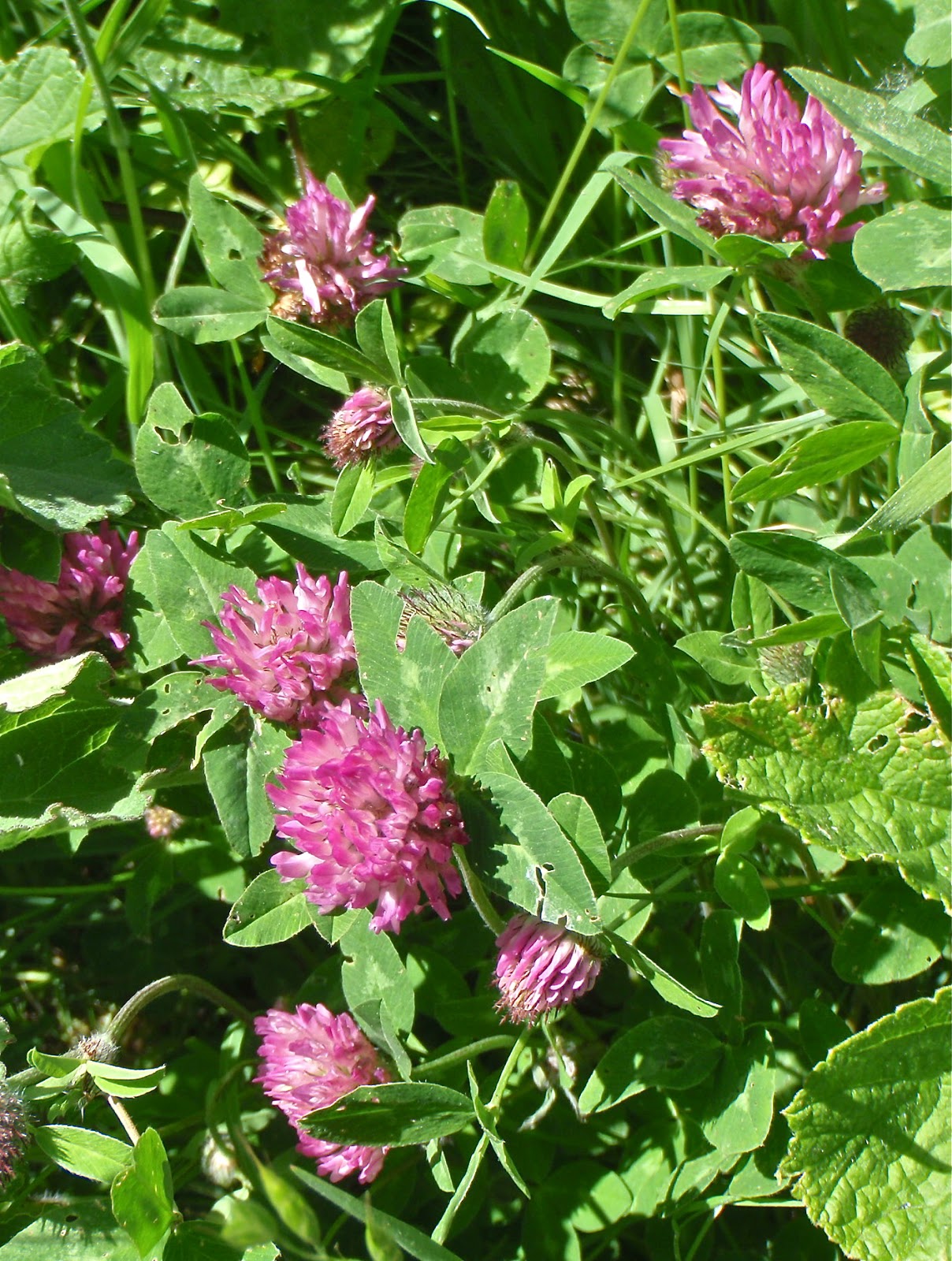
In additions to the Bramble blossom, wild flowers such as clovers were growing exceptionally well  in grassland and formed dense carpets in places, their abundant nectar and scent attracting more insects:


White Clover trifolium repens -
hopefully this will spread and increase, together with the earlier Dandelion plants.


Red Clover  Trifolium pratense
Bumblebees pollinate its flowers.

It is so good to see the return of Clovers to grassland - and of course other wild flowers such as Dandelions and Daisies.


The 2nd June 2020 was fine and warm, becoming windy later, with most birds still nesting. Adults seen carrying food to nests or feeding fledged young were chiffchaffs, pied wagtails, carrion crows, blackbirds, blackcaps, wrens, robins, dunnock, goldfinches, goldcrests and several preoccupied song thrushes so intent on preparing snails for their young they hardly noticed me on the path of hard stones. As the wind increased, a common buzzard was seen sailing over the river course.
A Banded Demoiselle damselfly male was seen ranging across a field next to the river, flying low under the wind and a Beautiful Demoiselle damselfly male was perching on a wide Hazel leaf in the sun. 

The next few days were cloudy and cooler with more showers. On 5th June, it was interesting to see an adult goldcrest fly from a Scots pine in pursuit of a moth almost larger than itself - dashing in a zigzag route from the tall tree. Halfway down the goldcrest nipped the moth's wing and it fell to the ground  where the bird retrieved it and carried it up to its nest high in an outer pine branch.

On 7th June the activity of feeding young continued but with some blackbirds, blackcaps, house sparrows, wrens and robins singing quietly and a nuthatch calling.   
Another male Banded Demoiselle damselfly was seen over the bank.
 Loud calls were suddenly heard -
this was common buzzard being chased over the bridge by carrion crows - all the noise coming from the crows not the buzzard, which quickly shook them off.  Higher up over the trees a swift was seen on its own but four greylag geese were flying south beyond it.  

A Southeasterly breeze and some sun on 9th June encouraged some birds to sing more - dunnock, wrens, common whitethroat, nuthatch, robins, blackbird song thrushes, chiffchaffs, house sparrows and of course the master-singer of the summer here - the blackcap - all very audible. Calls from a magpie and a group of herring gulls could not compete with loud calls from a grey heron being harassed by the gulls. It flew off towards a pond. Blue tits, great tits and long-tailed tits, many juveniles amongst them were foraging in the riverbank trees, some drying off after bathing in the river. Wrens - very numerous here seemed to combine nest-building or re-building with singing - a large fluffy Woodpigeon feather was seen flying low across the river - carried by an invisible wren. 
Bramble blossom was still attracting many bees.
The next few days were partly overcast with drizzle - the grey heron, or more than one, was heard calling several times, together with herring gulls; the fledged pied wagtails were still being fed by the adults; crowds of fledged house sparrows were joining in with singing and bathing and small numbers of swifts were seen most days catching insects under the clouds.