Sunday, 12 July 2020

June - it's Clover Time

After the heat of May, June was cooler, with some welcome showers to help retain the brilliant green of   vegetation and save the growing fruits from drying out. The most important benefit though was to maintain the proliferation of insect life - providing food essential for young birds.
Bees of course continued their work as pollinators:


Bee on Bramble flower.
 There was a record amount of Bramble blossom this June which quickly became covered in bees, mostly Honeybees but also Bumblebees - White-tailed, Buff-tailed and Red-tailed Bumblebees, not forgetting butterflies and Hover flies.

In additions to the Bramble blossom, wild flowers such as clovers were growing exceptionally well  in grassland and formed dense carpets in places, their abundant nectar and scent attracting more insects:


White Clover trifolium repens -
hopefully this will spread and increase, together with the earlier Dandelion plants.
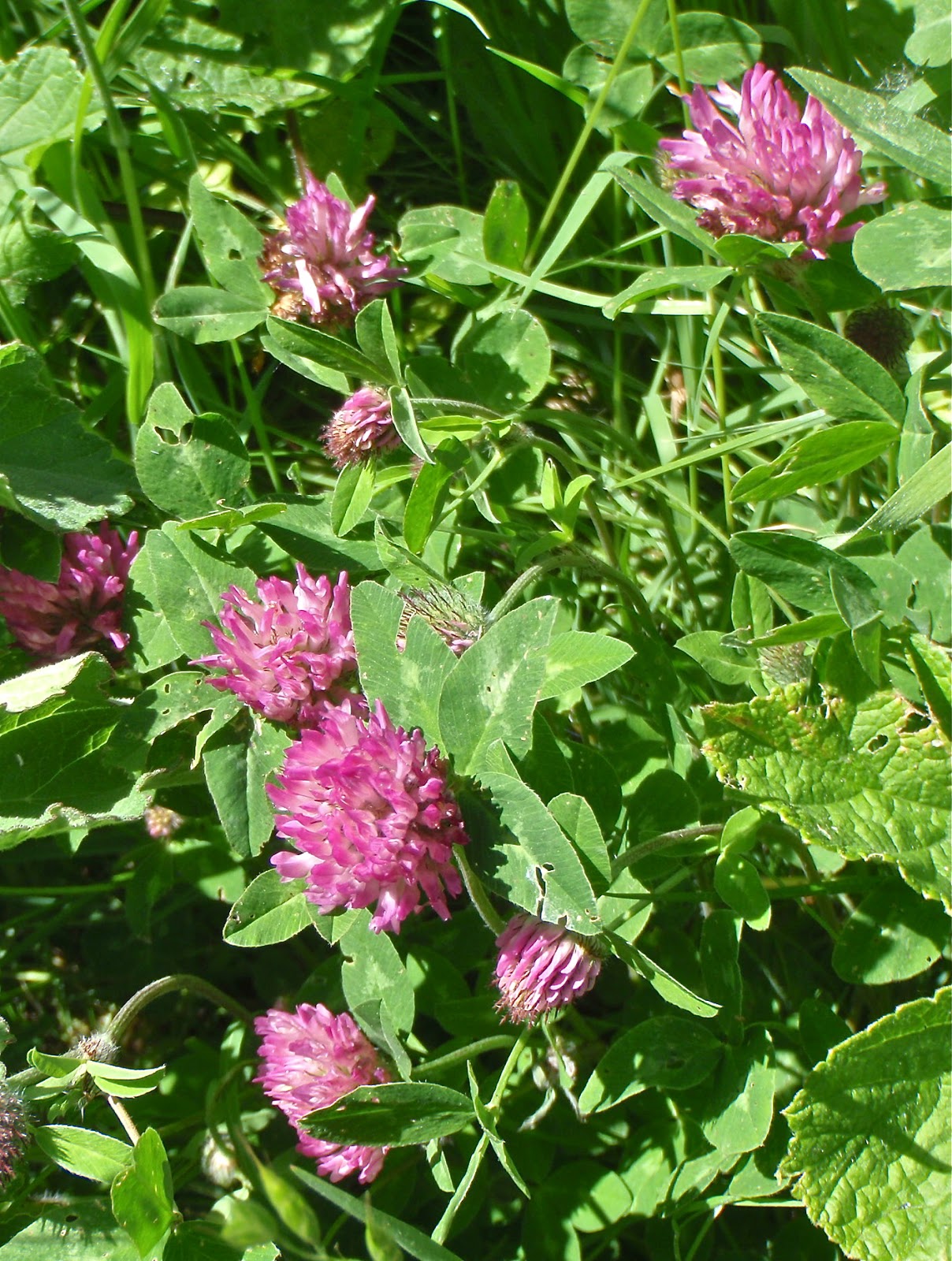


Red Clover  Trifolium pratense
Bumblebees pollinate its flowers.

It is so good to see the return of Clovers to grassland - and of course other wild flowers such as Dandelions and Daisies.


The 2nd June 2020 was fine and warm, becoming windy later, with most birds still nesting. Adults seen carrying food to nests or feeding fledged young were chiffchaffs, pied wagtails, carrion crows, blackbirds, blackcaps, wrens, robins, dunnock, goldfinches, goldcrests and several preoccupied song thrushes so intent on preparing snails for their young they hardly noticed me on the path of hard stones. As the wind increased, a common buzzard was seen sailing over the river course.
A Banded Demoiselle damselfly male was seen ranging across a field next to the river, flying low under the wind and a Beautiful Demoiselle damselfly male was perching on a wide Hazel leaf in the sun. 

The next few days were cloudy and cooler with more showers. On 5th June, it was interesting to see an adult goldcrest fly from a Scots pine in pursuit of a moth almost larger than itself - dashing in a zigzag route from the tall tree. Halfway down the goldcrest nipped the moth's wing and it fell to the ground  where the bird retrieved it and carried it up to its nest high in an outer pine branch.

On 7th June the activity of feeding young continued but with some blackbirds, blackcaps, house sparrows, wrens and robins singing quietly and a nuthatch calling.   
Another male Banded Demoiselle damselfly was seen over the bank.
 Loud calls were suddenly heard -
this was common buzzard being chased over the bridge by carrion crows - all the noise coming from the crows not the buzzard, which quickly shook them off.  Higher up over the trees a swift was seen on its own but four greylag geese were flying south beyond it.  

A Southeasterly breeze and some sun on 9th June encouraged some birds to sing more - dunnock, wrens, common whitethroat, nuthatch, robins, blackbird song thrushes, chiffchaffs, house sparrows and of course the master-singer of the summer here - the blackcap - all very audible. Calls from a magpie and a group of herring gulls could not compete with loud calls from a grey heron being harassed by the gulls. It flew off towards a pond. Blue tits, great tits and long-tailed tits, many juveniles amongst them were foraging in the riverbank trees, some drying off after bathing in the river. Wrens - very numerous here seemed to combine nest-building or re-building with singing - a large fluffy Woodpigeon feather was seen flying low across the river - carried by an invisible wren. 
Bramble blossom was still attracting many bees.
The next few days were partly overcast with drizzle - the grey heron, or more than one, was heard calling several times, together with herring gulls; the fledged pied wagtails were still being fed by the adults; crowds of fledged house sparrows were joining in with singing and bathing and small numbers of swifts were seen most days catching insects under the clouds. 


Thursday, 25 June 2020

Survey 28th May 2020

After a dry and sunny day the 28th May was windy - from the east north east but very clear and bright. The riverbank was still in the shade and the grass damp. All along the banks here the Rosa canina was in flower, with spectacular flowers hanging in fronds caught up and supported by tall trees, part of an old species-rich hedgerow with Blackthorn, Hawthorn, Field Maple, Elder, Hazel, Bramble Holly and of course oaks.


Dog Rose - Rosa canina, climbing high
over the river.

The first birds seen and heard were Song thrushes one foraging on the damp ground and one singing from the tall hedge. (2). Robins were mostly still nesting but eleven were seen and most heard singing.The largest number of birds today were house sparrows, more than seventy, their colonies distributed within short flights from the river. Most were in thickets on the banks awaiting the sun when they would bathe and preen, this years juveniles with adults. Others were busy with second or third broods on the nest.

Blackbirds (23) were numerous too, the conditions have been perfect for them so far and their song carries far without the usual background sounds his year. They are the stars of the Dawn Chorus.
Fifteen goldfinches were present, many more were nesting but unobtrusive until the young fledge and join a group with adults. Many wrens were singing (26) along the banks but the real number would be much more than double with those nesting. They have chosen good sites in the undergrowth this year. Dunnocks are always elusive (7) but those seen were mostly singing, with 16 woodpigeons seen watching over the activities of the smaller birds in various places. A pair of collared doves were well hidden in the ivy.
Blue tits (30) had already found areas where the sun was warming up the river and several juveniles were in a group, dishevelled after bathing. Adults were seen collecting caterpillars from fresh oak leaves and darting around amongst the branches before disappearing into nest holes. 
Fourteen great tits were seen but very quiet, with only a juvenile calling from the undergrowth.
Long-tailed tits were heard - with only three visible following each other through the dense canopy.
A great-spotted woodpecker and a single nuthatch both gave short calls from the oaks whilst a single goldcrest flew across between the same trees.
A magpie gave an alarm call but did not cause panic. Two others were seen (3).  Five carrion crows were seen, two on the grass, with very glossy plumage and three more in the air. Later two jackdaws also flew across, but corvids were certainly few and quiet today. Only one herring gull was seen flying over - and two starlings.
A sparrowhawk enlivened the airspace several times, searching for the best site for an ambush, and a fine bright male grey wagtail flew low over my head and landed on a shady bend in the river whilst a female flew around their river bank nest (2).  
Lastly, the migrant warblers:
Nine blackcaps were seen, a pair foraging for food for young in the nest, not singing, whilst another seven foraged and sang in different locations along the banks, mostly in Willows. Three common whitethroats in various locations were busy amongst the nettles and brambles and six chiffchaffs were heard, also mostly in willows. Contact calls were also heard. A garden warbler was just visible singing, in the Blackthorn.


Honeysuckle with bee
28th May 2020

Damselflies were emerging in the sheltered parts of the rivers, with three Large Red Damselflies, twelve male Banded Demoiselle damselflies and five females around the nettles near the water, a single Azure Damselfly and two male Beautiful Demoiselle damselflies chasing and one female.

Butterflies seen were:
several Speckled Woods and three Orange Tips.
Mayflies, Ladybirds - seven spots - and many bees were ranging the banks and grasses.


Wednesday, 24 June 2020

Welcome rain for a day then more sun at the end of May

May rushed through incredibly fast - with so much activity it was hard to keep up with wildlife.
On 20th a pair of buzzards were circling around each other directly overhead, a loudly calling carrion crow soon giving up the chase. After a warm night, the following day was clear, with no wind and birds were singing loudly. It was good to hear the usual blackcaps joined by a garden warbler and then a willow warbler - singing from a Willow.  Robins, dunnock, wrens , wood pigeons, collared doves, great-spotted woodpecker(calling),   house sparrows, chiffchaffs, goldfinches, blackbird and songthrushes were all singing too and there was a fine view of a grey wagtail in the sun on an 'island' on the river bed. In the same area on the bank there were Large White, Small White and Red Admiral butterflies and several damselflies: - female Banded Demoiselle, Beautiful Demoiselle damselfly male, and Large Red damselflies but the best was a White-legged damselfly Fi (immature female) on a fresh Nettle bank.

The 22nd was very windy - perhaps rain was on the way as a green woodpecker was busy on the bridge embankment where there are numerous ants nests. It took off in a flash of brilliant green towards the river then into an old tree where it gave a loud 'yaffle' - it's red plumaged head showing well, then made for the bridge. Known as the 'rain bird', hearing its loud call often heralds rain.

Sure enough the next day, 23rd, was overcast with short spells of sun. From 10.30 several thunderstorms moved over, one after the other, with lightning, heavy rain and hail. This was no deterrent to the birds. There were loudly singing blackcaps, blackbirds giving alarm calls and singing wrens and robins, then twelve swifts flew in directly over the river, catching insects trapped by the low cloud. There were some good views of an Azure Damselfly on a Hazel leaf taking advantage of a brief sunny spell:


Azure Damselfly   (Coenagrion puella) on a Hazel leaf on the river bank in the sun.
23rd May 2020

There were more Banded Demoiselle males on the river too.
There was a pile of Woodpigeon feathers on the path nearby - evidence of a sparrowhawk kill.

The following days were fair and warm but growth had been refreshed by the rain, with flowering Rosa Canina, Elderflower in bud, Clover, buttercups, higher river levels and yet more Banded demoiselle Damselflies ranging now across the nettle banks and grasses.


Elderflower in bud. 24th May 2020

On 25th May more swifts were seen again catching insects over the river course.


Sunday, 21 June 2020

More Firsts for Mid May

Rosa canina , Red clovers, Vetch and Bird's Foot Trefoil were flowering well before mid-May with weather still variable. 14th May 2020 was a special day, with a cold start, windy with contrasting bright sun and cloud. In a sheltered spot - the first Common Blue butterfly here was seen perching on a dandelion in flower then moving to another ranging here and there, always alighting on a dandelion flower or seed head as below:


Dandelions are a sign of life - a sign that wildlife will survive in the area where they flourish.


Common Blue Butterfly on another Dandelion seed head -
this time all the seeds had 'flown' or perhaps been plucked by Goldfinches or Bullfinches which frequent this diverse area.


Black Medick    Medicago lupulina (Fabaceae - pea family)
these plants are increasingly found here and are a good sign as they are one of the food plants of the Common Blue butterfly caterpillar. The plant has black seed pods, hence the name.

On the same day, 14th, at the same time, swifts flew directly overhead, the wind no deterrent, nor the dark clouds.

May 16th was another cool partly overcast day with yet again numerous singing birds - blackcaps, garden warbler, robins, wrens dunnock, and two singing songthrushes. Another song thrush was seen on  a path, hammering a snail which it carried away for its young. In another area, under the old oaks on the river bank, a Yellow-necked mouse was escaping from a very bored feline and a magpie. It succeeded. These mice are not common, being quite localised - and climb trees.
Out on the grass nearby - fortunately Dandelions were surviving. This time birds, not butterflies were feeding - a very smart male bullfinch, accompanied by a more nervous female bullfinch not far away.
I was able to watch for some time as they chose Dandelions that had gone to seed, carefully plucking the seeds either in bunches or singly. The male held down the long stems with one foot to bend them to bring the seed-head down to beak level. They remained busy until a blackbird gave an alarm call and the female bullfinch flew off, followed by the male. 
A grey wagtail flew low through trees to a rocky part of the river bank upstream where the water flows quite swiftly.

May 18th was a fine bright warm day - and another first - several Banded Demoiselle Damselflies were seen jousting low over the river surface from a bridge. The water was clear and quite low, with the river bed visible and the electric-blue male damselflies glistened in the sun.


Thursday, 18 June 2020

Magnificent May for Wildlife

May is always a busy time of the year and this year activity never ceased to amaze. April had gone in showers of hail and May began very wet but very green with almost all trees in full fresh green leaf.  I was able to stand under a Poplar sheltering from a heavy shower, with more hail. All the birds disappeared and fell silent, even the robin - but as the rain cleared the robin was the first to reappear, snatching insects from the grass and flying off with them to the nest. The next two days remained overcast and cool at times, with herring gulls seen chasing a grey heron over the river. Most birds however were very active collecting food and nest materials, small birds often seen carrying blossom petals, bunches of Dandelion seed and catkin fluff. Woodpigeons were heard cooing, with blackcaps, chiffchaffs and common whitethroats singing along the banks. Mallard Males were quietly patrolling the meanders.
On 4th the ENE wind increased, with buzzards sailing overhead. In sheltered places several Orange-tip butterflies were ranging over the nettles. The ENE wind continued but more swifts were seen catching insects. On 7th at least five House Martins were seen in the Town Centre flying around their old nests under the clear blue sky.

The 8th May was a fine quiet warm day and the first Large Red Damselflies were seen warming up on fresh river bank leaves:


The Large Red Damselfly is almost always the first Damselfly to be seen as the river water warms up
and the fresh riverbank foliage provides solar platforms for warming up.
This one was surrounded by many species of flies and hover flies and several long-ranging Orange-tip butterflies over the nettle banks and brambles together with Green-veined White, Large White and Brimstone butterflies.


A short distance further downstream near the Arun old bridge the bankside trees and vegetation held many birds, blackcaps, wrens, robins, collared dove, wood pigeon, starling, blackbirds, song thrush, dunnock, carrion crows and house sparrows, with many long-tailed tits, blue ts, and great ts,  singing goldfinches, a great-spotted woodpecker  and two goldcrests in the old oaks nearby. And a pair of nuthatch.

On the 9th May,  a walk through the copse:


in the morning was very quiet, with birdsong dominated by blackcaps, chiffchaffs and a great-spotted woodpecker calling and drumming as well! A few Large White butterflies were seen too, in the dappled shade.

More from May in the next post...


Sunday, 31 May 2020

April ends with 'Fine Flight Weather'

The last four days of April 2020 saw a change in the weather - a change in the wind direction that is eagerly awaited by our welcome summer migrants:
Swifts.
Swifts spend almost all their lives on the wing and head north from Africa only to breed, with  a choice of suitable countries which fortunately still include England. We still have old buildings such as church towers and water towers to which they return each year. New specially made Swift nest boxes and Swift bricks in newbuildings are checked out but are sometimes left until suitably shabby before being used.
Monday 27th started on a suitably cloudy note but 'deteriorated' later, ending in a fine sunny evening…. 
There were good numbers of singing chiffchaffs and some common whitethroats in the young trees and a grey heron was seen heading for it's lookout oak over a drainage basin. Nuthatches called and robins, wrens and house sparrows sang.

The weather improved the following day April 28th with fine continuous rain overnight, and more during the day, remaining cloudy.
Wednesday 29th was even better, starting cloudy, becoming quite dark with a Southerly wind.
Heavy rain was forecast but initially birds were singing loudly even under such dark conditions.
Blackcaps, robins, dunnock and blackbirds, with soft calls from a bullfinch. Two goldcrests flew into a conifer and a pair of jays flew back and forth building or strengthening a nest, carrying twigs. Looking up at the goldcrests and beyond at the leaden sky I saw a swift quite high, catching insects, then another   
and a third keeping quite close together. They were visible flying directly overhead then drifting off towards an area with buildings where they have traditionally nested in summer.
I guessed that they had been waiting somewhere across the channel and seized the chance of a 'swift' and easy crossing into Sussex as soon as conditions were favourable i.e. a southerly wind!
They had chosen a window of good conditions, as the next day, 30th April turned very windy with hail and heavy rain.
Swifts were reported to have first arrived further north in Norfolk several days after that.


Wild flowers flourished after the rain
This is Germander Speedwell (Veronica chamaedrys)
or 'Bird's Eye'
said to be a lucky flower to spot for those on a journey, walking along the track - hence 'speedwell'.
This year they seemed to be quite prevalent for a while.


Sunday, 24 May 2020

April Survey in the Silent Sun

At last - the Survey for April. This took place on Sunday 26th 2020., a fine sunny day , clear with no wind, just the sound of the babbling brook and birdsong. How easy it is to get used to absolute quiet with only nature providing the music!
Almost all trees were now in leaf (Ash and some poplars excepted), carpets of Wild Garlic still flowering on step banks.The ponds still contained some water and the ground around them was still damp, now midges were out, eagerly snapped up by birds collecting food for their young. Gritty path surfaces attracted seed-eating birds such as house sparrows, adults as well as fledged young although they still seek out insects whilst seeds are scarce. The 'bog' field seemed to be attracting large numbers of Starlings as well as house sparrows today. Birdsong was continuous along the river bank, wrens dominating with a background of blackbird song and cooing wood pigeons and collared doves.
The air was filled with drifting fluff from Willow catkins.


Full Blossom on one of the young fruit trees
attracting crowds of bees. April 2020.

The numbers of house sparrows (70) had suddenly increased with the fledging of young, with some adults pecking at the blossom - fine nest material for the next brood. 
Blackbirds (25) provided the most persistent song leaving no part of the riverside in silence together with singing wrens (26) in the low willows and on the banks, with no sign of the past winter's floods
left to deter them. Song thrushes have been doing very well in past months with very wet weather providing plentiful supplies of snails and slugs. Eight were seen, some giving short songs. Woodpigeons (c30) were not doing very much, most sitting together in pairs in the old oaks and maples. Some however were busy plucking choice fresh Ash tree leaves, in a leisurely manner. As usual collared doves were present amongst the Ivy but only three given away by their calls.
Robins (21) with several fledged young were mostly singing whilst dunnocks (7) today were active amongst the river Willows. Blue tits (25) called quietly as they moved about under the cover of rapidly growing leaves. Great tits (12) seen were singing or foraging but those nesting would have been unheard and unseen. Long-tailed tits (4) always seem to make themselves heard and then seen as they fast-fly from tree canopy to tree canopy. Many more would fortunately be unseen in their invisible nests. Greenfinches (1) and chaffinches (3) were as usual scarce here whilst goldfinches thrive (24), with most nesting unseen but others singing in groups in thickets.


Wild Garlic flowering under a riverbank tree. It will soon disappear completely and be replaced by summer flowering plants such as Cow Parsley and later Meadowsweet and Buttercups.

Starlings (c100) were today a constant sight flying over the river course, fly-catching. When it comes to feeding young, nothing can be better than fresh flies. At other times of the year starlings are not as numerous here, but spread out across the countryside. Three herring gulls were seen in the air, one magpie flew across and ten carrion crows were sighted here and there, some calling, then a single rook and two jackdaws, always on their way to some distant location.
Nuthatches (6) were very vocal today, seeing off unwanted intruders on their territories spread out along the river. Two pairs of jays were nesting in large trees, the nests hidden well but with a good view of the surrounding landscape.
A green woodpecker called and flew from an old tree not far from where two common whitethroats were seen amongst young trees, singing. A garden warbler was also heard singing in some willows.
Warblers are doing well -with twelve blackcaps which all seemed to arrive at once and settle down to sing and nest in their usual habitat. Chiffchaffs (11) were well established, all singing and moving very fast from branch to branch collecting food for young. 

Butterflies seen were 2 Brimstone, 3 Large Whites, 5 Orange-tips and 2 Peacocks.
but no Dragonflies.

The best is yet to come!