Tuesday, 3 September 2019

Riverside Spiders

August is a good time to spot spiders on vegetation with their prey, insects, most abundant.  One of the most common spiders is the Nursery Web Spider -  Pisaura mirabilis which can be found amongst bramble fronds and leaves. It's quite small and feeds on smallish insects which it catches, not in a web but by lurking and sprinting a short distance to catch its prey.
It does make a fantastic web but the purpose is to protect its young as its reactions are fast enough to catch insects directly, usually from the surface of a leaf.


Nursery Web Spider on bramble leaf

The web which it creates in order to protect its eggs and later hatched spiderlings is extremely strong and as can be seen here, a strong twig or bramble frond is used as the basic structure for the 'roof' of the 'tent'.  The female spider then sits on the roof of the tent to keep watch and catch food. The bramble leaf is quite small! The adult spider itself when stretched out is only about 14mm long.


Another interesting spider is the Crab spider   Misumena vatia.  This also waits to ambush its prey but uses its ability to change colour in order to merge with the bright flower it sits on motionless for many hours. It chooses a strong flower normally visited by insects, usually coloured yellow or white then gradually changes its colour to that of the flower petals:


Crab spider on flower petal

This spider however could not change from bright yellow to pale pink, even after 24 hours!
It was probably successful in catching insects nevertheless. It pounces and grips insects with the crab-like action of its front legs. The petal was less than 1.5cm in length.


Spider web - probably the start of a Nursery Web, after heavy rain,
showing how strong the the single web strands are. Raindrops are caught up
in the strands which are stronger than nylon thread.


Friday, 30 August 2019

Autumn Approaches - a Summary of August

The extremes of late July thankfully over, the riverside resumed its gentle progression into autumn with huge numbers of bees (many species) and Gatekeeper butterflies on the creeping thistles and native wild flowers and grasses. Although not a first in this area, some Emerald Damselflies (Lestes sponsa) were seen in the river where they seldom appear due probably to the flow of the water. This August there was a section of slow-moving water for a while until the rain came.The dense aquatic vegetation protected them. Male and female Banded and Beautiful Demoiselle Damselflies were seen in the usual places along the river and banks when the sun shone and some were even seen over the river at the new East Arun bridge construction site where it was sheltered from the wind by temporary walkways for the construction workers. Their presence is a good indication of water quality.
During the second week of August occasional cloudbursts cooled the air but conditions remained mostly warm and humid. After some heavy rain on 9th Gatekeeper butterflies thronged the thistle and bramble patches and a Small Copper butterfly was seen too amidst the more common butterflies such as Large Whites and Meadow Browns. Moths were emerging from their sheltered grasses when the sun appeared.


The Small Copper is easy to identify - not only is it very small but it has 
bright orange forewings and band on the hind wings - with distinctive black spots.

Southern Hawker Dragonflies were quite numerous this year, patrolling their territories along the banks. The weather was a lot cooler on 13th although sunny later.   A walk over a rough area of field with a good variety of wild grasses and flowers proved to hold plenty of interest as many butterflies were seen here. Large Whites, Meadow Browns and Gatekeepers were common but others were quite new, including Common Blues, Small Heath and Brown Argus.


Brown Argus, a very small but distinctive butterfly, very active.
Like the Small Heath, this butterfly was flying low and perching
very near the ground, easy to miss. Two or three others were seen
not far away.
Elsewhere, not far away, thousands of bees, species of Hoverfly, 
and some day-flying moths were seen on creeping thistle, Knapweed, umbellifers
and daisy species.
The following day 14th, it was much cooler with rain most of the time, then on the day of our meet, Sunday morning 18th, everyone out and about was soaked. However house sparrows were singing loudly in a dense hedgerow.

Records for the end of August, including a full survey on 30th will follow soon…


Monday, 12 August 2019

The Day after the Hottest Day - July 2019

Friday 26th July 2019 - time for a wildlife survey along the riverside.  
The day was cloudy and very damp after a night of thunder and lightening, with one very heavy cloudburst. The river was running fast but not high and the heat the day before had had little effect as the ground had remained damp. Most of our planted trees were fruiting well with other trees such as Oaks having very young acorns forming. Hawthorn and Blackthorn were showing new berries - food in plenty for wildlife later in the year.
The wet vegetation filled the air with a mixture of scents, with Meadowsweet dominating on some of the river banks and in the wild field.


Meadowsweet has flourished this July and transformed the riverside here. Amongst it are other flowering plants such as Bird's foot Trefoil and Fleabane.
The plants here form perfect habitat for birds and amphibians and the two river meadows remain an active location for hibernating reptiles - their ancestors having been translocated from neighbouring fields nine years ago.
Wild flowers and grasses elsewhere were prolific too with good mixes of fruiting brambles, thistle, vetch, clovers and honeysuckle all attracting insects such as overflies and bees, even in the cloudy weather. As soon as the clouds cleared, more bees headed for the thistles, and the butterflies appeared too. Meadow Browns, still present, Ringlets, Speckled Woods, Large Whites and Gatekeepers, the most numerous by far now.
Woodpigeons were busy nesting with some calling loudly (27), whilst starlings were elsewhere - only 5 seen here. Two collared doves were nesting in the ivy, only 3 carrion crows but 6 magpies and two rooks were seen with jackdaws absent. Herring gulls (16) were seen in some areas but no black-headed gulls today. Singing is not the priority for most birds now - blackbirds (15) were seen silently foraging, some still collecting food for young  but song thrushes (7) were singing together with wrens (15) which were probably still guarding their territories amongst the river bank roots. Robins were scarce (6) with juveniles most visible. As usual dunnocks were in hiding with only 3 seen. Blue and great tits were not seen in large numbers either (12 and 10) but it was good to see three coal tits, very close, two of them juveniles in the oaks and nearby high calls revealed two goldcrests with another in conifers (3).  Further south a group of 9 long-tailed tits were foraging high in the canopy and a single chiffchaff called (a contact call). In the same area, well hidden amongst willow leaves a blackcap made a very short song then two more, probably juveniles were seen in the same willow (3).
Over the past few weeks the noise from a roller levelling off a sports field has been disturbing the usually peaceful area but did not seem to affect birds much. The work has finished now and the area will be seeded and left to grow and settle over the winter. Wildlife will take over - it will be interesting to see which species.
Meanwhile, work was still going on during this survey but there were loud cries from a green woodpecker close by, forging for ants,  and a treecreeper was seen in the shade making its way up a tall tree trunk. Nuthatches were seen in several places - a family group of juveniles were calling to each other in a dense oak and nearby field maple (7).


Young green Hazelnuts on Hazel tree. 
Soon the ground underneath the trees will be littered with green nut shells and leaves - a sign that  jays and squirrels are plundering the unripe nuts.

Two great-spotted woodpeckers were seen - one alerting me with a loud call, the other flying across from an old ash tree, meanwhile a sparrowhawk dashed from a thicket and flew out of sight. Sparrowhawks often lurk along the river hoping to ambush sparrows or even woodpigeons bathing in the shallows. Today there were fewer house sparrows than usual seen (27) many of them juveniles, the adults still nesting, raising another brood. Goldfinches however were more numerous, with about 35 seen, again many of them juveniles, taking advantage of the seeding wild flowers and grasses. Teasels,  thistles and dock are the main attraction at this time of the year and will remain so throughout the winter. They are now forming singing groups, choosing dense thickets for protection. A single silent female bullfinch was seen flying into a thicket and just one chaffinch was seen too.
Checking the river during the cloudy weather did not reveal any dragonflies or damselflies but these were seen on other days. (will be in a separate post during August).
Whilst looking down onto the water however, a  kingfisher flew down from a bare branch over the river and disappeared around the steep bank.


Thursday, 25 July 2019

The Heat of July

So far July 2019 has been hot and mostly sunny but with intermittent rain producing a very different picture from July last year. The month started with perfect weather on the 1st with first sightings of freshly emerged Brown Hawker ( Aeshna grandis ) dragonflies over the banks and Beautiful Demoiselle damselflies ( Calopteryx virgo )  over the river. 
On 2nd a red kite was seen sailing overhead. Song thrushes were singing loudly, silent robins and singing blackcaps, whitethroat and a garden warbler were also present. Being another fine day, butterflies were numerous - Meadow Browns, Large Whites, and several Red Admirals were seen.

On 5th which was very warm, Large Skippers, Small Skippers and Meadow Browns were seen over and on dry grasses, Commas along brambles, and in shady damp areas Ringlets patrolled the banks, very seldom pausing:


Ringlets are one of the least spectacular of butterflies, with plain brown wings with white edges and  small 'rings' near the outer edges. They can be found flying on overcast days as well as on fine days.

Along the riverside trees, families of blue and great tits and chiffchaffs were seen foraging and three song thrushes were busy with snails along a path, still feeding their young,  whilst blackbirds were coming and going from nests deep in the hedges. Banded and Beautiful Demoiselle damselflies were seen over the river at the construction site of the new bridge - the river itself is allowed to run normally along its course whilst the bridge is being built.
On 10th the butterflies mentioned above were all present with blackcaps, wrens, goldfinches, nuthatches, song thrushes blackbirds, house sparrows, starlings and on this day, herring gulls were noisily chasing a common buzzard over the river.
Common Blue butterflies had been seen in late June and on 12th July a Holly Blue was seen near some ivy.
Always an occasion to remember each summer, usually after a long wait guessing when the first flowers would appear - the Fleabane here started to flower, at first on a warm sunny bank. and the first signs of wildlife foraging the still-green Hazelnuts were noted.


easily overlooked as just another yellow daisy - Fleabane is a special
plant, attracting a variety of insect species.

The 15th was a cloudy, cooler day and it was good to see a young green woodpecker collecting ants along the grass margin of a path. Its plumage was speckled but with adult colours coming through. It continued pecking on the ground undisturbed for a good while. The terrain is just right now for ants, with areas of dry loose earth. It was interesting to see a group of black-headed gulls around a large roller which was levelling the earth to create a new playing field in the distance. These gulls usually only spend the winter months here occupying old playing fields across the river where they are very territorial, chasing most other birds away from their foraging grounds. They disappear in the spring to breed on coastal areas - and now they are back!
Many goldfinches are now gathering in groups with juveniles, spending most of the time singing together and foraging for seeds. A long-tailed tit family flew through the tree canopy, occasionally mixing with blue and great tits and the more restless chiffchaffs. A group of starling flew across, most of them juveniles.
Walking along, listening,  all the various songs could be clearly distinguished, the songs being loud and clear (unusual for this time of the year). Two song thrushes, loud blackbirds, nuthatches and then a great-spotted woodpecker and wrens.
It became very hot again and on 17th there were very large numbers of bees of various species on the brambles now starting to fruit. More starlings, great spotted woodpeckers, Peacock butterflies and  spiders  (see next post) were seen. Then on 18th/19th/20th there was rain, enough to soak the ground and then more, cooling the surface of the earth, about 25mms. On 21st - Gatekeeper butterflies emerged in large numbers along the verges, fences, tall grasses, shrubs and bramble margins. Perhaps the rain triggered their appearance - they were all very fresh and fast moving. Meadow Browns, Ringlets, Speckled Woods and Large Whites were still present but hugely outnumbered.
Last year 2018 the first Gatekeeper was seen on 6th July! Two weeks late this year….


Sunday, 30 June 2019

Migrant Warblers and Resident Wrens along the river

The wildlife survey for June was on Friday 28th June 2019, a fine day with some high light clouds.  The last rain fell two days before and the ground was still damp in the shade. Conditions have been perfect for growth in all respects, with abundant riverside vegetation, wild flowers, some new to the area, springing up and signs of many birds starting on second broods with warblers and wrens especially vocal, singing loudly from perches amongst the dense leaves of trees and shrubs overhanging the banks. Meadow Brown butterflies are everywhere skimming the grasses and bees throng the flowering brambles.


Flowering Lesser Stitchwort on the embankment

The first impression on listening was the more or less continuous background calling of young starlings, flying across in groups of about 15, following adults, foraging on grassy areas and in trees with a total of around 80 birds along the riverside. This is a good sign as starlings have been declining in numbers for years as have house sparrows. It's incredible that many areas have no house sparrows at all now, whereas here there are thriving colonies around every corner, today mostly chattering in dense low vegetation such as hawthorn hedges and bramble patches - more than 90 were present.
15 wrens were singing along the banks whilst 16 blackbirds were more easily seen,some singing, others  foraging on the grass or 'sunning' out in the open, getting as hot as possible, part of their preening process.  Song thrushes prefer the cool shade and damp earth, and five were singing out of a total of 8 seen. Robins were either hidden away, moulting or nesting, they can have raise three broods in a summer. Only one was heard singing a short song, the others were silent, with only seven seen in total today.  Four dunnocks were seen, all low on the river banks and a single greenfinch was seen lit up by the sun in a conifer where goldcrests can usually be heard and seen, but today they were heard in riverside oaks quite a distance away (2). Two chaffinches were seen and heard in an open area with trees whilst a group (about 20) of goldfinches sang together from an old maple.
Larger birds were seen in the canopies, with 5 jackdaws, seven carrion crows, one collared dove near its nest,  only 17 woodpigeons and the noisiest birds, the magpies (7) caused a row in a conifer.
Above the canopy, 8 herring gulls were seen gliding, silent today as no raptors were in the area….
except for a sharp fast- flying sparrowhawk low over a pond.
Our resident birds, the blue tits, (15), great tits (7) and long-tailed tits
(4) (were all present but keeping a low profile, with young quietly following adults or foraging together whilst adults raise second broods. They keep to dense vegetation and fly fast and erratically between one thicket and another. A green woodpecker called across the river and two great-spotted woodpeckers were seen chasing in the pine trees, disturbed by a distant mower. Further along, in the very old oaks it was good to see a large family of nuthatches, about 7 flying short distances from tree to tree, branch to branch - the young calling loudly. At several other locations, all in old trees, more nuthatches were seen and heard, making a total of 13. This is a large number, indicating successful breeding!  More broods will be raised this summer.
Leaving the most interesting birds until last, it was very good to hear far more migrant warblers singing along the river than usual, with sustained song from whitethroats (5 singing), garden warblers (4 singing), chiffchaffs (2 singing) and a record number of blackcaps, mostly in the willows, (9 singing).
The song from the blackcaps was particularly loud!
Conditions have been good for them this year - on arrival in this country earlier in the spring, conditions were good, with insects plentiful along the sheltered meanders of the river allowing them to feed up after their long journeys.

Insects!  and spiders too…
Hoverflies, in large numbers appeared early and since then , with the warmer weather, many summer butterflies have suddenly filled the grassland areas that have been allowed to grow, full of wild flowers attracting bees after the blossom finished.Today the most numerous butterflies were the Meadow Brown butterflies, with Painted Lady, Ringlet, Large White, Large Skipper, Small Skipper and Red Admiral,  Common Blue and Speckled Wood.
Bumble bees and Honeybees were numerous too, now having switched from feeding on willow catkins to Bramble flowers, suddenly appearing in sunny patches.
It is worth noting that there are new ants nests forming in the same areas where the ground is dry - all good for the increasing diversity here.


Friday, 31 May 2019

Bees Winning the Battle

The last day in May - time for a short summary of a magnificent month on the riverside.

It was good to see rapid growth, quite startling towards the end of May with most plants springing ahead in the warm sunshine and no heavy rain to batter down fragile new shoots. We do need much more rain however as the ground is becoming dry, the heavy clay cracking in places. One result of this however is the creation of numerous hideaways for many species of insect, amphibians, small birds and  mammals, provided that they are hidden amongst tall grasses. Some species of bee have been found to make very good use of such spaces. The lush growth on the banks and verges has created the perfect nesting habitat for song thrush, blackbirds, wrens, great tits, dunnocks and other small birds, all great singers too, which have been contributing to the very impressive Dawn Chorus each morning.
The large increase in amounts of blossom and catkins produced by plants along the river has attracted more bees and other emerging insects to forage amongst them, overcoming the extremes faced last year with poor spring weather and summer heat and drought. Hopefully we will have a more varied summer this year. more growth and less destruction. 
Just cutting down a few branches of flowering Rosa canina or any other flowering plant will deprive bees of a major source of sustenance and cutting a hedgerow during the spring, summer and autumn will cause mass destruction, not just for nesting birds but for bees and many other insects and small mammals. Such habitat is also valuable in winter, providing shelter for many species and should only be subject to 'trimming' in long rotation, not every year.

The latest event for encouraging bees has been the sudden flowering of Rosa canina - dog rose. Cascades of the single flowers are now lining the footpaths and buzzing hedgerows.


A heavily laden bumblebee moves round, gathering pollen as it feeds on a single Rosa canina flower.

Earlier in May some of the first Clovers appeared on the verges:

Large Red Clover flowers


and some smaller wild flowers, just as important:

Greater Stitchwort, another early summer flower.

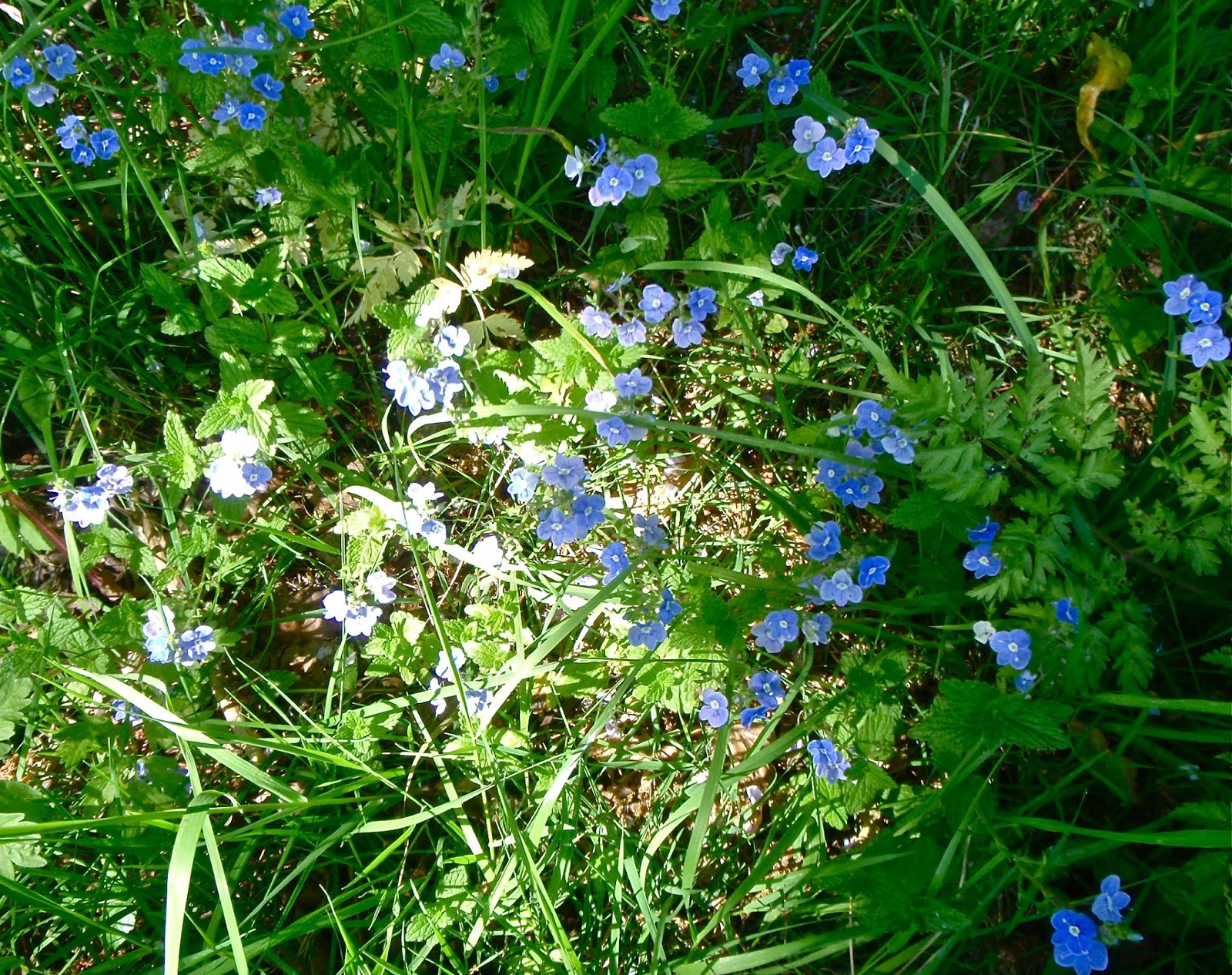
Germander speedwell (Veronica chamoedrys)

 Common daisies cover the grass like snow, in strong May sunlight.
Just leave them to grow!


Wednesday, 29 May 2019

The Greenest May

Much has happened during May 2019 with the river warming up. Damselflies and Dragonflies have appeared later than last year, but are now emerging into the sun.


This Large Red Damselfly male on 24th May was shifting from place to place but returning to the same sunlit leaf on the river bank. Flies of all kinds were numerous over the water  and foraging was easy.

The survey this month was made on Tuesday 21st May 2019, a fine day after overcast weather. There was no rain and not much wind and very bright clear sunshine. Dandelions along verges and banks were mostly in seed now with 'clocks' sending flying seed in all directions, some of it taken by house sparrows as it drifted past. Cow Parsley was growing prolifically along the banks and under hedge margins in semi-shade:


 The young green  Cow Parsley shoots emerging from the winter layers of fallen leaves are always one of the first signs of spring and the flowers herald summer. The Oaks are now in full leaf and ash trees in leaf at last. Fruit trees have tiny fruits following on from the blossom and bramble flowers are just appearing in the sun. Soon they will be full of bees. This acceleration of growth means that birds have more hiding places and associated aphids and caterpillars to pluck for their young, perfect timing.
A continuous chorus of small birds singing and calling filled the air but today singing blackbirds were the loudest. Thirty-nine were present along the riverside, many singing, whilst others gave alarm calls or soft contact calls to their young, finding their way through the under storey of Cow Parsley and ivy.
Less obvious but always present were the calls and 'songs' of House Sparrows, juveniles increasing the usual numbers present in colonies totalling well over one hundred.  Most of these prefer insects to seed at this time of the year. Starlings were seen flying over in a new flock of about thirty with many noisy juveniles scattered amongst branches in other places totalling more than forty. Another common bird was seen in fewer than usual numbers, the wood pigeon but this was only due to many nesting or foraging in fields beyond the river  (22). Magpies were even more scarce, for the same reason. As usual the more delicate collared doves were hiding, just one pair being seen and heard.
The songs of robins were short and subdued, with 19 visible including 2 juveniles silently exploring in the undergrowth, the habitat of the dunnock too. Eight were seen, some had been bathing in the river, on an island of twigs. Song thrushes were at different stages, some giving short songs with just one singing a full song, the rest were foraging, collecting food for young in their low under-storey nests, six in total.   Nuthatches, as usual whilst nesting, avoid attracting attention - but two were seen in the oaks today.
Wrens (20) are so numerous that they can be seen and heard at different stages too, all along the river banks.
Their songs and alarm calls could be heard in many different places, three were singing from very prominent tree-top perches whilst others were singing close to nest sites, low down - but the total effect was for their songs to echo along the river banks. 
Blue tits (26) and great tits (9) were active amongst the thickets, foraging for insects, the great tits preferring to search amongst tall grasses on the ground of on the river banks. Two coal tits flew fast into a tall hedge, making their way down, probably to a low nest.


Buttercups take over from Dandelions, and grow tall, attracting numerous insects.

Whilst most wildlife activity is taking place at a low level in undergrowth on the banks, in hedgerows and roots,  loud calls from above distract the observer. A carrion crow calling loudly from a tree top made me look up, as the calls were too strange to be just crows. It was a common buzzard, very close, flying up from the tree over the river, chased by aggressive crows. It has possibly flown too close to a crows nest, but it retreated. Further down the river a different buzzard war also being mobbed by crows circling in the sky. Later a buzzard was seen flying very low over a drainage basin - again followed by a crow (two or maybe three individuals). As for the carrion crows, a total of 8 were seen and a single jackdaw.
A grey heron was seen to fly up out of the river in a stretch with high banks where it had been fishing or catching frogs and 4 Herring gulls were seen flying across whilst a single male mallard paddled upstream.
The star of the river today was a fine grey wagtail  which shot along the river, skimming the surface near it's nest site, very low down.
High calls alerted me to a single goldcrest near some conifers, with two more seen close by (3)
Back at tree level, 4 chaffinches and a single greenfinch were seen in the branches amongst dense leaves. 20 goldfinches were heard and then seen in a thicket, with some anonymous-looking juveniles amongst the group. A family group of 7 long-tailed tits flew forging along the willows, where a blackcap was singing. Elsewhere along the river, more blackcaps were seen and heard, 12 in total, some very quietly sub-singing, but one or two were in full voice.
Chiffchaffs (15) were singing in most places along the riverside trees and seen easily too. Others were contact-calling, probably juveniles.The singing of these migrant warblers was enhanced by two garden warblers in different places and nesting common whitethroats (11) in more open scrub, now only giving short songs.
Finally at the end of the survey, a fine pair of Bullfinches were seen in a thicket on the river, very close to each other. These are resident birds which remain in pairs all the year round, seldom separated by more than a few meters.

Last but not least, insects are the key to our survival - especially bees of which there were large numbers today, thronging the newly opening Bramble flowers and Rosa canina in special places warmed by the sun. Bumblebees, Honeybees, White-tailed, Buff-tailed and Red-tailed bees to name a few.

Butterflies present were Speckled Wood, Green-veined White, Red Admiral, Orange-tip and Holly Blue accompanied by many Hoverflies.