Sunday, 8 July 2018

A Memorable Week in July - Gatekeepers!

The first week in July 2018 has been especially memorable here,  with large numbers of butterflies patrolling the grasses, brambles and nettles along the warm river banks, in the sun and dappled shade. During the first four or five days of July, Meadow Browns, Ringlets, Speckled Woods, Large and Small Skippers, Green-veined Whites, Large and Small Whites, Commas and Red Admiral were seen foraging and chasing amongst the rapidly drying grasses, flowering Brambles and Dog-roses.
On the 6th July however there were suddenly many more, hundreds of Gatekeepers had emerged and were restlessly flying from plant to plant, very few pausing to bask on leaves or flowers - perhaps it was too hot. They are late to emerge this year, after the cold winter.


A small bright male Gatekeeper perches for a second on a Bramble leaf before flying off to chase another amongst the mass of leaves and flowers, in sunlight and cool shade, then across onto the embankment grasses where hundreds more were active.


Another Gatekeeper amongst the grasses, now outnumbering the Meadow Brown butterflies.

They are quite easy to distinguish from any other butterfly. The other most common species present was the Meadow Brown - but this is larger and not as bright, with a dull orange patch around the single white pupil in a black eyespot and the wings dull brown and grey-brown. The Gatekeeper's eye spot has two white pupils in a black ring.   
Skippers have bright light orange and brown wings but lack eye spots and usually bask with wings half-closed.

Birds were still very active here all week too, with common whitethroats,singing wrens, blackbirds, song thrush, chiffchaff, blackcaps, garden warbler, dunnock , house sparrows, calling great-spotted woodpecker, nuthatches, great tits, blue tits, all with 'yellow' juveniles in tow and a grey wagtail flying over the water. A grey heron dropped a common frog whilst being chased by a herring gull.
Banded Demoiselle damselflies, both male and female were seen perching in the early sun on the river bank vegetation, waiting to pounce on small insects above the water and Southern Hawker dragonflies were seen ranging along the banks.

Saturday, 30 June 2018

A Butterfly June

Friday 22nd June 2018 began, as usual, in bright sunshine, with a cool northerly breeze, becoming hot later.  The ground remained green and damp in shady places, with Bramble still very much in flower along the banks, attracting numerous bees and other insects whilst the long grasses were thronged with butterflies - mostly Meadow Browns in the hot sunny areas and good numbers of Ringlets in dappled shade. Speckled Woods also frequent dappled shade but usually range along woodland and tall thickets. Several Green-veined Whites were present too with unusually high number of Large Skippers in their favoured habitat, long dry grasses. If perched, they look just like orange-brown dead leaves which suddenly spring to life. 
Banded and Beautiful Demoiselle Damselflies are still present along the river, chasing under the steep banks and perching on nettle and Bramble leaves, in wait for insect prey. Along the banks several bright Comma butterflies were ranging, fast flying and inquisitive. Loose clusters of Stitchwort were growing well  amongst the tall grasses and flowering Common Mouse-ear was seen on the shadier banks:


Common Mouse-ear on green banks

With such a slight breeze it was very quiet indeed on the riverside - apart from birdsong. All kinds of 'rustling' occurring in the trees and tickets was significant today as there was no wind.
A large clump of Rosa canina was flowering abundantly, facing the sun on the river bank, covered in bees and flies:


Dog Rose - Rosa canina in the sun, overpowering the Brambles

This was Sparrow Weather - house sparrows (65) could be heard in colonies all along the river course - they love the hot weather but also seek out water where they can drink and bathe. The river provides plenty of safe places here. No silent summer yet - singing blackbirds (25) could be heard, near and far,  their voices echoing, whilst others were 'sunning' on verges, wings and tails spread out in
the sun. Fledged juveniles were foraging nearby and other adults were nesting with second broods.
Song thrushes continue to sing loudly (5) and were seen under green damp hedges and undergrowth, foraging.
Also very audible were wrens (26) most singing again whilst others watched over newly fledged young. There was a fine view of four fledged juveniles keeping close together, learning to forage on branches over the river, lining up together on a small twig just above an adult  grey heron foraging on 
the river, which flew off, it's fishing disturbed by the juvenile wrens. Much further away downstream a juvenile grey heron was fishing under the steep banks (total 2).
There were now many blue tit  (58) juveniles forming groups in the thickets, easily visible with their yellow plumage mixing in some places with juvenile house sparrows. Great tits (18) seemed to be keeping in family groups,  'yellow' juveniles and adults foraging together. Noticeably absent at first were robins whose song is often the first to be heard - but not today. Only 9 were seen, with 5 singing.
Their 'absence' doesn't mean they have flown away but are probably in hiding, perhaps raising more broods whilst some may already be moulting.Three dunnocks were seen and heard in the undergrowth. Like the robins, few goldfinches were seen and heard (6) and only one greenfinch.
21 wood pigeons were seen, some calling and 5 magpies just sitting in trees, chatting. A small total of 4 carrion crows, sat inactive in the heat of the day - and a single herring gull was sailing high.
With the longest day only yesterday and continuing fine weather most birds do not have to frantically seek food all their waking hours and can rest, hidden from view for a while.
Nuthatches (11) however have now become noisy again, with fledged young calling loudly, still keeping to their nesting territories.  A distant green woodpecker nest still held young, making the loudest calls! whilst one adult was seen flying across. It's been a very good summer so far for ants - food of the green woodpecker having a wide choice of ants nests to forage from. A great spotted woodpecker flew across to its tree but no young have been seen yet.

Lastly, our summer migrants are still active here, with four whitethroats still nesting, chiffchaffs still very vocal (6), a single singing garden warbler and ten blackcaps, most of these singing too.

Finally a mallard family enjoying the calm slow waters of the river, perfect for rearing young - the adults only were seen today but later were seen with at least 8 duckings in tow.
Just above, a common buzzard was seen being chased by a carrion crow.


Thursday, 28 June 2018

Perfect Pollination

This spring has proved to be perfect for pollinators and the essential task they perform in keeping our world alive. Most pollinators are insects: bees, flies, butterflies, moths and beetles but some birds play an important part too and bats, whose work goes largely unseen. Many wild flowers are essential to the survival of these pollinators.
Dandelions are right at the top of the list for bee survival. After a long winter, the flowering of Dandelions decides the fate of bees for the year - no dandelions, no bees, no bees - failure of crops and reduction in harvests of fruit and vegetables.
Bees and other insects need lots, carpets of dandelion flowers, not just the odd one here and there as they are the best source of early nectar for bees emerging from hibernation, coinciding with flowering in spring.


A Hoverfly nectaring on Dandelion - 25th April 2018


Dandelions on the river bank field - 20th April 2018

Like most wild flowers this spring, they were late in flowering - but bees and other insects were late in emerging too.
Later the flowers will go to seed providing food for house sparrows and goldfinches.

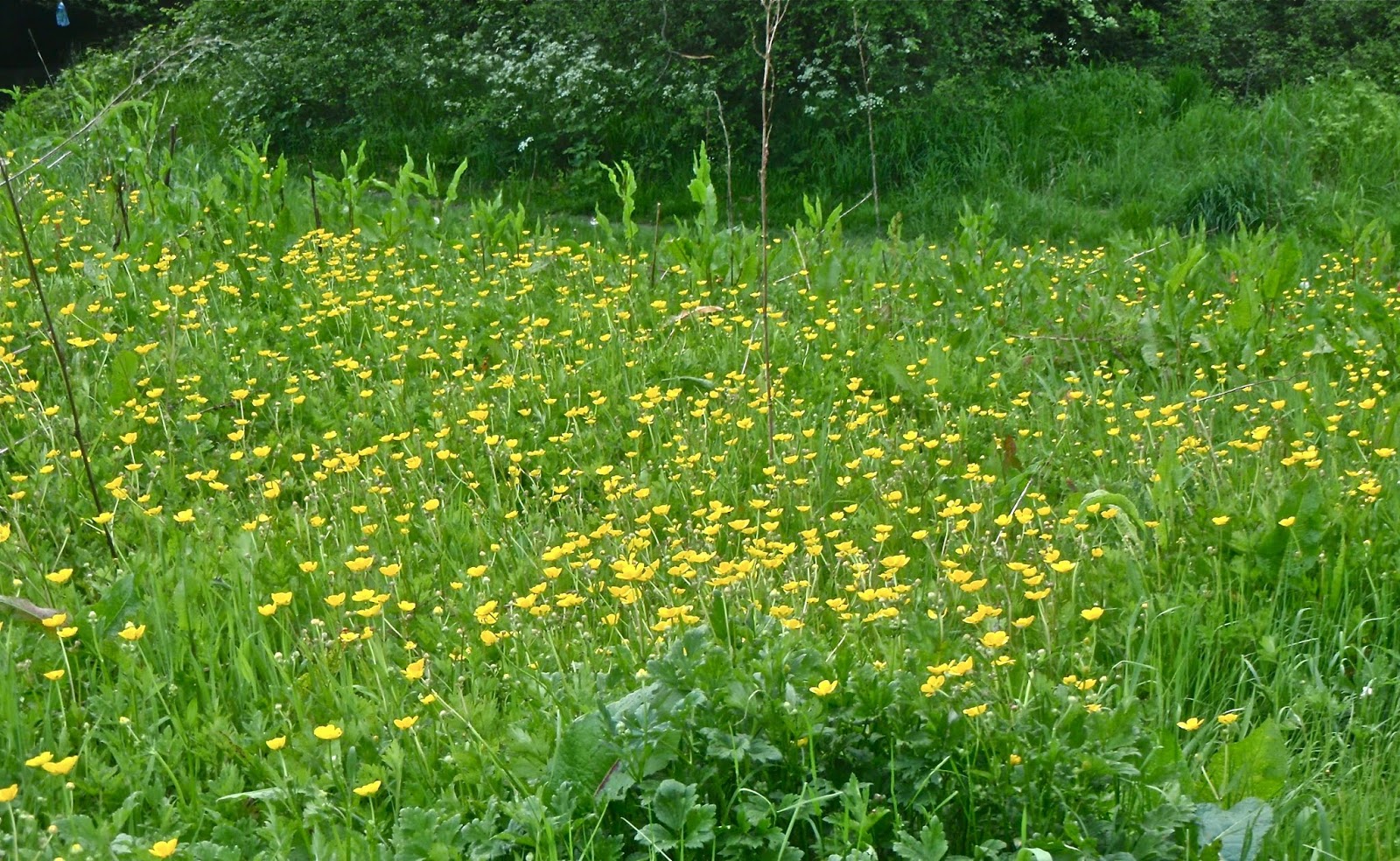
The abundance of Dandelions eventually gave way to an abundance of Buttercups:


Buttercups on the river bank 10th May 2018

At the same time, in a shady copse, Wild Garlic gave way to Cow Parsley:


10th May 2018

Many insects were attracted to the Cow Parsley flowers in damp, dappled shade along the river.
With so many bees, flies and other insects having been attracted to the wild flowers, pollination of nearby fruit trees and berry-bearing plants continued and now, at the end of June, we can see their success - an abundance of new berries and fruits, meanwhile pollination continues amongst flowering Brambles and Rosa canina.


Honeybee on flowering Bramble - 22nd June 2018


Monday, 11 June 2018

Summer Skipper and Meadow Brown butterflies

Yesterday, Sunday 10th June 2018, marked the start of the butterfly summer. The day was warm and bright with thin hazy cloud and a slight NE breeze. The grassed areas were growing very well with a diversity of wild flowers and grasses appearing, including Cock's-foot (Dactylis glomerata).
Most butterflies have been slow to emerge this spring and it was good to see the first Large Skipper (Ochlodes venata) perched in the sun in a sheltered spot, on the leaf of a new Oak tree seedling. Looking around, numerous such seedlings were springing up around the old oaks where carpets of acorns had formed after last autumn's huge crops had fallen and lain unclaimed by Jays and squirrels on the river banks.


This Skipper, although called 'large' is not necessarily larger than the 'Small Skipper'  but can be distinguished by it's markings, the Large Skipper having more variegated orange and brown patterned wings. The Small Skipper is generally plainer.
The eggs are laid singly under blades of Cock's foot grass which provides food for the caterpillar when it emerges.

At the same time as this Skipper was seen resting on the leaf, the long grasses of the embankment held many insects, with at least two Meadow Brown (Maniola jurtina)  butterflies which were extremely active, in contrast to the inactive Skipper. They ranged amongst the grasses with a random fluttering flight without resting. The caterpillar prefers a variety of grasses with Smooth Meadow grass (Poa pratensis) a favourite. The Meadow Browns were exactly on time emerging during the second week in June. Given reasonable weather, butterflies should do well this summer.
On the river bank itself there were more Banded Demoiselle damselflies, males and females and Beautiful Demoiselle damselflies in good numbers with a single Large Red damselfly seen:


The Large Red damselfly (Pyrrhosoma nymphal) is usually the first damselfly to be seen in the spring - in late April - but it's emergence this year was certainly delayed in this area.


Wednesday, 30 May 2018

The First Dragonfly of the Summer

The first 'true' dragonfly appeared here on 23rd May 2018, and was one of the early dragonflies, a Hairy dragonfly (Brachytron pratense). Conditions must have been just right for it to have emerged within the last few days and it was now flying strongly, patrolling its site over the bank vegetation in bright sunlight.  Subsequent sightings of the dragonfly were good but always in flight rather than perching.
Here's the survey for May 23rd:
Wednesday 23rd May 2018 was misty to start with but then clear with continuous sunshine. There was a dry breeze and no dew on the grass. It was good to see small fruits most about 1cm across, forming on the all the young fruit trees. the blossom had been spectacular with good pollination.


Young fruits forming - frost had not affected the blossom this spring

The breeze was rustling through the trees, all now suddenly in full leaf, and birdsong was carried along the river course; house sparrows (over 100) were gathering in groups along the banks, their numbers magnified by newly fledged youngsters closely following the adults into a new strange world, with running water and muddy banks on which to bathe and preen. Adults were still collecting insects to feed their young.
Resident birds have done well this spring - although nesting was delayed, numbers are good but many migrant species have been very late in arriving, held up on their journeys by bad weather and freezing north winds. Numbers of swifts, swallows and house martins are all fewer than usual and those that survived are late in arriving.  Today it was very good to see at least 8 swifts above, over the river. Migrant warblers are affected too, arriving late, but fortunately finding good habitat conditions here, locally, the growth of riverbank vegetation and insect life having been delayed as well. 
Blackbirds (34) were singing strongly here, with no lack of food for their young in the long damp grass. Wrens don't move far and hold very local territories, so they are a good indication of healthy habitat from year to year. Today there were 26, most of them singing and flying low short flights across from bank to bank. There are more sitting unseen and unheard on nests. Robins were also heard singing (15) but many more are on nests, perhaps incubating a second brood already. Loud and seemingly endless song carrying far down the river came from a song thrush, with more birds (5) singing  in different locations close to the river or seen foraging low down under hedges and around tree roots.
Most birds feeding young at this time of the year are searching for insects - and moths are no exception.
Here is one seen during the day feeding on a dandelion flower:


This is a Burnet Companion moth (Euclidia glyphica) nectaring on an essential food plant -
dandelion - one of the best plants for insects and therefore for birds - destroy the dandelions and other common wild flowers and you destroy the insects that feed on them - meanwhile depriving young birds of food.
Blue tits  (22),  great tits (16)  and long-tailed-tits  (1) seen today were collecting small insects too - mostly caterpillars and aphids found on the undersides of leaves on trees and nettles, and small spiders.
These resident birds were late to start nesting too and the relatively small numbers seen means that they are still raising young in the nest and don't fly far to forage for food.
Looking up at the conifers - with branches moving in breeze it seemed unlikely that any small movements would be detected - but 3 goldcrests were seen, one flying in and two more on the top branches.  Woodpigeons were seen in small numbers too (10) and magpies (5). Carrion crows (6) were probably surveying for easy prey, whilst about 30 herring gulls wheeled high over the field and drainage basin. A raucous cry gave away a grey heron well hidden on the bank - they are usually quite silent but this one may have been accompanied by a juvenile both from the heronry to the north. On the river itself two mallard ducks, male and female were swimming downstream followed closely by two more males.(4 total).  Angry calls from over the river made me look up over the riverside trees - a low-flying sparrowhawk was being harassed by two crows . It soon threw them off. and disappeared.   Starlings (4) had formed groups including juveniles and had flown elsewhere. They usually return to their 'day roost' amongst ivy in the afternoon.  Two jays were seen, one being chased by two magpies in a tree and a single nuthatch was flying through branches towards it's nest - they are also late in nesting this year.  Dunnocks (5) are always present but seen in small numbers as they seek out dark and secret places well inside hedges or amongst roots where they remain well camouflaged, only emerging to forage for insects on a track or to sing from an elevated perch on a branch in spring.  Chaffinches have been singing but only two were heard today - and no greenfinches. Goldfinches on the other hand, were quite numerous again (34), singing in several groups along the river amongst dense thickets. Their survival here during the winter is dependent on seeds, especially Dock seeds. Teasel seeds are also a favourite.
Bullfinches were also nesting and remained under cover but one was heard calling and a second was seen flying into a thicket. High above, a common buzzard was circling, catching the thermals from the sunlit land.
Migrant warblers were present in good numbers along the river, with a total of 12 chiffchaffs, all singing, collecting insects, fast moving, partially hidden amongst fresh green leaves - and 13 blackcaps, most were also singing a far more complex and melodious song. Another song-specialist, the garden warbler was heard singing too. Common whitethroats (9) are doing very well, here, some were still singing but nesting is taking priority. Nine were seen, now keeping mainly to low dense undergrowth such as nettles or brambles - or low in dense thickets in various places along the banks. They usually have two broods. A single willow warbler was heard together with a chiffchaff in a willow. 


A Speckled Wood butterfly with wings closed, perches on 
a new Bramble leaf.

Insects:
Hoverflies, Speckled Wood, Brimstone, Large White, Small White, day-flying moths, numerous bees including Red-tailed and Buff-tailed bumblebees were seen.
As the day warmed up, insects thronged the river, most just above the water but many more over the banks. Beautiful Demoiselle damselflies were present in good numbers, both males and females, taking advantage of easy prey in the form of small insects and midges, perching on broad leaves (Dock is a favourite)  pouncing on flying prey or dashing out over the water in pursuit. Banded Demoiselle damselflies were more numerous, with the brilliant blue males most easily seen, often chasing just over the surface of the water in sunny sheltered parts of the river with more exploring the banks and grasses beyond. A Large Red Damselfly was seen too - perched on nettles - but the star of the day was of course the Hairy Dragonfly.


Monday, 28 May 2018

Mid-May - Damselflies appear with the sun

By 12th May, the days were warming up but no sign of Dragonflies or Damselflies over the river - was it still too cold, too windy, too dark? There were plenty of spiders throwing themselves and their webs across from stalk to stalk on the dry old Dock plants from last year around the fruit trees, now in blossom. The embankments were alive with house sparrows flying out of the hedges to land on the swaying stalks, now stripped of seeds by goldfinches. Blue tits and great tits joined in - what were they doing? They were all still feeding young in the nest and had found a source of food, extremely nutritious and easy to catch - spiders.
Out in the open many adult starlings were foraging the hard way - by fly-catching on the wing, zig-zagging across the sky. The just-fledged young birds were calling noisily to be fed, being quite helpless at this stage. 
The 14th May 2018, a fine day, all day started with loud yaffles from a green woodpecker, with singing common whitethroats. Blackcaps and a song thrush were singing too against a loud background of goldfinches in a thicket. House sparrows were out foraging again but the day was special - the first Damselfly of the year appeared. It was a female Banded Demoiselle damselfly flying low over the river bank then perching on a nettle leaf to rest. This was not late when compared with other years, it just seemed to be late as the first Calopteryx Damselfly (a Beautiful Demoiselle male) had appeared on 24th April last year 2017, but this was unusually early (see entries for 28th and 30th April 2017). On 15th May this year the first Large Red Damselfly was seen, with three others chasing on a damp well vegetated pond. The following day three swifts were seen across the river under cloud in the wind.


A male Banded Demoiselle Damselfly (Calopteryx splendens) on river bank bramble leaf on 19th May 2018 watching out for passing insect prey. 

On Friday 18th May 2018 (another fine day) it was all happening - with the first Beautiful Demoiselle Damselflies appearing, males and females ,with good numbers of Banded Demoiselles, mostly males.
In the same area, common whitethroats were singing and displaying with singing blackcaps,  song thrush, a garden warbler, a goldcrest, robins, dunnocks and a few starlings. Orange-tip and Brimstone butterflies ranged over the nettles, a common buzzard flew overhead, a kestrel circled over the river and a carrion crow was seen chasing a Red Kite.
To signal the return of summer, house martins were confirmed to be nesting again in the town centre!
On 19th May - a sudden flowering of Rosa canina some shoots having climbed to the canopy of old Field Maple and Hawthorns:


One of the first of the Rosa canina flowers this year
19th May .


Friday, 25 May 2018

Holly and Hawthorn blossom in early May

May began with changeable weather with slight frosts on some mornings. The Hawthorn blossom was appearing everywhere,  the presence of Blackthorn becoming less obvious as the last blossom was blown away. 


Often overlooked, Holly blossom flourished too, an important food plant for
 Holly Blue butterfly caterpillars. Holly is not overlooked by birds at this
time of the year as the plant harbours many tiny insects and spiders, mostly on 
the undersides of the leaves.

Unlike Holly, May blossom is spectacular and is prolific this spring:


Hawthorn branch weighed down with blossom on 10th May 2018.
It shows how well integrated the Hawthorn is with the other riverside and hedgerow plants here, such as Dog Rose, Blackthorn, Field Maple, Guelder Rose, Holly, Hazel, Elder, Honeysuckle and more.


Guelder Rose flowering, 10th May 2018, promising a good crop of berries for the winter.

A summary of the first few days of May:
4th - 11th May: Common Whitethroats were displaying and singing.
Goldfinches singing in thickets, Good numbers of Orange-tip butterflies both male and female over the bank nettles and brambles, with many other insects, small bees and Hoverflies.
Nesting nuthatches were quiet. Blackcaps were singing loudly, clearly visible in several areas along the banks. It was interesting to observe that one or two of the birds were singing whilst foraging for insects amongst the fresh new leaves - cutting their song phrases short when they found insects, then resuming their song until the next foraging interlude. Chiffchaffs were singing as usual, moving quickly along the willows. about seven adult long-tailed tits were foraging under the closing tree canopies, collecting food for calling young, whilst blackbirds, song thrushes, wrens and robins sang lower down in the trees and roots.
Three bullfinches were seen flying across to the river bank from a densely-leafed tree.


Hawthorn in blossom on the riverbank margin 10th May 2018