Thursday, 22 August 2013

Kingfisher in command


Small Tortoiseshell butterfly (Aglais urticae)
It's a good year for butterflies - and birds!

Today, 22nd August, a hot and humid day after about 5mm rain, the river was running faster than of late but still low. 
On Monday 19th August I had seen the magnificent sight of three Clouded Yellow butterflies (Colias croceus) flying fast, showing off their deep yellow/orange upperwings over the wild flowers and grasses on the river bank, so decided to have another look today. They were seen with a Brown Hawker dragonfly and a Small Copper butterfly, with two juvenile nuthatch calling, one each side of the gap left by the fallen oak tree last year.
But today only Large White butterflies could be seen. I glanced down and suddenly became aware of a Kingfisher, perched on the top of a section of old oak branch which had been deliberately left overhanging the river last year by the Environment Agency workers 'for the Kingfishers to perch on'.
Great to see that their efforts to create habitat for wildlife from that site of devastation have been a such a success!
The Kingfisher remained for a while intently surveying the river just below it, then dropped down and flew fast and low downstream. It was a fine sight when perched - seen from above the shining blue streak on its back between the darker wings and white neck patches instantly identified it, then when it flew the brilliant 'kingfisher blue' of its back lit up the river for an instant, catching the light.
Kingfishers are with us all year and this year, judging by the calls heard and occasional split-second sightings, it has been a good year for raising young, unlike last year when the river flooded in June, almost certainly flooding the kingfishers nests.


A Small Heath butterfly (Coenonympha pamphilus)


A Seven Spot ladybird heading for the nearest infestation of aphids


Sunday, 11 August 2013

Bees, berries, brambles - and Butterflies


Perfect summer weather now with sun, clouds, rain showers. On Tuesday 6th August 2013, a fine morning, a very slight breeze, dry after intermittent heavy showers the day before. Excellent conditions for insects on the river banks.


Starting with one of the smaller species - but fascinating in its unique mode of flying -
a hover-fly. This one is the beautifully patterned Episyrphus balteatus, enjoying the
nectar rich Calystegia sepium.


The Bramble provides food for wildlife all through the summer and well into
the autumn and perfect shelter during the winter for many species. Some plants
growing in more shady areas flower late and many plants still have blossom buds
together with ripe blackberries.
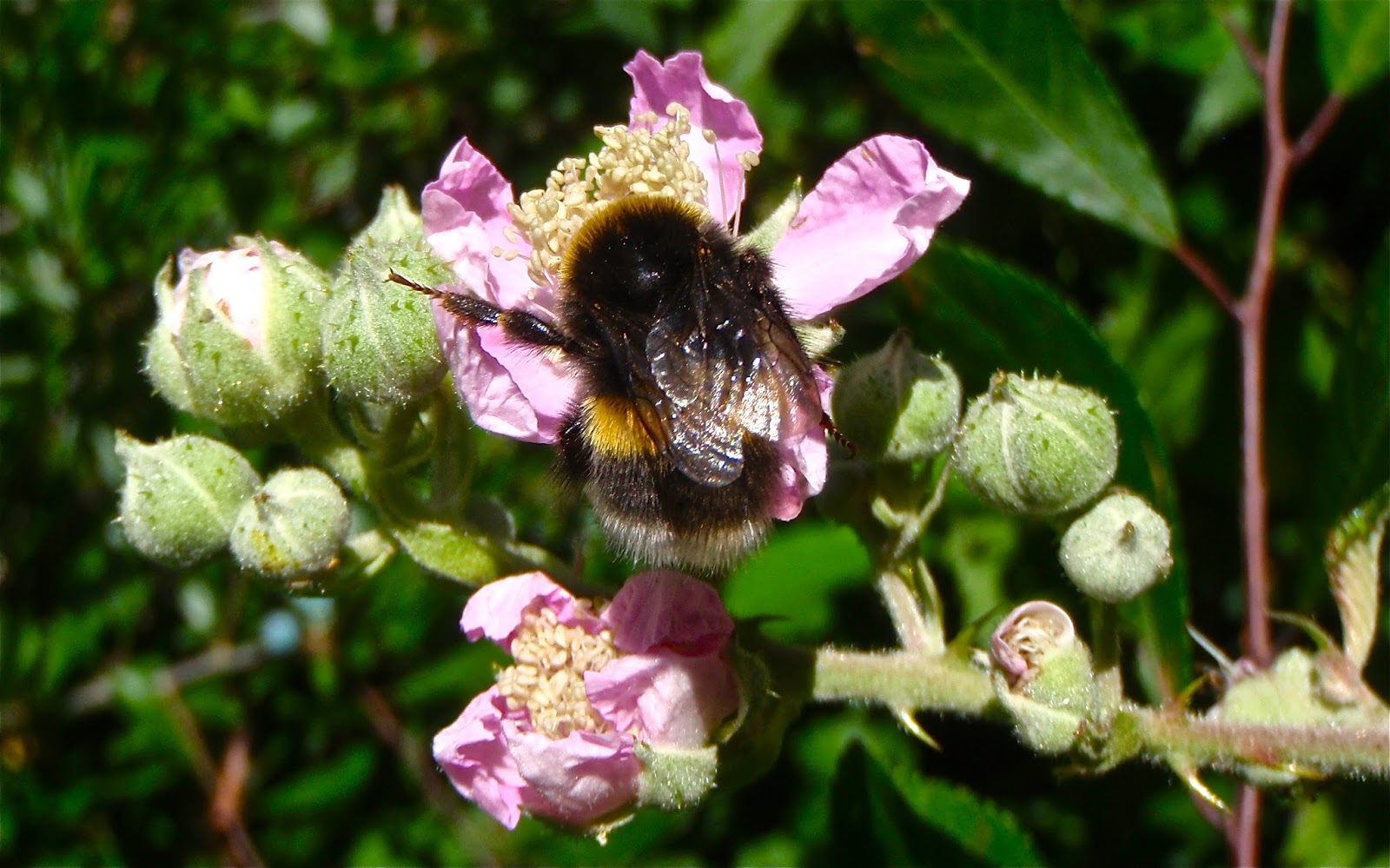
This bumblebee is White-tailed bumblebee Bombus lucorum.
Bramble blackberries will soon be ripe enough for birds to eat


Sloes are plentiful this year on the Blackthorn where there were none
at all last year. In late winter they will provide our winter migrants
- the Redwing and Fieldfare, with a welcome source of food, encouraging them
to pause and gather strength to continue their journey.


Guelder-rose  (Vibernum opulus) berries ripening on our
2 and a half year old plants along the River bank, another
excellent source of food for birds during the winter


Ringlet Butterflies are numerous this year along the river - they 
prefer damp secluded habitats and unlike most butterflies can be
seen flying on overcast days, even in the rain. They do feed on the nectar
of  'butterfly plants' such as this  Senecio jacobaea and bramble.


This Ringlet is a female which has easily visible upper-wing 'rings'.
The male is darker and the rings on the upperwings are almost
invisible. 

Today, 6th August - a fine, still day after intermittent heavy showers yesterday. The 'budding' wild flower area of sub soil on the river bank was proving popular with bees, foraging amongst a few unexpected poppies and cornflowers. The river was flowing well with clear water. Blackberries, sloes, Hawthorn and Elder berries, Hazel nuts and forming acorns all numerous this year. In the sun, the ground was very dry with the ground clay cracking.
The conditions were good for butterflies, with at least 23 Speckled Wood butterflies keeping to the shady trees, some low over the river, some spiralling high, chasing. Large White butterflies were numerous too, more than 20 over the grass, in the sun but the most numerous were the Gatekeepers, small restless butterflies, ranging erratically along the base of the bank side vegetation, chasing other butterflies or basking for a moment. (27). There were fewer Meadow Brown butterflies (4) around thistles where the heat of the sun was intense. Here Bumblebees were very numerous, White-tailed, Buff-tailed, Red-tailed and Carder bees, together with some Honeybees and many hoverflies and tiny wasps of various species. A single Brimstone butterfly was seen, and 3 Large Skippers on the sunny bank with just one Ringlet (they prefer cooler, damp conditions). Strong-flying Peacock butterflies were enjoying the wild flowers (7), together with brilliant orange Commas (6) and some fast flying 7-spot Ladybirds. Whilst admiring the abundance of sloes on the Blackthorn, a Red Admiral butterfly perched briefly on my shoulder, the only one seen today.
The first butterfly I saw earlier this morning, however, was the best - having never seen one here before - A fine Purple Emperor, flying high into the top of one of the old river bank oaks from an adjacent field maple. Looking up its markings and colour against the light - and its large size and shape - were unmistakable - brilliant. I was looking up for a chiffchaff as had heard its 'hweeet' call.
One of the last butterflies seen today, to make it even more special, was a White Admiral in a thicket not far away.
Dragonflies were about today as well - a Southern Hawker, 3 Common Darters, a Ruddy Darter and 4 banded Demoiselle Damselflies.

Now the birds - at this time of the year juveniles are busy fending for themselves whilst adults may be keeping out of sight, moulting, unless raising another brood. 
It was very quiet all along the river with woodpigeons cooling off in the river or foraging in the fields (27) and only 3 starlings were seen flying across. The blue tits (34) and great tits
(11) seen were mainly juveniles learning to glean aphids and small spiders from under leaves on the oaks, hawthorns and willows. House sparrows were also cooling off in the river then flying up to perch on the dead hawthorn branches - soaking wet juveniles mostly, there's nothing they like more than communal bathing! Drying off in the early sunshine, well fed, what could be better. (30). Blackbirds were mostly enjoying the shady, muddy riverbanks but one was seen sunning itself, wings outstretched, beak open, balancing in the forked branch of an oak. Chaffinches too were down on the riverbank bathing (7) - silent at this time of the year. A song thrush was foraging in the shade where the ground was still very damp and above it a glimpse of a silent bullfinch as it flew into the thicket. A loud yaffle from a green woodpecker, higher pitched, rang out - probably a juvenile.
Looking up again to the tree canopy for that very elusive butterfly, a great spotted woodpecker flew over and I came across another further along the river, calling, probably warning its young ones. (2) 
 A very short snatch of song from a blackcap alerted me to small movements in a Hazel thicket, the male flew up then back down to catch an insect then a juvenile, with a red cap appeared. More leaves moving on a windless day gave away the presence of 3 more juvenile blackcaps in a Spindle tree (5 in all). Only 4 wrens were seen, just one singing. There are many more down there, hiding. A high 'hweeet' contact call revealed a chiffchaff restlessly moving amongst the insect-laden leaves and a silent willow warbler was seen nearby. Another, louder and more persistent 'hweet' call came from across the river - a nuthatch, again probably a juvenile and its call was answered by a second nuthatch which then flew across to join its sibling. A speckled juvenile robin was busy in an old apple tree and 3 others, adults, were seen in various shaded areas amongst tangles of blackberries and sloes. 
Above the trees 3 black- headed gulls, a single magpie, and a single crow were seen but later, on my way home, 5 swifts appeared from nowhere, flying high and amongst them, for an instant, a hobby.


Monday, 29 July 2013

Butterflies in Disguise

Nearly the end of July, and the end of the 'heatwave' but the days are still warm and it's hot in the sun.
Butterflies which were seen later than usual this year on the riverside have made up for lost time and have appeared in large numbers over the past few days. 

What's this, just a shadow, a dead leaf, a piece of bark?
No it's a Peacock butterfly alive and well, feeding on nectar in the hot midday sun.
The inky black colouring of the outer surface of its wings enable it to absorb heat from the sun more efficiently, even early and late in the day when the angle of the sun is low.


 Another tatty dead leaf?
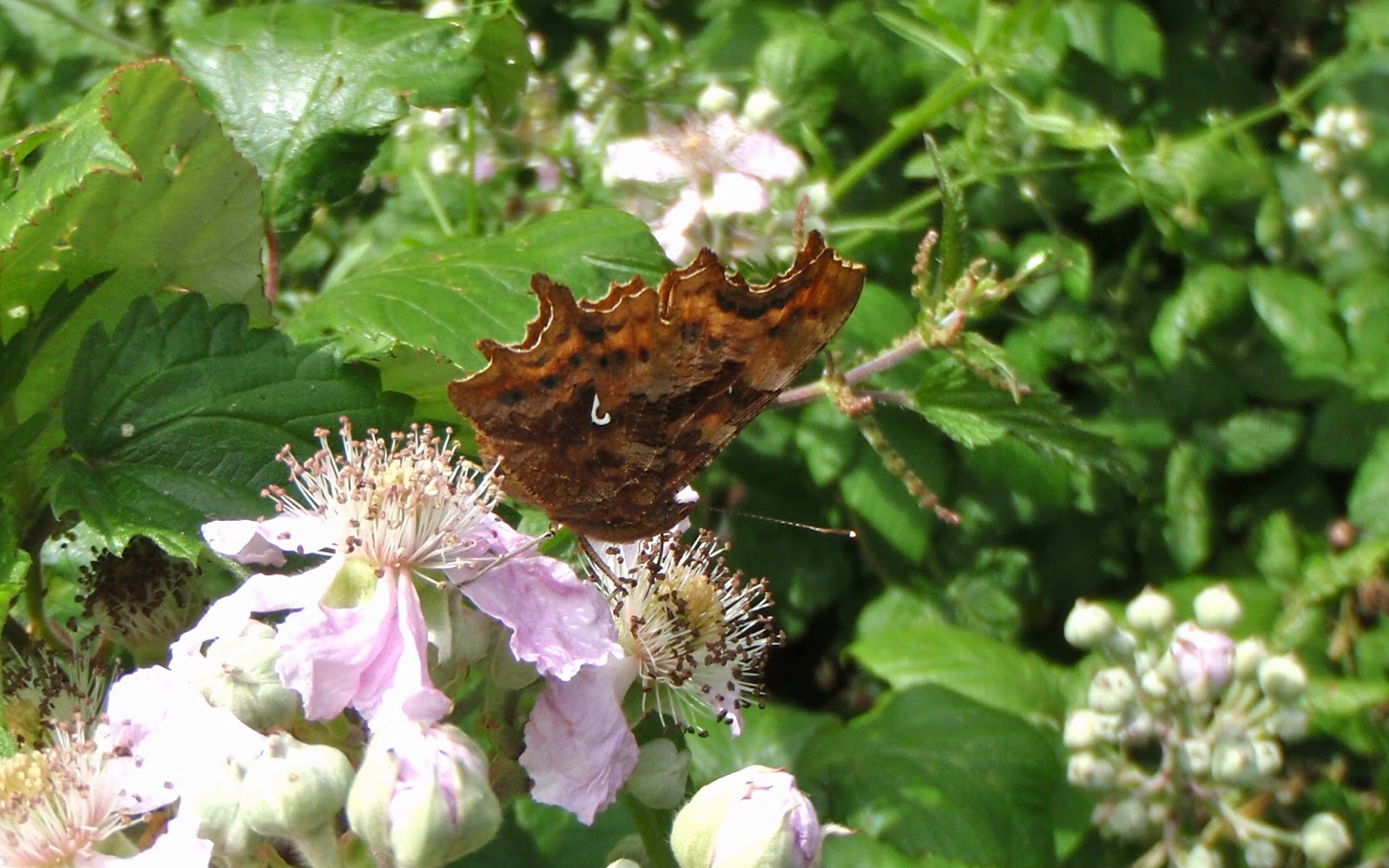
No, this is a Comma butterfly feeding of brambles on a hot day.
Basking with open wings is only necessary for part of the time. Note the white 'comma' mark on it's wing, from which it gets its name.


What's this unexciting old piece of vegetation?
It's  a fine Small Tortoiseshell butterfly on it's favourite plant, nettle on which the Small Tortoiseshell caterpillars feed when the eggs hatch. These are usually laid on the underside of a new nettle leaf.


In the shade, well camouflaged except of the double eye on the 
bright orange corner of the inner wing...
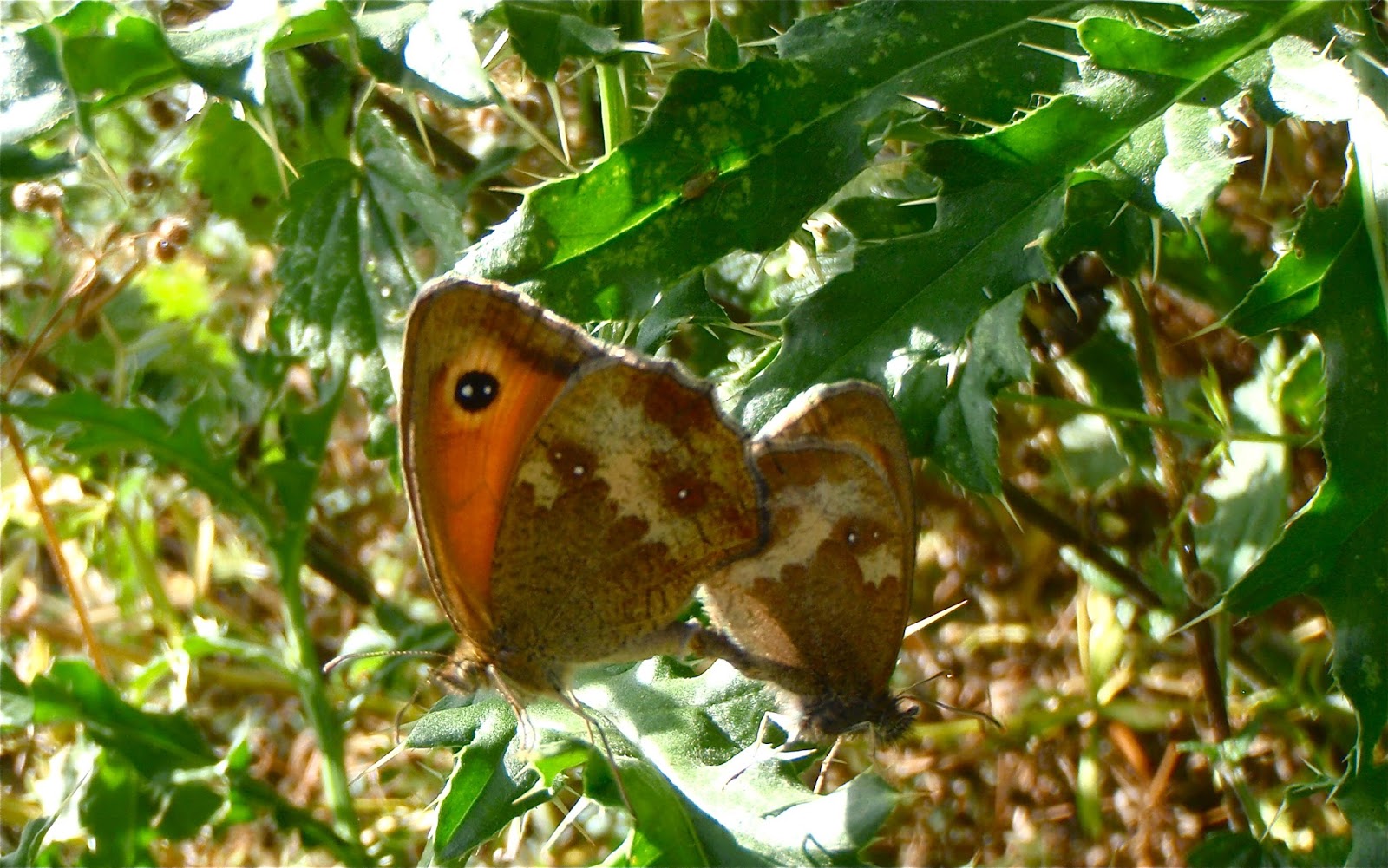
Two Gatekeeper butterflies mating amongst the riverbank vegetation.


BIRDS first
Friday 26th July 2013 - looking for butterflies along the riverside here - a late start (10.30) as some butterflies don't appear early - being cold-blooded, they need warmth from sunlight in order to gain strength to fly. Other wildlife seen is recorded as well.
Mainly cloudy but bright with breaks in the cloud, becoming warmer, sunny and hot. 
A very good sign for the coming winter, a Blackthorn hedge laden with sloes! There is an abundance of Hawthorn berries too, still green.
Down on the river bank, house sparrows were enjoying bathing, coming up to dry perched on the dead branches to get the most of the sun.  A colony was coming and going from a hedgerow whilst others were chatting in the dense Brambles (36). Blue tits (15) could be heard bickering, for once not busy foraging but just preening (15), watching the Bumblebees whirr past. Great tits (7) were very quiet, foraging in a Hazel tree. 
Hweeet calls from the Willows gave away chiffchaffs (3). These never stop foraging for insects.
Woodpigeons were looking very well fed, with most dozing in shady places in leafy trees (10).
Only one carrion crow was seen, calling - they too are well fed now, with food easy to find. 
In the shade under the bridge a Song thrush (2) was bathing in the clear running river water and another was seen foraging under a hedge, obviously still collecting food for young in the nest. Blackbirds too (5) were still foraging and collecting food for nestlings, searching amongst the moist shady grasses, beaks full with enough food for several young.
Wrens were at their most elusive, only three seen, two of them singing in the Blackthorn. They are all there, hidden on the river bank but have no need for song quite yet, they may have young close by. Robins (2) hiding away like the wrens were even quieter - and two juvenile dunnocks were seen in the same area in deep shade under cover at the base of a hedge. Movements in the Willows overhanging the river, so slight it could just have been the breeze catching the leaves - but long tails can't be hidden - they belonged to 5 juvenile long-tailed tits, obviously just fledged and uncertain what to do next, staying close together, reaching out to passing insects, giving very quiet contact calls. 
Further along, two juvenile blackcaps were quietly foraging.
Up in the sky, a Buzzard was gliding and circling, calling - then it's call was answered by another, unseen behind the trees, whilst magnificent swifts (9) turned and dived, catching insects - far more than last year, they are with us over the river every day, a good indication that they have nests and young to feed not very far away, although if food is scarce they can fly very long distances to forage. Herring gulls (5) were seen scanning the fields then disappeared.
The only alarm call today was from a great spotted woodpecker in an old oak, perhaps a jay or magpie was annoying it, although none were seen.

Now back to the intended species - the insects!
BUTTERFLIES and their companions:
Only five days ago many more birds made themselves visible but there were fewer insects...

Green-veined White butterfly in our landscape - feeding on the riverbank plants in the hot sun.

Each butterfly species has its own characteristics with different preferences  of food plants, habitat and range. The species found here on the riverside are here because of the diversity of the riverside plants, trees and grasses. Some are scarce and some are quite numerous in good years but all species are under threat of extinction in the not-too-distant future, not just here but everywhere in the English countryside. The Large Tortoiseshell butterfly is already extinct.
Here today on the riverbanks a short survey revealed:
Gatekeeper butterflies (21) 'sunning' on nettle leaves awaiting the sun, some nectaring on Brambles, others on Senecio jacobaea, most just patrolling their territories along the riverbank nettles, chasing off intruders.
Green-veined White (7) mostly identified when perching, they have a unique pattern on the wings, sometimes very pale grey-green - the one pictured above is a clear example with a good pattern.
Large White (18) butterflies along the banks and over the fields of winter wheat.
Small White butterflies (6) could be confused with the Green-veined White but behave more like the Large White, wide ranging across the countryside.
Speckled Wood (3) butterflies chasing each other in circles higher into the trees.
Large Skipper (7) butterflies chasing each other along the drier margins of the banks and on bright wild flowers.
Small Skipper butterflies (3) just as the Large Skippers but without such dark markings and without the light pattern on the underwing, also favouring dry long grasses and bright wild  flowers.
Meadow Brown butterflies (17) are quite common, ranging over drier areas with long grasses. They can become worn with paler colours, sometimes basking on the ground.
Comma butterflies (9), always beautiful in bright orange colouring, unique shape and ragged-looking wing margins. The white 'comma' can only be seen when it perches with wings closed (as on the above photo)
Ringlets (22) very numerous today, favouring the damper places, some basking to warm up but being disturbed and chased by bees. They are modestly coloured in dull brown but have beautiful outer wings studded with rings, unmistakable when perched with closed wings. 
Peacock butterflies (5) perhaps the most showy and distinctive of those seen here, emerged into the sunlight late in the morning but clearly needed to warm up more as they perched with closed wings with the almost black colouring absorbing the heat of the sun. Only occasionally did they spread their wings showing the fine Peacock colours and eye markings.
Red Admirals (4) probably the toughest and most brilliantly coloured of all - and the most inquisitive, were investigation our new 'wild flower meadow' patch only recently seeded where just a few flowers were showing. They can be seen much later in the year than any other butterfly, having good furry body insulation. They hibernate in our sheds and outhouses.
Small Tortoiseshell (1) only one,  rather faded, was seen today but this was probably an intermediate phase between the early first butterflies appearing and the later emergence. 
Holly Blue butterfly (1) also just one seen, flying high near Holly and Ivy, it's never seen in large numbers.

and others:
Lots of small day-flying moths were seen amongst the grasses, all food for birds!
Good numbers of Bumblebees, white-tailed, buff-tailed and red-tailed mainly, a few wasps, many hoverflies, good numbers of ladybirds, mainly 7 spot, all on the nettles and trees after the aphids.
Last but not least, Banded Demoiselle Damselflies (8) on nettles, reeds and lily pads in sheltered places on the river and Southern Hawker Dragonflies (2) in different locations, fast-flying over the nettles just as the sun appeared from the clouds, one investigated me with interest, flying towards me then away, then back again several times before flying high up into the trees.




Wednesday, 10 July 2013

As birds hide, butterflies colour the Riverside

July 10th and still hot with a NE breeze - there are always sheltered areas to be found on the banks of the meandering rivers, varying with the wind direction. Butterflies and damselflies take advantage of this. Today was an excellent day for butterflies, some areas becoming so popular it appeared that species would collide. One sheltered sunny nettled and brambled bank held Small Tortoiseshell butterflies and very fresh Comma butterflies chasing, brilliant colours of the Commas visible high in the Hawthorns and low over the water with Speckled Wood butterflies spiralling up and down in the shade. 


This Comma butterfly was perched on one of the best plants for
many butterflies, the nettle, today. There were more Commas than
I have ever seen here in this wooded corner, they are usually seen in ones and twos.
Small Tortoiseshell butterflies however were the stars of today, mingling with the Commas and perching on the nettles, some laying eggs on the undersides of young nettle leaves, ensuring
another generation sees the light of day. These will seek out flowers and feed up before hibernating over the winter.
Several Gatekeeper butterflies were seen for the first time this summer, ranging along the verges and fences and there were several here over the riverbank today, together with Red Admirals, Large Skippers,  Meadow Browns and Large Whites over the rapidly drying grasses, and a Ringlet in damp grasses.

Over the river, male Banded Demoiselle damselflies chased each other, quite aggressive but beautiful creatures. Low down over the river they dance like dark shadows and suddenly transform when the sun hits them, showing their true colours - brilliant metallic blue males and green females with green translucent wings.


This female Banded Demoiselle damselfly today chose a warm sunlit 
bramble leaf on which to perch whilst watching out for insects, rapidly flying out to catch one, returning to the same leaf to perch and eat - then watch again and dart out for the catch.
There always appear to be more males than females but this is mainly due to the females having near perfect camouflage, perhaps just the white false wing spot gives her away.  

Birds will of course catch insects especially when feeding young, including butterflies, moths, damselflies and dragonflies but with such plentiful insect life of all kinds on the river, these are not endangered.
Today most birds were quiet - but with exceptions -  blackcaps and a whitethroat were singing, but most of the song came from wrens along the river. Robins and blackbirds were seen foraging low down on the river, carrying off food for their young. High above, three buzzards were again seen circling over with some swifts disappearing into the distance. 


Monday, 1 July 2013

Tree Bumblebee time in the Brambles

The First of July - and yesterdays Peacock caterpillars are still doing well on the river bank, venturing further afield after finishing off their home nettle foodplant. It's still warm, mostly sunny and dry with Brambles flowering at last - the bees taking full advantage. Several types of Bumblebee were foraging on the open flowers, shooting across to land on the centre, making a rapid turn to forage and taking off again. It was windy and bees are not usually found basking!


This one is a Tree Bumblebee ( Bombus hypnorum) in action,
taking off from a Bramble flower, laden with pollen, wings whirring.
The Tree Bumblebee is of interest as it suddenly decided, in 2001, to
investigate living in England, when the very first one was found near Southampton.
They had formerly not been seen here but were resident in other countries
including mainland Europe. They are probably named 'Tree Bumblebee
as they nest above ground. It is known as an excellent pollinator.
They have made steady progress north since 2001 and ONLY 4 DAYS AGO
the first one was found in SCOTLAND.
Congratulations to that courageous bee, we hope it survives! 

Whilst studying the Brambles, I was alerted to faint but familiar cries. Looking up into the windswept sky - nothing - but gradually the calls became louder, then a common buzzard appeared over the tree line, sailing very high, then it was joined by another, gliding, circling around, coming closer to the river, then a third buzzard appeared - all three enjoying the wind, gliding against it then dropping fast and around again, calling each other.
Later, after they had sailed away, a kestrel was seen - wings beating against the wind. Swifts were present too, they are seen now every day over the river.
A whitethroat was singing in the old wildflower meadow (AKA Reptile Field) then flew over to perch on a fence post, still singing. They always choose this field to nest in the scrub each year - it's popular too with foraging house sparrows as soon as the grasses produce seeds. . Several pied wagtails were seen on the bare earth, blackbirds were foraging on the damp grass and a fine treecreeper was making its way along the branch and up the trunk of one of the old oak trees over the river.

Sunday, 30 June 2013

One Skipper doesn't make a summer

Today, the last day of June, one tiny Large Skipper butterfly (Ochlodes venata) was dancing over the riverbank vegetation, moving so fast it was very difficult to follow, then another appeared, equally restless. Returning to the same area on the bank later at about midday at last I found one perched, feeding on a common daisy. It did not stay long but here is the photo.


The name 'Large Skipper' is deceptive as it can be smaller than
the 'Small Skipper' and written off as a small day-flying moth!
This is the first Skipper I've seen this year - they are always seen in sunny, warm, dry weather here and only fly when the sun shines, choosing sheltered places. It may just convince me that it's summer!

Another sign that it may be summer today was the fine sight nearby on riverbank nettles of large numbers of caterpillars - beautiful amongst the silky webs they had built for protection, with glossy black spines - showing that the caterpillars were in their final stage. They will leave their colony and find separate areas to pupate,  some even move to high trees.


What is the result? Peacock butterflies.
Hopefully they will grace the Riverside with their splendid colours at the end of July.
These caterpillars are about a month late this year but conditions are good at present.


Tufted Vetch (Vicia cracca) in the wild flower meadow


and Common Mouse-ear (Caryophyllaceae)


Friday, 14 June 2013

Diversity for Damselflies

Today, 14th June, started typically dull, cool and windy but the clouds suddenly cleared in time for the damselflies to demonstrate their flying and hunting abilities in the sun along the river.
 They were active in numbers in every sunny and sheltered spot amongst numerous midges skimming the water surface, hunting and catching prey then pausing to pose on a chosen leaf for a while, then off again. Banded Demoiselle,  Beautiful Demoiselle and Large Red damselflies were the most numerous, some preferring calm and still waters whilst others prefer locations where the water is fast flowing.
Here, the rivers provide a suitable diversity of habitat to suit these different species, with plentiful and diverse bankside vegetation.


 A Banded Demoiselle damselfly (Calopteryx splendens) male on a hazel leaf in the afternoon sun this
afternoon. The dark band, like a thumb print on each wing gives it its name - but only the males have this characteristic and they are more often seen chasing and perching in the sun. The females enjoy dense nettlebeds and tall fresh grasses where they merge into the background colours.
The spikes along the legs are used for catching prey such as flies on the wing and hold the prey securely whilst it is eaten. 
This shows the fine structural engineering of the wing, very light but very strong, operated by strong wing shoulder muscles.

The same Banded Demoiselle damselfly and its shadow on its hazel
 leaf, showing its relative size. 
(the leaf has been chewed by another insect, probably caterpillars)


This damselfly is a Large Red damselfly (Pyrrhosoma nymphula) male, perching on a favoured
nettle leaf on the river bank. It's not all that large, but they vary in size according to the timing of their emergence, those emerging early in the year being larger as early hatching larvae usually have the best choice of locations for feeding. This year was not typical, as these Large Reds emerged late, together with other species of damselfly, whereas they are normally the very first to emerge in the late spring.