Wednesday, 12 June 2013

June contrasts

After a few fine days with a drying and cool NE wind, it was back to rain brought on a south westerly wind but this morning, just before the rain set in, under cloudy, windy skies, the fine sight of a Red Kite gliding in circles over the river, with a kestrel closer to the ground, also gliding rather than hovering, covering the same ground.

Here are some fine weather views from the previous few days
on the Riverbank:


The wheat crop growing well in fields just across the river, with an old
Blackthorn hedgerow and oaks


A Brimstone Butterfly resting after some marathon flying,
looking like a pale leaf, fluttering along the river.
 This butterfly needs Purging Buckthorn which 
grows in scrub in neutral areas, or Alder Buckthorn which grows
 in scrub in acidic areas.


AZURE damselfly male (Coenagrion puella) perching in the sun on river bank vegetation


AZURE damselfly female nearby on the river bank

Sunday 2nd June 2013 - a fine sunny morning with a NW breeze and grass wet with dew, strangely the river was higher than during early June last year - but the 2012 June floods were yet to come.

Large numbers of our local birds were very active on the riverside - it was good to hear the constant chatter of house sparrows (70) with juveniles joining the adults on their first exploration of the river - lining up along the fence, waiting to be fed whilst their parents collected insects in amongst the Blackthorn and deep amongst the Hawthorn blossom where insects were plentiful - at last, after a long cold spring, enough food for all. Blackbirds seen were adults, some singing whilst others collected food for young still in the nest, very late this year. (29)
The smell of Wild Garlic on the banks was not as potent as it had been, being replaced now with other more fragrant wild flowers. Robins (10) were singing and 'fly catching', some singing loudly in competition with the chiffchaffs in the oaks. Woodpigeons (17) were wing-flapping displaying and preparing nests, they will have several broods, nesting until late in the autumn. Blue tits (18) and great tits (8) were elusive as nesting means no singing or roaming far - they save energy by collecting food close to their nests.
Chaffinches were still singing however (6) and a single dunnock sang out from a shady tree root. Wrens (11) were singing, each in its own territory low along the river, nesting late as are most birds this year. The late spring has had huge advantages, late nesting coincides with a proliferation of insect species, feeding on late spring plants and flowers, the late blossoming of the hedgerow and thicket plants mean bountiful crops of berries and fruits later, unaffected by frost. 
Nuthatches (4) however were quite early to nest and the youngsters were out and about, giving quiet contact calls, feeding on insects until the autumn brings (hopefully) a choice of nuts and they are again in competition with the Jays (2 seen today) and squirrels. A green woodpecker flew silently across - an adult visiting its nest does not draw attention to it. Goldfinches, just 2 were seen as they split up their flocks and keep quiet too.
Very faint calls above - a party of long-tailed tits,(6) juveniles not yet in their full adult plumage were foraging together in the Blackthorn - both these and the wrens, together with other ground and low-level nesting birds were all affected by the June floods last year - this year they will make up for the losses. A song thrush was busy under the cover of a hedge base, collecting food, definitely a late nester this year, whilst a great spotted woodpecker flew across from the trees. In the air just 10 starling appeared, 2 crows, a jackdaw and 3 magpies were seen. Noise above alerted me to a single herring gull over the river, trying to 'mob' a fine superior buzzard. The buzzard sailed away and 5 swifts were seen whizzing around directly overhead, collecting insects. Down on the river bank, a peaceful scene of a mallard pair dozing, safely sheltered from predators by the river bank vegetation and out of sight from predators on the wing under the overhanging branches. 2 more were heard, hidden from view (4).
Best of all were the visiting migrant warblers, the calling chiffchaffs (6), male blackcaps singing their beautiful songs from the willows and Hawthorn blossom (5), 2 willow warblers, a reed  
warbler amongst the tall grasses, 2 garden warblers flying amongst the willows, identified by their song and the whitethroats (11) such characters!


Friday, 31 May 2013

Out of the river and flying!

31st May 2013, after a warm night a fine warm morning with Orange Tip butterflies ranging along the river banks and the first sighting of a Red Admiral butterfly this year, brilliant in the sunshine, plenty of activity amongst the birds, four swifts, a blackcap singing loudly in a river thicket and the persistent call of two chiffchaffs, one singing chiffchaffchiff, an embellishment on the usual call and a whitethroat busy collecting insects and darting down into a well hidden nest with its catch.
It was around midday, the sun had warmed up the river as well as the banks and - for the first time this year a great sight - damselflies. Not just one or two but many more, in several sunny spots along the river, freshly emerged, not yet in their full colouring, warming up on the nettle leaves and actively flying along the river bank, exploring their new world above water for the first time after spending a year or two years in larvae form as vicious predators under water on the river bed - what a transformation!


A Beautiful Demoiselle male damselfly warming up on
fresh nettle leaves after emerging from the river bed.

Usually the Beautiful Demoiselle damselfly species is the first to emerge here in the spring but this year it was clear that conditions have been too cool in the water and three species at least have emerged together - lots of Beautiful Demoiselles and with them, drying off on nearby nettle leaves were some Banded Demoiselles, with Large Red damselflies flying amongst them. I'll have to wait until these immature damselflies mature to see them in their true colours.
Good news today for riverside birds and bats - millions of small flies and midges circling in swarms low over the river which is still flowing quite swiftly after recent rains, but with quiet and sunny regions  where the river turns or slows down around roots and branches.

Friday, 24 May 2013

May Migrants from the across the channel

Rich riverside growth and thickets, flowering banks and blossom attracting a diversity of insects welcome the exhausted migrants, providing warmth, shelter and plentiful food after a cold and hazardous journey.

The previous post showed how the wildflowers on the riverside all appeared at once, this post will be describing how the migrant birds reached our riverside at last.

Sunday 12th May was sunny with a breezy start - Listen!
Blackbirds were singing in their usual trees together with a song thrush. Many starlings were about, to and fro, clearly busy raising young somewhere. Robins were singing still or collecting food for young. An unusual song came from deep inside the blossom-faded Blackthorn - and Hawthorn, this now dense with new leaves. What was singing? It was still singing over an hour later - a warbler, almost certainly a reed warbler perhaps attracted by the new pond created alongside the river over the past year.
Looking up, small clouds were scudding past on a south west wind and with them, a fine hobby - zig-zagging in a typical hunting flight over the river until it was out of sight.
Where were the swifts?. The insects attracting the hobby were heralding rain - the cloud thickened and , in the last of the sun, the swifts appeared at last quite high over the river, the first seen here this year! Above them, even higher soared a buzzard. House martins have only been seen in ones and twos, also very late. Perhaps this is just as well as had these migrants, the swifts, swallows and martins arrived earlier they would have found no insects to feed on. There have been reports of migrant birds arriving on our shores in a weak and starving state, finding insufficient food en route.

Monday 6th May was clear, sunny, a very slight breeze in places with abundant wild flowers now clothing the once bare river banks. Trees were coming into leaf, leaves replacing blossom on the Blackthorn in some places but in others the blossom still dominated. Signs of blossom were appearing amongst the fresh green Hawthorn leaves. Nature has arranged the perfect timing of the two 'companion' trees, Blackthorn providing the earliest blossom for early bees then, when that is blown away, Hawthorn takes over, providing a continuous foraging source.

THE DAWN CHORUS!    A slight diversion here, back to the early hours:
Waking at 4.30 am most mornings as it started to become light - with most of Sussex sleeping, opening the window, a sound so unworldly wafts along the river, waves of voices, some near and some far all combining to form the river dawn chorus.
The sound is more like an infinite choir with each bird singing its own song but, being birdsong, the combined song is full of harmonies, with no notes clashing or out of tune, it is sound in landscape, now soft, now loud, not static in space. Nearby blackbirds, robins and song thrushes can be singled out but the more distant the voices, the more strange it becomes, a blanket of song with thousands of voices, like mist along the valley, disappearing too in wisps like mist at sunrise.

MIGRANT WARBLERS and others
At 09.15 on 6th May many birds were singing all along the river, the dawn chorus long since ended, each bird was busy - too busy to maintain continuous song. It was a clear sunny morning with no wind just a slight breeze.
In shady patches, Bluebells and Lesser Celandine were still flowering with signs of Hawthorn Blossom appearing amongst  the fresh green leaves. Oaks and Ash were also coming into leaf at last and the wheat crop in the fields was growing fast.

 Buttercup  (Ranunculas)
attracts insects to the damp meadow grass

A good number of Warblers were now active in the river bank willows and blossoming Hawthorn, with singing willow warblers (3) and chiffchaffs (11) in various stages of nest preparation, making the most of the fine calm weather. Blackcaps (8) were catching up with nesting, all having arrived on the riverside in a  'fall' of migrant birds. Some males singing loudly, one right at the top of a tree, pausing now and again to fly out and catch an insect then back to perch and resume its variable and beautiful song, another was singing a soft subsong whilst others uttering a 'chink' deep in the undergrowth were certainly nesting. One or two had been bathing down on the river and were drying their feathers in the sun.
From three adjacent riverbank willows came songs from three warblers and a wren. This time the warblers were garden warblers (3), inconspicuous birds which confusingly are not usually seen in gardens but prefer habitat such as this with dense low cover from where they sing a fast musical
 and long-lasting song. Further along the river in an area of long grasses near the edge of one of the new ponds came the mixed song of fast chattering and musical notes of a sedge warbler (2), which also prefers dense tangled vegetation - and damp nettlebeds and ditches - hence it's name. Another bird was heard on the other bank of the pond. Good news as the new ponds and their vegetation should increase the diversity of habitats in the area.
Common Whitethroats (by no means common!) (10) were enjoying the drier areas on the river bank, singing their scratchy song and searching out nest sites. Here again these warblers prefer scrambled scrub, nettles, bramble patches and tangled riverside undergrowth in which to hide and today some were singing from the dense and leafy Blackthorn thickets and flying across to survey other areas, singing at each perch. More birds were joining in the song, no longer just a trio or quartet but more of a large choir, two from the willows, three from a bramble patch and more from the Blackthorn.

Local birds, the wrens have been singing for a long while now and have well established territories low on the banks but they have to continue to advertise their presence by first singing form low down, then moving upwards so that their loud song can be heard all along the river. Today they were easy to count, 16 at least, each guarding their own patch.
Other Resident birds ('sedentary' doesn't do them justice) - were very active too, with blue tits (27) and great tits (15) calling and foraging in their own territories, blackbirds (23) were present in good numbers, some foraging on the muddy river edges and others singing loudly from prominent perches.
It was good to hear song thrushes (4) out-singing the blackbirds although far less numerous.
Robins (13) too were singing, giving sudden loud bursts of song very close by.  Dunnock (4) were much less conspicuous, one flew across into a blossom filled tree, another was lurking under the nettle stems on the bank and two were busy foraging low down under tree roots. Up higher in a tree, making its way along a horizontal oak branch over the river was a treecreeper, with another glimpsed nearby, possibly a pair, foraging.
House sparrows (36) were busy in the Brambles, Blackthorn thickets and blossoming Hawthorn, hard to see but their chattering gave them away. More were bathing in the river and flying up to dry off, leaving a female mallard dabbling close to where they established a nest last year.
Goldfinches (5), some singing in the undergrowth were seen in small numbers, the winter flocks having split up now, whilst chaffinches (6) were all visible and singing with greenfinches (6) calling from high perches in nearby trees, the males showing off their brilliant spring green plumage....

and the Hawthorn blossom has suddenly appeared, attracting bees,
as the Blackthorn blossom has blown away.

The sun had brought out the butterflies, with a fine Peacock butterfly seen basking on the river bank on dry warm nettle stalks then flying off and returning to the same spot to resume basking. The value of last years nettle stalks cannot be underestimated! They form a platform which quickly dries out and warms up for freshly emerged butterflies - and form cover for small mammals, nesting places, nest materials for birds and hiding places for unfledged juveniles. Other butterflies seen were a Comma, basking on river bank nettles, a Green-veined White on the long grasses, a Small Tortoiseshell butterfly flying low over the river bank grasses and nettles, a Holly Blue butterfly around an ivy clump, two Speckled Wood butterflies over a shady bank - and - by far the most numerous, Orange Tip butterflies chasing over the wild flowers on the meadow grass and Cuckooflower along the river bank (at least 20 males with the characteristic orange wing tips and less easily identified white females).   Bumblebees (white-tailed and red-tailed) and many smaller flying insects ranged the riverside flowers and blossom.

A sudden loud warning yaffle from a green woodpecker in an old tree meant there was danger overhead. The anxious cry came from a nesting green woodpecker - but what was the cause of the alarm? Looking up, there, skimming the treetops, circling around and returning, was a kestrel, its head down, focusing on the trees and river under its flight path.
The kestrel disappeared, leaving the sky to herring gulls (23) gliding on the warm thermals, a single magpie, several small groups of starlings (31), and 2 buzzards, probably a pair, and lastly a fine song in the sky, high up, came from a skylark, hardly visible.

Wednesday, 22 May 2013

Has May arrived at last? Wildflowers on the river banks

All the wild spring flowers have appeared at once, in profusion along the river after just one or two warm days - but now it's cold again.
Here's a May calendar of wild flowers all here, on the riverside, with the dates when photos were taken (not necessarily when they first appeared) starting with the most recent:


31st May   Wintercress     (Barbarea vulgaris)
Damp places along streams and around ponds


23rd May  Greater  Stitchwort  (Stellaria holostea)
Woodland and hedgerows


19th May   Herb Robert  (Geranium robertianum)
Banks and light woodland


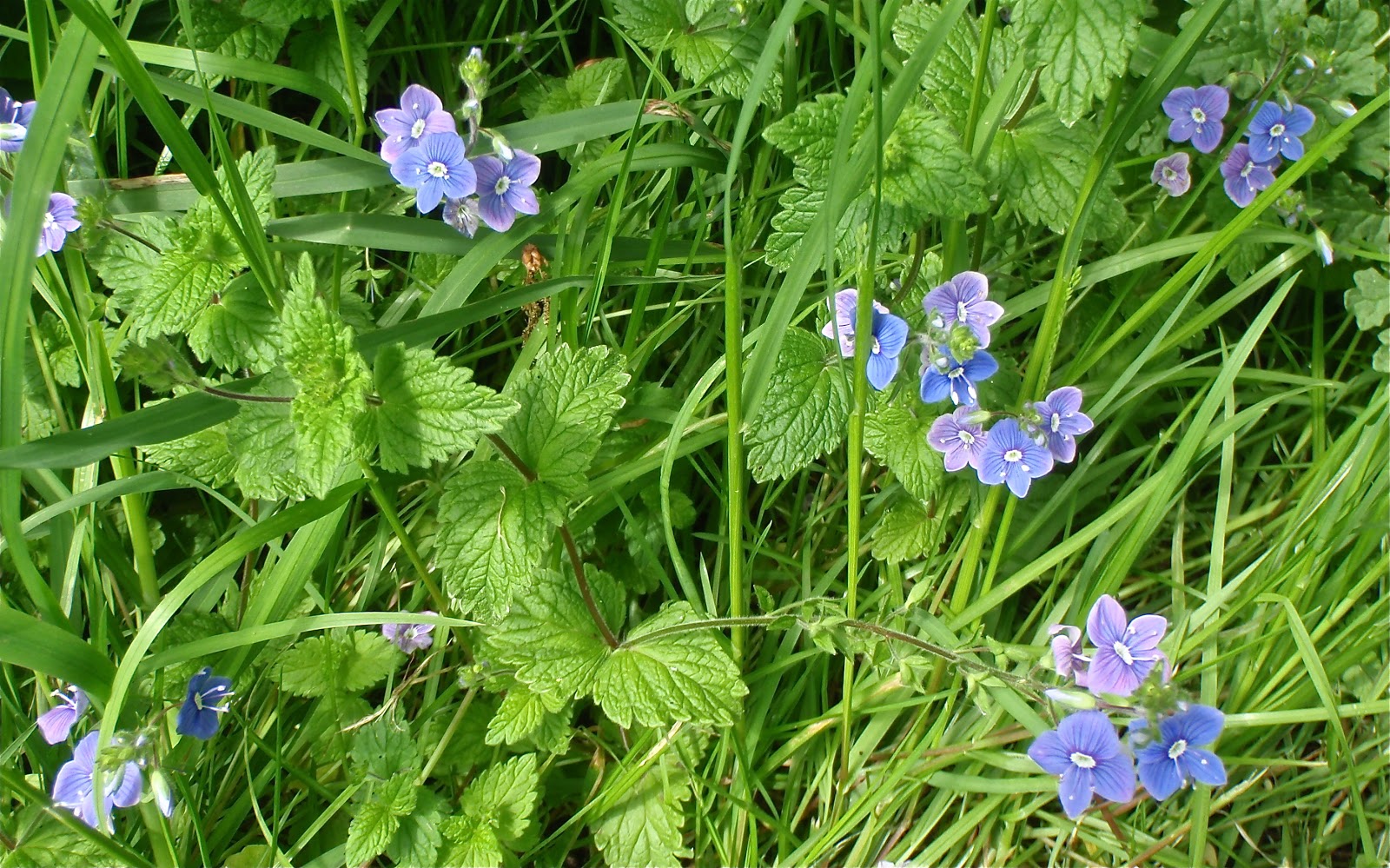
19th May    Germander Speedwell  (Veronica chamaedrys)
Hedgerows, shady banks


and two foodplants for the ORANGE TIP butterfly:

19th May   Garlic Mustard   (Alliaria petiolata)
Hedgerows, field margins and banks


and Cuckoo flower  (Cardamine pratensis)
Riverside banks,  meadows

12th May  Cow Parsley  (Anthriscus sylvestris)
Damp hedgerows, field margins, river banks

12th May  Wild Garlic  - Ramsons   (Allium ursinum)
under an oak on the river bank
Damp woodland, shady river banks


12th May  Oak leaves just unfolding, with catkins
Very old oaks on the river


6th May  White Dead-nettle  (Lamium album)
Hedgerows, grassy verges

6th May  Bluebells   (Scilla non-scripta)
Banks and woodland


1st May   a profusion of Blackthorn blossom on the river confluence
- and blue sky

Monday, 29 April 2013

Stealth Hunter over the River

Sunday 28th April was a fine spring day after a slight frost. Signs of spring after such a long wait and several false starts  are appearing in leaps and bounds. The most colourful heralds of spring are the butterflies and it was very fortunate that a Comma butterfly chose a warm sheltered area of the river bank amongst last years dried out nettle stalks to bask for a while.


Normally restless and wary the Comma butterfly needed time to warm up
in the sun on the river bank after a cold and frosty night.

Many birds were singing and setting up nests or had already built nests along the banks.
The popularity of the river environment naturally attracts predators too.
Looking down onto the water, one such skilled hunter suddenly appeared, flying very low over the water following the river course - a female Sparrowhawk, silent and generating no alarm calls from the numerous inhabitants of the banks - somewhere downstream it will make a dash for an unwary bird
of any size even a woodpigeon taking a bath could be the chosen prey. 
The fields, in the recent past lying for so long uncultivated and dead, any growth soaked and smothered in herbicides but with good mature hedgerows surviving, have this spring, as soon as they became less waterlogged, been ploughed, tilled and sown with wheat. Today sprouting shoots had turned these fields green again.  Some of the hedgerows have been partially trimmed in parts and others left to blossom.
Along the river a fine view of whitethroats, one amongst the old nettle stalks on the bank, bouncing up in its display flight, two more foraging amongst the Blackthorn blossom and others flitting and bouncing above the brambles and singing, joined by a fresh Peacock butterfly nectaring on the blossom and warming up in the sun.  Wrens were trying to out-sing the warblers but the warblers were winning with a fine singing sedge warbler  and a willow warbler in the chorus but the chiffchaffs were the most numerous and heard continuously. Two blackcaps chose more isolated location in which to sing their varied and beautiful songs.  A song thrush was also singing, together with nearby blackbirds. Others were quiet, carrying beaks full of nesting material - they outnumbered robins today but the latter were still singing strongly whilst dunnocks added their tuneful songs from high perches in the trees.
Greenfinches, great tits and blue tits were calling too and even a coal tit was heard amongst the pines that also held a foraging goldcrest. House sparrows were chattering as they do all year round but males adding a rather plain persistent breeding call now. Long-tailed tits were very quiet, busy nesting, careful not to attract attention whilst chaffinches did the opposite and goldfinches sang from under the cover of ivy where they roost and retreat if the weather is cold. A nuthatch was seen amongst the trees collecting food, silently.  From out of nowhere a large flock of herring gulls descended onto the field, a single lesser black-backed gull amongst them and on the perimeter a single magpie and a few woodpigeons and crows waited. A cock pheasant marched purposefully along the fence at the margin.
The river was flowing swiftly and clearer than it has been all winter and it was getting colder fast with an old willow creaking in the wind when two mallard flew over the river and a flash of bright yellow and dippy flight gave away a smart grey wagtail darting along the river.  
Looking up, hoping to see a buzzard I saw instead a kestrel making a sweeping glide over the river, its fine colouring showing brightly as it turned.


Monday, 22 April 2013

Bumblebees in the blossom

Yesterday, Sunday 21st April was a fine and still day, with Blackthorn blossom appearing almost overnight all along the river where the sun warms the earth.

A profusion of Blackthorn blossom with a very bare old oak in the background but a fine blue sky. Some Blackthorn, in more exposed and cooler areas has yet to flower, with only tiny buds visible on the branches

The Blackthorn blossom was buzzing with Bumblebees, White-tailed and Red-tailed mostly, foraging amongst the pollen-laden blossom as the usual wild flowers are only just appearing on the river bank, the warmest spot for the first flowers.

Bright and fresh Hawthorn leaves with another old bare oak as backdrop

A very welcome sight - a Small Tortoiseshell butterfly, looking very fresh, was basking on the debris of the past winter deposited by recurrent flood waters on the river banks  which have never looked as bare. There are signs of life however, with shoots appearing through the dead wood and mud.


A male Mallard paddles along the river, wary that the bare banks provide no hiding place yet.


A view over to High Wood Hill with the newly tilled fields across the river and bare trees

Birds were present in good numbers all along the river banks: 15 robins some singing and others nesting;  52 house sparrows in several colonies, chattering and calling,  25 wrens easy to see and hear, 48 blue tits,  23 great tits, all busy foraging,  7 long-tailed tits,  1 siskin,  4 goldcrests,  5 dunnock, 22 blackbirds foraging in the damp mud of the banks,  3 song thrushes,  2 nesting nuthatches, 
2 great spotted woodpeckers,  1 treecreeper,  3 green woodpeckers,  2 jays,  1 bullfinch
10 chaffinch, 4 goldfinch, 1 starling, 7 magpies, 38 woodpigeons, 1 carrion crow, 3 mallard,
 1 pheasant, 2 buzzards

 - and the new arrivals:
10 chiffchaffs,  2 willow warblers, 4 whitethroats

and butterflies newly emerged:
Brimstone, Small Tortoiseshell and Comma together with many Bumblebees and Hoverflies.


Sunday, 14 April 2013

Mid April - Another attempt at The First Day of Spring


14th April 2013 - Today Spring has arrived at last.

The first Chiffchaffs have arrived and are now singing - a very welcome sound on the riverside. Only short  'chiff  chiff  chiff  chiff chiff' calls at first but the bird I was watching, perched in this willow, warmed by the sun, soon broke into the traditional song 'chiff chaff'  'chiff chaff'  then took off  to feed in characteristic chiffchaff mode moving rapidly from branch to branch around the willow, pecking at the catkins in the company of several blue tits.


Blackcaps too have arrived and are now singing after settling into their favourite habitat of thickets along the river, appearing more numerous than last year but probably just all arriving together after being delayed by the continuous freezing north winds. 

 The day was mild, breezy with hazy sunshine which brought out some 'early spring' wild flowers:

Lesser celandine shining through the old oak leaves under trees
on the river bank


Wood Anemone at the base of an old oak over the river - surviving
the repeated floods in the shelter of the massive roots.


with the muddy river flowing swiftly past, very high
for this time of the year.

The day also brought the first sighting SINCE one single sighting on March 5th this year of Comma butterflies - just one pair basking and chasing on the river bank nearby. They are hibernating butterflies which usually choose holes and bark in old trees to hibernate in over the winter, so they will usually be seen first close to the place where they spent the winter when they first emerge, basking in a sunny spot to gain energy.