Monday, 30 April 2018

Rapid Changes along the River

Wednesday 25th April 2018 saw rapid changes in the weather with one minute cloudy and cool and the next minute brilliant sunshine. The landscape seemed to change every day with the advancing hours but wildlife adapts quickly to the varying conditions.


Apple Blossom made a very sudden appearance with bees emerging to forage
amongst the flowers at the same time.

The day was cool, with clouds racing across - one minute bright sunshine with a clear sky, the next minute under cloud, instantly cooler for a minute before the sun reappeared. Most trees and plants had suddenly come into leaf, Hawthorn with blossom buds, taking over from the Blackthorn blossom. The riverside was suddenly carpeted in Dandelions attracting insects, and the flowers of Garlic Mustard were mingling with Wild garlic and Cuckooflower on the banks. The delay in growth of leaves on the trees has encouraged wild flowers to flourish this year. The old oaks were just springing into leaf but not yet casting dense shade. The young oak planted to replace a very old oak which fell in a storm several years ago had been hanging on to last-years brown leaves over the winter, as young oaks do - then suddenly, over a windy night all the leaves were blown away leaving a bare tree but with small leaf buds. Poplars were the only other trees not yet in leaf, with Ash trees only just showing signs of large buds coming into leaf
It is definitely an 'Oak before Ash' year.
The river was running fairly low but fast and there was plenty of water in the ponds but no sign of damselflies, the water wasn't warm enough. None have been seen on the river here yet either - last year's early sightings were quite unusual.
Despite the day's erratic weather, birdsong was continuous all along the river, with migrant warblers doing very well. Chiffchaffs were first to arrive back from their winter habitat and are now singing loudly (12) voices carrying far. Blackcaps arrived after the Chiffchaffs, returning to the same areas along the river, as before - choosing Blackthorn and willows to perch and sing over the riverbanks. (10 seen) Whitethroats are definitely more vocal than last year, singing strongly  from prominent perches (7), in short trees and bushes in more open positions. A single willow warbler was heard.
Singing blackbirds dominated the soundscape today - large numbers were present, some singing and the rest foraging for food to take back to young nestlings. It is at present a good spring for them with no lack of food to be found under last year's fallen leaves, even during the days of ice and snow (41).
After some silent days, song thrushes were singing again, with six heard and seen. Robins were occupied with feeding young and guarding territories, as many were silent and keeping out of sight with only 11 seen along the river banks. Like the blackbirds, wrens (32) were signing strongly most from visible perches with others flying to and fro across the river from bank to bank collecting food for young. Out and about, easily spotted amongst the fresh green leaves of large trees were the wood pigeons (33) often very inactive, as they can nest at almost any time during the year. In the same trees, magpies with fledged young were noisy as usual but always present in small numbers - six were seen.
Starling numbers vary a lot, today twelve were active, mostly just flying over, with herring gulls seen now and again, five flew over together. Four carrion crows were present, keeping a watchful eye on activities below them, perched on the top of oaks or just flying over, calling occasionally. Did they spot the grey heron flying low over the river? It was heard calling further downstream. Both herring gulls and carrion crows have been seen 'mobbing' a grey heron carrying its catch, a fish or frog, in the past - the noise distracting most riverside birds and mammals. Just one jackdaw was seen overhead.
A common buzzard was flying into the wind which was increasing, bringing more cloud with a short light April shower. The best place to find shelter from these showers is under a leaning, ivy-clad tree trunk when trees are not yet in full leaf - and this is where birds will hide as well, or disappear into the nearest holly bush.
A bird zipped low through the trees - a sparrowhawk attempting an ambush in a hedge holding a colony of house sparrows which today were more active than usual, chasing each other and bathing in the river where they gather during the day, low amongst some dense hawthorn thickets and old bracken  in good numbers (67).
Blue tits (46) and great tits (17) were also very active with both species nesting, finding the habitat perfect for raising young with plentiful supplies of insects and especially nutritious - spiders. Some of the male great tits were also singing loudly. Just one long-tailed tit was seen flying, others are most likely still feeding young. Nesting dunnocks have chosen a site close to a great tit nest site but on the opposite bank- the contrast is interesting - the foraging dunnocks are easily overlooked, being very well camouflaged compared to the very bright great tits. Five dunnocks were seen but maybe there were more! A nuthatch pair command the old ash tree close by, always observant but now seldom calling, as they too are nesting. Of the finches, goldfinches were the most numerous (about 35) singing together in groups, most well hidden in dense thickets and trees. A   bullfinch pair were easily seen foraging, pecking at fresh new leaves, silent, as they probably have a nest nearby. At last - two greenfinches were heard singing, with a distant chaffinch heard too.
Three linnets flew across into the top of a Maple.
The day was notable for the numbers of Hoverflies over the river and large numbers of Orange-tip butterflies chasing over the river banks, some perching on their caterpillar food plants:
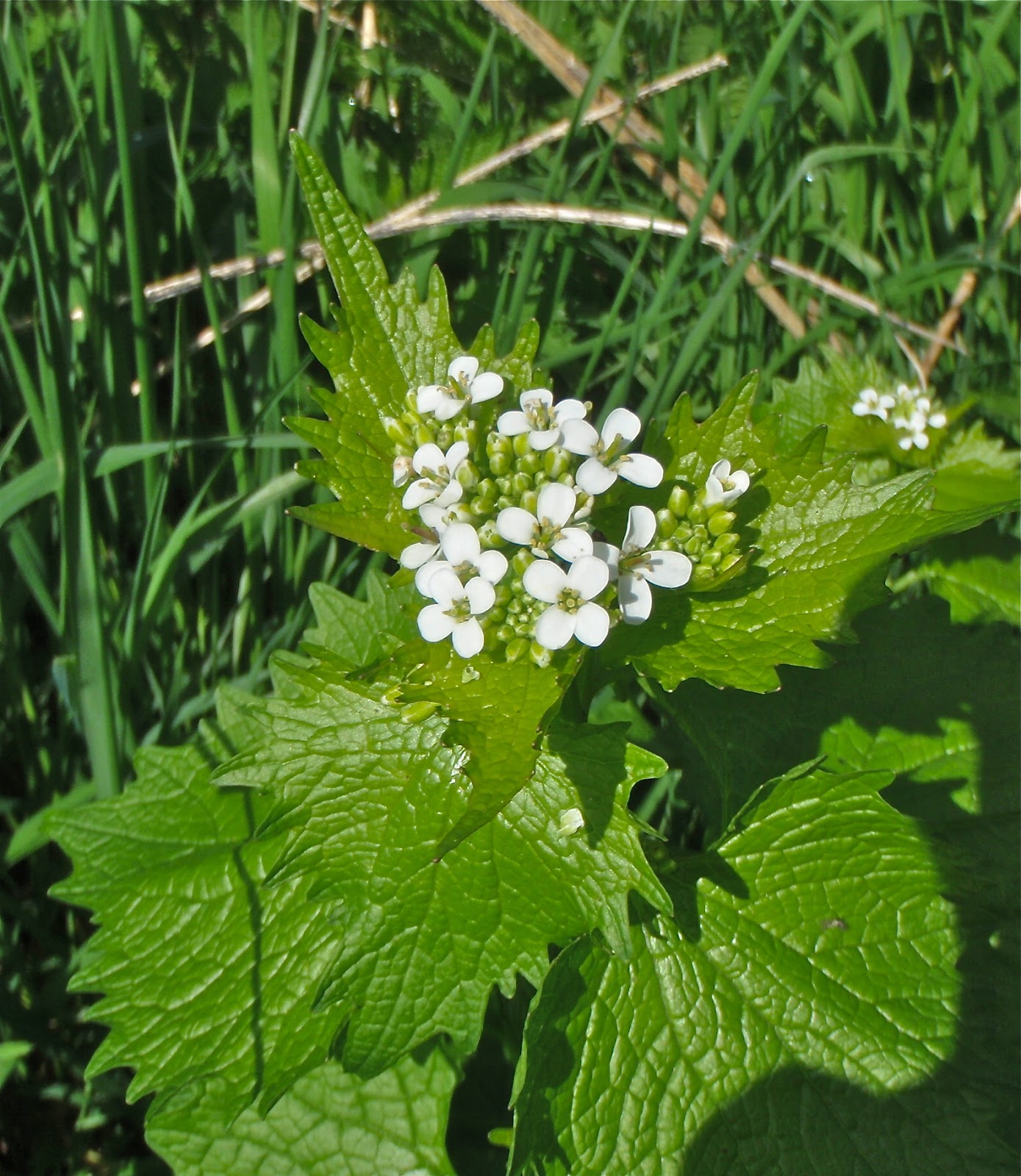

Garlic Mustard - food plant of the Orange-tip butterfly caterpillar


Garlic Mustard is this year present in large patches on the river bank
(not to be confused with Wild Garlic which is much stronger-scented):


Wild Garlic  - No - not a butterfly caterpillar food-plant.


Friday, 27 April 2018

Heatwave in April..

The next few days saw the Riverside gradually heat up, with unique weather conditions bringing a short-lived false start to summer.
The 15th April 2018, after a cool night, was overcast with dark clouds and threatening rain - however the riverside was again lively with a blackcap singing in Blackthorn but in a different location to the previous day whilst a buzzard circled over the river, gradually coming closer. A treecreeper flew across low to the base of a bare tree and worked its way upwards. Wrens, blue tits and great tits were calling and a fine male bullfinch flew across from a 'house sparrow hedge' where the colony was singing, into a hawthorn on the opposite bank. A great-spotted woodpecker called from a bare ash tree whilst below, a robin was collecting some fresh green leaves, carrying small bunches in its beak from the river bank up into an ivy-clad mound. A song thrush was seen bathing for some time in the river, perching on a floating twig island. It then flew off to a higher branch to preen and dry off.
More windy and damp days followed - but by the 18th it had become considerably warmer and at last butterflies emerged, firstly a fast-flying male Orange-tip showing up brightly over fresh green bank vegetation, then a brilliant male Brimstone butterfly.
Cuckooflowers were now appearing in clumps along the banks and in the wild field - an important food plant for the Orange-tip caterpillar :


Cuckooflower (or Lady's Smock) on the river bank April 2018. 
Orange-tip females will be ranging the river banks selecting these plants on which to lay their eggs.
The butterfly caterpillars will then feed on these during the summer. They will then leave to hide in dense vegetation to pupate and spend the coming 10 or 11 months in chrysalis form before emerging as adult butterflies in April the following year.
The following day, 19th, was very hot and sunny and many more of these butterflies were seen.   

Friday 20th April was another very fine day with the opportunity to do a survey of the South area during the morning as so much was happening. The full survey covering north and south will following the next post.

On 20th there were no clouds, a very slight breeze, the grass slightly damp with dew. The river level was lower but still fast-running. A large old oak was just coming into leaf, together with the Hazels and Willows. Wild Garlic was found growing in some new places together with Lesser Celandine almost certainly due to the upper storey remaining bare longer than usual allowing light on the under storey. Blackthorn was now covered in dense blossom and the grassed areas covered in brilliant Dandelions.
One can only hope that the profusion of wild flowers is allowed to flourish and provide pollinators with sustenance during the Spring.
House Sparrows singing  were encountered in their traditional colonies, in hedgerows, bramble patches and banks (about 60). Wood pigeons were not numerous, only 9 were seen, mostly in pairs. A pair of Carrion Crows were balancing in a tree top whilst a buzzard called from oaks on a wooded margin. Three jays were seen and heard chasing, with three magpies taking flight, the jay in this case being the more aggressive species. A nuthatch was heard calling loudly and continuously - the calls directed at unwelcome attention - it obviously has young to protect in the nest. Its mate was seen briefly amongst the branches (2).  Blackbirds were also vocal in protecting nests (14) or foraging in the damp grass and mud on the banks , with a single song thrush seen in deep shadows. Dunnocks are normally found lurking under vegetation in shade but today four were easily seen, two singing from prominent song posts.
Blue tits (34) were active with a few singing or calling and great tits (15) were easily seen when calling loudly but with some flying silently low over the river to nests in old tree roots. Robins were definitely nesting as fewer were seen than usual (10) but those seen were singing strongly. Goldfinches (about 17) were gathered in a loose group high in an old Maple, singing to themselves, occasionally flying out to forage.
A single male bullfinch gave a fine view, intent on feeding, gorging on the Blackthorn blossom near the top of a thicket, not easy to miss in the bright sunshine, balancing by flapping it's wings.


Blackthorn Blossom along the river April 2018

Warblers were doing well, with blackcaps (5) singing from the dense blossom of Blackthorn thickets and others from Willows just coming into leaf.  Song from Chiffchaffs (7) was the most penetrating - heard from just about every corner - not always the simple 'chiff-chaff' but sometimes  with 3 syllables such as 'chiff chiff chaff'. Just one willow warbler was seen, its song unmistakeable. Wrens won the day for singing however with 18 along the length of the river banks; there were certainly more present but nesting.
The most welcome were the common whitethroats which have arrived in good time, settling after their long journeys in their usual habitat, the bramble and low tangled scrub,  their songs also clear (4).
Butterflies - the first Commas were seen flying over young nettles on the banks and numerous Orange-tips were seen ranging along the banks, mostly males (orange wing-tips) looking for females. Peacock, Brimstone, Speckled Wood and Red Admiral butterflies were also seen. Large Bombus terrestris bumblebees were quite numerous as were smaller bees feeding on the numerous wild flowers and blossoming trees. Hoverflies were present in good numbers too.
A very active morning - and more for the end of April to come.


Monday, 16 April 2018

Spring for a Day

After a week of overcast days, often with long spells of fine rain, Saturday 14th April 2018 was much warmer, clear and bright after a misty start. Lesser Celandine and Wood Anemone were in full flower and seemed to be more vigorous, covering larger areas than in previous springs, perhaps because the plants have remained dormant for longer. Blackthorn blossom is prolific too this year.


Lesser Celandine 14th April 2018

Traditionally thought of as the herald of Spring as it is usually one of the first flowers to appear - towards the end of February in our warm southern land.

Some observations in a few minutes just walking along the banks:
A grey heron flying slowly over the river and above it, two circling buzzards.
Nuthatch calls carried far along the river, two birds communicating with each other, whilst song thrushes, at least three could be heard singing from different locations.
A male blackcap was singing a fine song very close by, at first completely obscured in a dense Blackthorn thicket. Moving gradually around, I had a very clear view of it near the top of a branch
surrounded by blossom where it continued to sing. Across the river, amongst the grassy clumps, a green woodpecker yaffled, and in the distance a great-spotted woodpecker could be heard signal-drumming.
Blackbirds were now singing full songs, with robins, dunnocks and wrens singing too, voices carrying far through the leaf-bare riverside. Soon their voices will be baffled by leaf growth. Great tits
and chiffchaffs called tirelessly and male house sparrows sang loudly, to be heard by birds perhaps in a neighbouring colony.   

Another flower usually seen in early spring is the Wood Anemone but although the flower buds appeared in March, this year it is flowering only now, as the sun appears through the bare branches of the old oaks:


Wood Anemone flowering under an old oak on the river bank 14th April 2018.
It is important to remember that this is a sure sign of ancient woodland and the plants confine themselves to the same areas, roots creeping extremely slowly year on year.


Saturday, 31 March 2018

The Last of March

It seemed like a good idea at the time to do a survey yesterday morning  30th March 2018 - there was even an early glimpse of sunlight - but this was probably an illusion as the riverside remained under a leaden sky all morning with light drizzle gradually turning to rain. The survey was cut short due to adverse weather conditions halfway through leaving the southern half to do on 31st March. This morning the conditions hadn't changed much - it was cold with no wind under an even darker leaden sky but at least the drizzle was absent.
Both days however were quiet with little background noise to dampen the splendid sound of birdsong.

Blackthorn blossom over the river.

Saturday 31st March - the second half of yesterday's survey:
The weather was slightly better than 30th in that there was no rain but it was still very cold and dark with the same river conditions. Starting out at the same location, but this time heading south, following the river which in places is wider, with sharp meanders. Following approximately the same order as Friday, house sparrows were the first to be heard singing, some in Blackthorn and Hawthorn thickets and others in their small colonies amongst the brown bracken and others in dense bramble patches on the banks (approx 30). Woodpigeons (34) were busy preparing for nesting, some calling whilst a few foraged on the playing field, now empty - the black-headed gulls having returned to the coast, in their summer plumage.Two dunnocks were singing, one from the top of a thicket. The area on the meandering river bank where an Ash tree had to be felled a year ago, has become a very popular place for great tits with a pair nesting early under the roots of the felled tree. They had shown interest in the location last year as soon as the work had been completed. Now one was seen collecting food. Several
more were seen here - and more further along (18). Blue tits were numerous here where they were seen flying from tree to tree, copse to copse prospecting for sheltered nest sites along the river (32). There were about the same numbers of wrens in this southern section (17) as in the northern half, most singing strongly from their territories - there is no lack of food here in the damp and muddy terrain. 
Robins too were found in similar numbers to the previous day on the northern half (15), scattered quite evenly along the banks. Chiffchaffs were moving rapidly from tree to tree, two were heard and seen today and two goldcrests, not easy to see in the prevailing gloom. A single chaffinch was calling but no greenfinches, goldfinches or coal tits were seen in this southern half today. 
A green woodpecker suddenly started to baffle close by on the green whilst two calling jackdaws flew across into the trees and three herring gulls crossed the sunless sky. Carrion crows (6) were seen in various trees on the lookout for prey  and two magpies were noisily ganging up on a blackbird which obviously had a nest somewhere under a bramble patch It easily saw them off and they flew up to hassle one of their own in an oak with another nearby. (4) A total of twenty blackbirds were active today, most foraging but some nesting amongst ivy and thickets.
Song thrushes were also busy, under roots in a copse, in a bramble thicket and on a willow (5).
A great spotted woodpecker female flew over  into an old riverside ash tree and a male followed it,
calling, whilst drumming was heard several times in the distance (3). A small group of birds flew from the open sky into some trees - calling. These were linnets (5) and low down on the river a moorhen called and nearby a grey heron flew low over the banks.
Further upstream a small bird flew low across the grass onto a tree and swiftly climbed up the trunk - a treecreeper.


Few signs of spring but much activity taking place in trees and bank vegetation


Friday 30th March 2018 - intermittent drizzle gradually changed to continuous rain halfway through the survey after about an hour when the survey had to finish early due to adverse weather. This was the first half, covering the northern area along the river. The first birds heard were house sparrows, calling loudly from bank vegetation and their usual colony hedgerows (about 42), with dunnocks singing above the sparrow chatter, choosing high, hedge-top perches (5). It seemed as if the bad weather had delayed the start of great tits singing but they were certainly singing loudly today, mainly from Hazels on the river bank (7). Without moving from the first location, at least 8 species could be heard singing - whilst I was listening, a grey heron suddenly flew up from the far bank drainage basin where it had been silently foraging for frogs here and around the ponds - easy food at this time of the year.
Blue tits were everywhere, foraging, calling and chasing in the oaks and willows - they are attracted to willow catkins especially (26). They should do well provided that the rain is not torrential.
Carrion crows were visible now, calling and chasing. They have been seen carrying nest material recently (3), whilst one of the smallest species, the wren, dominated the riverside with its very loud song, echoing along the river course under the banks and trees. 15 were counted, all guarding their territories and new nests under construction along the banks. Fortunately the river is high and fast running at present, which will prevent nest-building in dangerously low locations. Long-tailed tits also have a preference for low nest building on sheltered banks, but amongst undergrowth such as brambles
but usually they seem to allow for flood conditions and build slightly above the usual limits. Two pairs were seen today.
Very close outbursts of song from robins all along the river were heard - the numbers only slightly less than the numbers of wrens - but each robin is clearly settled in its own location now (12). 
The song of chiffchaffs (3) - spring migrant warblers could be heard for the first time this spring amongst the wrens and the robins - it's good to see them clearly whilst the trees are not yet in leaf and below them a single goldcrest foraged in an oak for a while before moving on. A loud song from the top of a Hawthorn gave away a smart coal tit whilst two others, probably a pair were on a willow nearby. (3) It's good to see them as they have been quite scarce here in previous years. Goldfinches were seen here and there, some singing but not in large numbers now (12) and only one chaffinch was heard calling. (It is worth noting here that greenfinches have been heard singing very recently, on several days here by the river - but not today. This marks an important return to this location.)
Looking up- a sparrowhawk was visible against the dark sky, gliding directly above me, surveying.


Wild flowers of spring - Wood Anemone flowers remain closed
on the river bank, awaiting the sun.

Mallard ducks were very active today despite the river conditions, with two males fighting under the bridge and three other chasing, paddling strongly upstream.(5)
Blackbirds were quite numerous (11) and most were seen foraging rather than singing, amongst ivy, on the wet grass and mud and on the river banks, whilst a single song thrush watched from a tree.
Loud cries from a nearby buzzard were heard - it was in an old oak. Overhead 5 Herring gulls and a single black-headed gull were seen.

Large bumblebees (Bombus terrestris) were seen on both days along the river, both north and south.


More Icy Blasts from the East

A summary of a fickle March:
The Beast from the East continued its attack into March - nevertheless by 3rd March many birds could be heard singing along the riverside with robins and song thrushes dominating and others showing clear signs of nesting, with calling nuthatches and chasing mallard ducks, chasing blue tits and great tits and calling chaffinches. By 13th March Lesser Celandine flowers were appearing - a sure sign of good weather, at least for a while:


Lesser Celandine pushing through layers of dry leaves into the sun.
On 14th the day was fine, with a common buzzard circling slowly over low trees along the river course. Nuthatches were calling again and several loud great tits, many house sparrows and robins. Wrens  were  vocal too along the river banks with the river still flowing muddy and fast. A grey heron flew over riverside trees in search of awakening amphibians. The following day, 15th blackbirds were singing strongly for the first time, after 25mm rain overnight.
On 17th the Beast from the East returned after a few balmy days, with snow.
By the end of the month it was losing its hold but the cold bite continued, with small birds and mammals retreating into the natural shelter of the banks:


A completely natural shelter on the riverside where broken tree trunks, roots, last-years dry nettle stems and bramble shoots arch over each other and tangle together - a choice place for wrens, dunnocks, robins and hibernating small mammals, insects and amphibians, well above the river flood level.


Sunday, 4 March 2018

Wildlife prepares for the 'Beast from the East'

Since January a warming of the Arctic Stratosphere has taken place, and the resulting so-called Beast from the East was about to be untethered and set to head west towards the British Isles.
Friday 16th February 2018 was a fine sunny day after a typically (for this winter) frosty start.
All along the river, birds were active, preparing for spring but also preparing for severe weather, instinctively aware, unlike most humans, of the need to continue foraging for, collecting and caching food. The signs were there - early morning frosts on clear sunny days, alternating with cold windy weather with sleet, or mild but wild days. On the 13th and 14th the weather suddenly turned mild, very wet and windy, then in another sudden change turned cold and frosty again.


Willow catkins burst out from the top branches of the Salix,
shining silver in the sun agains a clear blue sky.
16th February 2018

More than 50 birds were counted at the start of the survey, just whilst standing still on the riverside, looking around.
The ground was muddy from recent rain but frozen hard in places. The total count for blackbirds along the riverside was 36, with most foraging where the ground was muddy, on the river banks or under hedgerows. They were accompanied by song thrushes (8). Low down on a sheltered sunny bank, a preening bird had been bathing and remained there, perfectly camouflaged in the dry fallen leaves - a song thrush. Dunnocks (5) were singing today, emerging at times for under the bushes, into the bright sunlight - and wrens - quite scarce on the previous survey - had emerged too into the sun to sing (24) but also to forage in amongst the dry twigs and tall grasses or amongst dense ivy. They need to maintain their body weight to survive the cold nights and coming days.They will have special roosting places where they can perch tightly packed together for warmth.
House sparrows were singing loudly too,(about 80) some were bathing and drying off in the sun but most were foraging in hedges, dry banks, bramble and bracken patches. They will also spend the nights and cold windy days in dense undergrowth, crowded together often singing in chorus throughout the foulest weather.  Robins (34) were singing strongly too, in their individual territories, being constantly on the alert for invaders of the same species. Hollies are prized as territories not just because of berries which have probably already been consumed but because of the prime shelter they provide - dense, evergreen and prickly, with the undersides of the strong leaves harbouring many tiny insects and spiders. Another important feature of evergreens such as Holly and Ivy is that the ground around their root systems will remain unfrozen for much longer than surrounding ground under deciduous plants. Most birds will find food under the evergreens, together with other wild life.


The morning sun on the frozen pond alongside the river. It will spring back to life as soon as a thaw set in, with frogs and tadpoles, then much later with dragonflies.

A green woodpecker flew across, shining in the sun. It will be looking for unfrozen earth which holds insect life, still easy for now, until it snows. Nearby a nuthatch could be head calling loudly, with another answering in the distance. Further along the river, two more (total 4) were seen and heard protesting on the appearance of a magpie. The nuthatches are usually surrounded by foraging blue tits (about 45 today) and great tits (28) which fly through their territories in roaming flocks, gleaning what they can, prising lichen away from branches to eat the insects found underneath, much as the nuthatches do when food is scarce.Two coal tits were seen, which move fast in stashing away surplus food, unobserved.
Goldfinches are very much at home here and don't seem to need to forage continuously - like the house sparrows they can find shelter, and today a group were singing together in a dense blackthorn thicket whilst another group flew across to the dry grasses to feed on seed heads (20). A small bird which never seems to stop feeding but sings as it moves around, is the goldcrest - today three were seen crossing from a bare tree over the river to a conifer where they remained, fast-foraging. The densely bunched conifer needles will provide good shelter from the cold wind and driving snow  when it arrives. Three bullfinches were seen, one on a bare hawthorn in the sun and another (f) on a Guelder Rose trying out the juicy red berries, left until last. Another male was calling from behind a thicket.
Another fruit-lover, a blackcap, an over-wintering female (warbler) which has been seen quite often this winter, was warming up in the sun,
The starlings (58) were, like the house sparrows, singing or whistling in the sun and foraging in good numbers today, keeping together as a small flock, whilst wood pigeons (60) were scattered all along, in trees and on the unfrozen grass with some bathing in the river. A loud flapping and splashing sound came from a part of the river with steep banks, on a sharp bend - this was a mallard pair which frequent the area. Just one pair of collared doves were seen amongst Ivy again, where birds are still feeding on a never-ending supply of Ivy berries. Black-headed gulls (27) were arriving in twos and threes, landing on the playing-field grass to forage. 
Three rooks flew across above the trees with a single vocal jackdaw and two herring gulls. Carrion crows were the most numerous corvids (11), very active today, calling and scavenging. In the distance, a common buzzard flew down, disappearing amongst the oaks.
Lastly the master of all it surveys - the sparrowhawk, flying quite high over the river, looking directly down at me, circling slowly, the sun lighting up its translucent wing-feathers. 


Tuesday, 13 February 2018

Late January Gales

Monday 29th January 2018 was not the best day to choose for a survey, but a typical January day, cloudy to start with but dry. Rainfall over many months has been less than usual, despite the impression 
given by frequent showers keeping the earth's surface damp. January has continued the trend, with no decent amounts to top up reservoirs and aquifers. The previous day had been very mild but now a strong wind was bringing cold weather. The wind howling through the bare branches had scattered many small branches and twigs over the muddy ground, giving an air of desolation, but with rose hips and hazel catkins brightening the landscape. There has been a profusion of Hazel catkins this winter, on very young and old trees alike -it's easy now to count these trees which offer so much to wildlife.


Hazel tree flowers are often overlooked as are only one or two mms
across, forming at or near the joint where catkins hang from the twig.
The pollen from the 'lamb's tails' catkins is shaken off by the wind and pollenates the tiny flowers where later Hazel nuts will form. The other buds on the twigs and branches are leaf buds.

The river was lower that it was after a day or two with no rain and there were still plenty of acorns lying just user the layers of leaves beneath the old oaks, with here and there bright green shoots of Wild Garlic emerging amongst the tree roots. The lack of substantial rain has meant that the river levels have remained within the banks so far this winter although cold weather has subdued early growth along the banks.
Despite the wind, house sparrows  were singing in tightly packed colonies in their hedges, bracken and bramble mounds, staying put today in dense shelter (about 80) along the river. Blackbirds were numerous too (34) some of them winter migrants, the attraction now being bountiful supplies of ripening Ivy berries which form on old Ivy branches - timed to appear and ripen just as the rest of the fruits and berries on the riverside become scarce - looking up into the Blackthorn, Hawthorn, Elder and Hollies there's hardly anything left now for hungry birds although some Guelder Rose berries and hard- to-reach Dog Rose hips are still available.


Ripe Ivy berries, a great source of winter food for larger birds,such as thrushes, collared doves and  wood pigeons, although some may have difficulty in reaching the tempting food amongst thin branches.

 Only one Redwing and one Fieldfare were seen today although more Redwing could be heard in a thicket. They can make very fast progress through the hedgerows stripping them of berries when they first arrive but most then head west to milder counties before returning to their breeding habitat across the sea in the early spring.
The Song thrushes (6) were singing quietly, just short songs, foraging still taking up most of their time and energy. At least the ground has mostly remained damp and muddy, as a prolonged hard frost could affect their food supply.
It was very obvious how the cold wind affects most birds, with Herring Gulls enjoying the wind (45) making slow graceful flight patterns over the fields and a beautiful buzzard low-flying confidently against the wind and a second one sloping down to land in a tree. Another bird happy in the wind was a sparrowhawk seen fast flying across a gap in a thicket filled with sheltering small birds. In the wind it could go unnoticed. Black-headed gulls (about 60) were grounded, all foraging on their traditional winter field. They fly up when disturbed but land again as soon as possible. Eight carrion crows were seen in various places along the river, a pair were sitting in an oak facing into the wind whilst others called nearby, also choosing sheltered places. A pair of jackdaws flew across calling.
Woodpigeons (32) always seek out comfortable perches when not foraging and today most had chosen  
sheltered oaks with views over the grasses and banks, tolerating noisy magpies in the same trees (6)
Blue tits (54) and great tits (30) were seen mostly in the lower thickets, brambles and hedges but where it was sheltered some were seen chasing and singing. Part of a thicket formed of Buckthorn seemed to be an attraction with blue tits foraging on the thin vertical branches amongst new leaf buds. 
Two coal tits were seen then thin calls nearby came from a chiffchaff moving in the thicket. Further along where the wind was roaring through the tress there were few birds, but a single long-tailed tit was glimpsed making its way to shelter.  Only four chaffinches were seen and heard low down out of the wind, whilst starlings were also scarce (5) most probably hiding low as well.
Nuthatches choose to nest in traditional sites, holes in old tree trucks - but if they have to choose  new site, they choose a location facing away from the prevailing weather. One nuthatch was seen today, calling from it's old location but busy creating a new nest hole.
Robins were numerous today - most, having taken up territories, were now singing short songs (26 total along the river) again all found in sheltered places.
Of the small birds, wrens were scarce again today (5) and were not singing yet but in hiding, whilst dunnocks (5) were keeping low under hedges and tree roots - but one was singing from a higher perch.
In a flock flying under the buzzard, in an area with plenty of Dock still carrying seed, were a flock of goldfinches, with other small groups low down amongst long grasses and perched in dense thickets, singing (about 45 in total). With the smallest birds last,  goldcrests (5) were seen foraging in several places with deciduous trees and hollies which provide good shelter when needed. A treecreeper was seen foraging on an oak branch very close to the goldcrests.