Thursday, 24 June 2021

A Wild Start to May 2021

 This May  was more like March, with rain, hail and wind but blossom appeared as soon as there were warm and sunny intervals. Some flowers however did not survive the elements after two or three attempts at flowering. There was very little shelter from other trees.most of which had yet to come into leaf. 

What a change from last year.... 


Fruit tree on the river bank fully in blossom
attracting bees. 11th May 2021

Tuesday 11th May started fine  and warm but breezy from the south with some varieties of fruit trees suddenly in blossom. A buzzard was circling overhead with blackbirds, whitethroats, blackcaps chiffchaffs, willow warbler, goldfinches, robins, wrens, dunnock, song thrushes and a mistle thrush all singing and most quite easy to see through the bare branches of Oaks, Maples, Ash and Willows low and high.


The bank with a leaning fruit tree in blossom and daisies in the background
and Hawthorn in a sunlit location - one of the first trees to come into leaf and 
then come into blossom:


Close up  - May flowers awaiting insects on 11th.

The following days became dark again with drizzle and rain but with the welcome sight of swifts flying under the clouds, catching insects.

Even the early butterflies disappeared for a while:


This Peacock butterfly was the first seen -here  on 4th April 2021
warming up in the sun on a warm bed of straw - last year's  dry long grasses.

See the next post for the May Survey on 27th May 2021...


Saturday, 22 May 2021

What! April without chiffchaffs?

No! there were 23 chiffchaffs at least along the riverside on the day of the survey - 27th April 2021 

Their characteristic song forming a background to other migrant warbler song which filled the river banks.

When they first arrive  -  and they really are the first to arrive in the spring, their song is a very welcome sound, If chiffchaffs are heard singing - it's a sign that  blackcaps, whitethroats and more will be following in a few days. They are not just passing through, as winter migrants do, but will usually settle here for the summer and raise at least one brood of young. When a pair of chiffchaffs nest they will make 'hweeet ' contact calls to each other so their usual 'chiff-chaff. chiff-chaff' song will not be heard for a while.


Arctic April - an unusual Sussex Spring

 April 2021 will be remembered for the relentless block of high pressure over the land, fighting off the weak areas of low pressure bringing warmth and rain. It remained cold with prevailing dry north easterly winds. The surface of the earth was too hard for the usual green shoots to grow and buds on the fruit trees   were mostly small and brown, whilst leaf buds on deciduous trees were hardly visible.

The survey for April took place on 27th April with no signs of rain - a bright clear cool start, no wind and hazy high cloud. The lack of wind was welcome allowing some warmth from the sun to touch the surface. The river was still low but flowing well providing a damp habitat along its course and banks, attracting birds, small mammals and insects. Open Willow catkins attracted many Bumblebees and small birds too.

Cuckooflower was growing extensively along the banks together now with Garlic Mustard and more Lesser Celandine . Wild Garlic was flowering everywhere between the trees . It has been a record month for wild flowers growing under trees both in the amount of growth and the long length of time they are lasting. This is most likely due to the delay in trees and shrubs coming into leaf, allowing sunlit glades to last far longer than usual before they become too shady for the flowers to last.


Wild Garlic or Ramsons (Allium ursinum) in flower under bare trees near the river where the ground remained damp.
Later their somewhat overpowering scent would give way to an amazing mixture of scents from various blossoming plants along the river.

Listening to and identifying birds was possible today without any wind roaring through the trees.
Blackbirds (36) were the first to be heard, with most in trees and shrubs whilst many more were foraging on the ground and carrying food to young in the nest. Many House Sparrows were nesting in various sites and taking time out to bathe down low on islands of twigs in the river or take dust baths on the pathways. There were more than ninety (counting the colonies in hedgerows and flying across the river).
Woodpigeons were as numerous as Blackbirds (36), some carrying twigs for nest-building, others bathing in the river which has become a magnet for all wildlife. Eleven carrion crows, one jay and five magpies were visible in the Oaks (not yet in leaf) whilst starlings (25) were for the first time this year circling overhead, catching insects which had formed clouds over the river area between the trees. These would be fed to their young. Herring gulls (8) were in place over the school whilst 5 jackdaws were seen in trees near the copse where a single stock dove was cooing.
Brambles were now throwing out new shoots and a Field Mouse was seen looking out of a dense patch of old brambles.


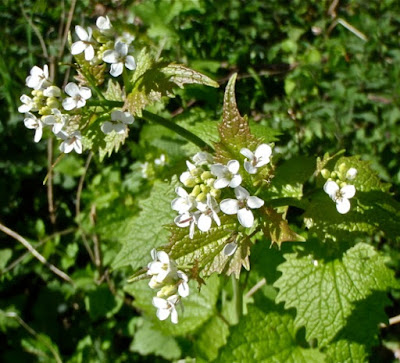
Garlic Mustard (Allaria petiolara)  flowering, quite different from Wild Garlic, with the scent of garlic only when the leaves are crushed.
This is a food plant for the Orange-tip butterfly, as is the Cuckooflower.

Loud calls came from an old Oak, still leafless. This was a nuthatch, very visible as were three others in  different oaks, their individual territories settled for the spring (4). There were no signs of chaffinch but today a single greenfinch was seen and heard having been seen the previous days well. These are still uncommon, having suffered a population crash some year ago when they were common garden birds.
Fortunately goldfinch  numbers are increasing although today only a small colony was present (10).
They are not finding much cover for nesting in the leafless trees.
About the same numbers of robins (25 and wrens (28) were seen today but with several fledged young robins now exploring not far from attentive adults. Many wrens were singing loudly,  still guarding their territories on the banks. Four Dunnock were seen, also low on the banks.
Song thrushes (9) were present, some  still singing loudly with others seen low down in the as yet sparse undergrowth, foraging for young in the nest. It was interesting to hear 2 mistle thrushes singing, their song carrying far along the riverside.
A single goldcrest was seen flying across to a conifer, and a lone male mallard was seen paddling its way upstream on the Arun.

Blue ts (21) and Great ts (12), some singing, were ranging along the trees and especially the riverside Willows with some swinging on the ends of Hazel branches.

Most of the summer migrants are now here, also ranging along the Willows, with 8 blackcaps, 3 whitethroats, 2 willow warblers and a single garden warbler seen, singing.

The sun had brought out the butterflies, with 6 Peacock butterflies over the dandelions, a Holly Blue around the Lesser Celandines, three Speckled Wood butterflies in a copse and last but not least, at least 26 Orange-tip butterflies-  bright males and more subtle females ranging singly along the bramble banks,  clumps of Cuckoo flower and Garlic Mustard.


Monday, 5 April 2021

Chiffchaffs Lead the Way - the survey for March 2021

 The March Survey was done on 23rd  March 2021 - a cloudy dry day with no wind, with the prospect of a warmer, brighter day to come.

The ground was becoming drier with many signs in the mud made by birds such as blackbirds and song thrushes foraging in the mud on previous days.The river was flowing well, the water no longer muddy and furious but now the colour of the millpond water upstream, a fresher grey/blue/green, translucent. It was clear enough for sharp-eyed birds to spot small fish and amphibians.

Signs of regrowth were everywhere amongst roots and piles of last-years fallen leaves washed to the banks during 'water out of bank' events.  Old bramble fronds support the new growth whilst providing continuous shelter for small mammals and birds during what is sometimes the hardest month for wildlife - March. The fruit trees all have buds, remaining closed whilst Blackthorn blossom staged a graduated appearance, the shaded areas still in bud. On the grassed areas, daisies Dandelions and Ground ivy had started to flower but brilliant Lesser Celandine flowers were spreading rapidly across the verges now.


Given the chance, Lesser Celandine ( Ranunculus ficaria) a type of buttercup, will be the first wild flower to brighten banks and verges in spring as it tolerates partial shade in addition to thriving in bright sunshine.

Chiffchaffs - the first of our migrant warblers:
The first bird of the day was also the first of our spring migrants - quite an amazing 'fall' of many birds arriving together and filling the riverside with their song, an unmistakable 'chaff - chaff' or interesting variations thereof. Fifteen were present  where the previous day there had been none. They were easy to see as they  worked their way through the bare trees feeding on insects, occasionally stopping to contact each other. Their song was definitely the dominant song of the day.
One other song was significant - the song of a blackcap in the willows, just one which may have been one of our winter migrant blackcaps which has decided to stay here rather than fly off to the continent to breed.

As well as sightings of new spring birds, another first sighting of a spring flower was also seen today:


Wood Anemone ( Anemone nemarosa)
A well-known sign of mature or ancient woodland, this was probably seen in swathes on the woodland floor when West Sussex was forest. It still exists in clumps but is very slow-growing and needs undisturbed ground  to flourish.


Blackbirds were seen in many different places today, 34 in total which included two males fighting loudly in a ditch. Often the only calls made at present are alarm calls with birds already nesting, although a few were still singing. Five song thrushes were present, taking advantage of shady areas where the mud is still soft. They run into cover rather than fly low like the blackbird when alerted. A single redwing flew across to some old ivy on a tree where it stayed to eat ripe ivy berries. It will be leaving very soon for it's summer breeding grounds probably in  the north east of Europe.
There are so many robins here that although most are now nesting under cover, some are still preparing. 24 were seen today, many of them singing, ever watchful. Dunnock (6) were still more easily seen than during the summer and appear to be doing well under the base layers of hedges
Almost the same number of wrens were seen today (22) but we have to remember that wrens make themselves almost invisible when nesting along the banks and are less easily seen throughout the year.
Four goldcrests were seen, a good view of one perched on a mossy branch, picking at the moss and filling its beak - an obvious sign of nesting activity whilst another two were seen chasing in a conifer.
No chaffinches or greenfinches were seen or heard today in this area but there are a few in other places not far away.  There were 23 goldfinches, most active flying across the river whilst others were singing almost out of sight in thickets. They nest in secret and don't advertise their presence at this time of the year.
A single bullfinch was calling but unseen amongst the willow catkins.
Large numbers of house sparrows (over 90) were seen and heard in most places where there are hedgerows and thickets - safety in numbers - they outsmart the local sparrowhawks which are far more successful in catching wood pigeons. The resultant piles pigeon feathers provide good nesting material for the house sparrows. 23 wood pigeons were seen today along the river.
The crow family is not large here and numbers are few.  Seven magpies, twelve carrion-crows and four jackdaws were seen. 
In the tree canopies, still mostly bare,  about forty blue ts were very active with seventeen great ts mostly lower down and amongst tree roots and a pair of long-tailed ts were busy nesting under a bramble bank.
Woodpeckers are doing well in the old trees, usually oaks, with one great-spotted woodpecker flying across and calling to its mate, with  another heard drumming and a green woodpecker heard yaffling on a grassy slope under some old oaks. Starlings (54) were more numerous than usual today, mostly around their ivy roost or seen foraging in pairs. Nuthatches (6) change their calls in spring but they mostly keep to their traditional nest sites, adapting where there are changes. It is reassuring that they are present in good numbers here, sending out youngsters into the wider landscape to establish new territories each year.
Finally :
The bird flew up into a tree from the river onto a branch overlooking the water where it perched for some time intent on surveying the river. I had a good view this time as had seen it on several days recently but only glimpsed distanced views. It was a Little Egret . It is usual for a few of these birds to move inland along the Arun each winter at the first frosts, preferring to choose areas with trees over the warm river  which doesn't freeze over rather than stay on the freezing windswept coast.They then return to the coast to 
nest after the winter. Perhaps the March weather had proved too cold to encourage the little egrets to return to their summer habitat.


Tuesday, 23 March 2021

A Cold Winter - but signs of Spring

The survey for Sunday February 21st 2021

 In recent years we have become accustomed to signs of spring early in the new year but February this year 2021 has been cold - as it used to be in the previous century....but at least this weekend showed that spring weather was a possibility after all. 

There had been a shower overnight but it was becoming brighter and the wind had dropped. High cloud allowed the light through, at least for a few hours.The river was running lower and muddy with paths churned up by the leaden feet of weary joggers seeing only numbers of miles and minutes - well kms sounds more impressive. The green leaves of Wild Garlic were shooting up above last years dry grasses and flower stalks. Insects were now gathering around the soft crab apples and Hazel catkins marked out the presence of Hazel trees along the riverbanks - their stages dependent on the site location - shade or sun, north or south. Bird song provided a continuous background chorus. 


Dog rose hips continued to provide colour along the fencing, failing to tempt most birds, although eventually they will be eaten if food is scarce in early spring.

Larger birds with powerful beaks are always good survivors , such as the characterful Carrion Crows which are always seen in small numbers along the river. Today there were 11 seen and heard in various locations. Woodpigeons too are always present  with 30 seen either singly or in small groups, spread out. Seven magpies, three rooks, two jackdaws, six herring gulls and one black-headed gull were also seen. Starlings have their own rules and are rarely seen here in large flocks although large number can hide away in dense Ivy roosts where one can only guess their numbers by their calls. Today there were about twenty seen, mostly around a green with a dense bramble margin. Two jays, probably a pair were seen flying into a small copse where they remained out of sight.

House sparrows were numerous as usual and very audible, in several colonies about 85 in all whilst more than ten goldfinches had gathered in a tangled thicket of dense bare twigs and branches, flying off and returning now and again. Others were seen flying across the river in small groups.A chaffinch was heard calling but no greenfinches were detected and only one calling bullfinch was heard in bare willows.


Frog spawn in one of the ponds. The erratic  and often very cold weather has not been ideal this spring, but this patch survived, with lively adult frogs very visible. Grey herons have been patrolling the river and ponds recently, searching out food to take to their young some distance upstream.

A smart single male pied wagtail was busy on the shorter grass at the river bank, perhaps one of a pair that has been seen recently on another meander of the river. Blackbirds (35) were seen just about everywhere, with song thrushes (16) usually in the same damp areas when foraging, They do seem to be more numerous now than a few years ago - perhaps more winter migrants make the journey and perhaps more migrants decide to stay all year.  A single migrant - a redwing was seen amongst ivy and berries - this bird definitely returns to breed mostly in  north and east Europe  - they are only here for the winter berries! Dunnock were visible today (6) two chasing in the undergrowth  with others on the margin of the pond where a common toad was heard.

Wrens were singing loudly  in many mossy places, warming up after the freezing days (21) . There is no sign that the number of small birds has been reduced by the winter weather in this particular location. Its diversity means that there is always shelter, unfrozen flowing water and undergrowth cover for all.  Robins have certainly prospered with 28 mostly singing and preparing to nest. Blue ts (over 50) too seemed to be preparing to nest as were long-tailed ts (3), whilst great ts were very vocal (32) and active, searching for spiders and prospecting for possible nest sites. One of the smallest birds, the goldcrest is usually resident  - three were visible and very active in the conifers.

It gradually became warmer and brighter for a while and Buff-tailed Bumblebees appeared, ranging slowly over the banks.

Two nuthatch were seen in the old oaks - one quietly tapping, probably refurbishing a nest,  then calling with the other calling from a more distant tree. In a different location a great-spotted woodpecker called and flew across to an Ash whilst some distance above a common buzzard was gliding, followed by two carrion-crows. Another gliding buzzard looked down at me.(2).

Finally there was a very good view of a mistle thrush singing loudly from the top of a tree.


Wednesday, 17 March 2021

Mid January - A Short look

 Before proceeding to February 2021- just a few observations on 21st January- a fine evening for birds.

The 'evening' started at 14,15 (remember those short winter days when the sun was fast setting below the tree line before 3pm). A mistle thrush was was singing loudly from a tree top although each song was short. The tall conifer provided a fine song post with a good outlook. Small movements amongst the branches revealed several goldcrests foraging and a family of magpies flew away across to nearby woods to roost.

Further along the river a great-spotted woodpecker called from an old oak and two song thrushes sang in a copse overlooking one of the meanders. Two local carrion crows, a known pair, flew down to the field where two herring gulls were patrolling on the grass. They were disturbed by a single black-headed gull which flew over them, getting lower with each aggressive swoop, attempting to persuade them to leave this traditional meeting place for a flock of Black-headed gulls. (It succeeded eventually,  as several days later the winter flock moved in as usual, ignoring the crow pair). 

Two more song thrushes were seen, foraging on the grass further north and a redwing flew across, its red underwing flashing in the evening light. Several blackbirds, probably a mix of winter visitors and resident birds were gathered around a crab apple tree where the fruits were now ripening at last. Robins,were singing on each corner and great ts, blue ts, a coal t, several Dunnock and a colony of house sparrows  were all active.


Hazel catkins in profusion indicate  a good crop of nuts for birds and small mammals which will harvest them well before they ripen in early summer.


A 'charm' of goldfinches were active under shrubs and dried Dock grasses, their constant soft song giving their presence away. A small flock of starlings flew around their ivy roost - after all it was getting dark - then another mistle thrush started to sing whilst the first one was still audible in the distance.


Sunday, 21 February 2021

A Traditional Winter - the Survey for 31st January 2021

 A traditional winter's day here? Not quite, but almost cold enough, the survey for Sunday 31st January 2021 was made on an unexceptional day. Just above freezing all day, reasonably bright with light cloud cover and a light Easterly breeze. The ground was very muddy,  the river itself muddy and fast-running about a meter below the tops of banks. It was very easy now to pick out the Hazel trees amongst all the other species lining the riverside by the catkins. Crab apples were now ripe and attracting many blackbirds. Dried up blackberries offered seed heads to the smaller birds where brambles produced only small dry fruits during the hot summer. Bright Rose hips remained mostly untouched.There was very little new growth visible, just small patches of cow parsley and the green shoots of Wild Garlic in places. A Mistle thrush dominated the bird song high in the tree canopy whilst great.ts were singing their varied songs too.

Young song thrushes were concentrating on foraging in the muddy grass and undergrowth, silent, in groups, perhaps last year's young keeping together whilst adults concentrated on their spring songs.


A blue sky for a few minutes.

Robins were the first birds heard on the riverside (21) and the first birds seen at dawn and the last seen at dusk.Wood piigeons were easily seen too but far less active on the branches (44).  Resident and migrant blackbirds were seen in large numbers (34) compared with summer birds, feasting on remaining sloes and crab apples to which crowds were attracted. The most numerous birds as usual were the house sparrows,(more than 100) some taking seeds from the dry brambles and others waiting for the sun to appear on the hedges, jostling for the best positions. 
Singing wrens (14) were seen in various places low down along the banks - like robins they are fierce individuals and do not seek safety in colonies. Large numbers of Blue ts  (80) and Great ts  (34) were active everywhere, the Blue ts having found that willow catkins were appearing on the bare branches.
Nine Dunnock were seen in scrub and on paths, sometimes together with house sparrows, but most were singing today.  Goldfinches (50 approx.) were more visible;e today, foraging in thickets and undergrowth where they could be heard singing together, remaining partially under cover. A single greenfinch was heard - these usually move around foraging in groups but there are never enough to form groups now. A female bullfinch was seen and a male heard nearby - they remain elusive even during winter. A single goldcrest was seen in a conifer.  In the air, a group of starlings (14) were seen flying towards their Ivy roost and there were eight magpies foraging on a new field in the distance ,  sixteen herring gulls flew across and two black-headed gulls arrived on the playing field not far from the territory of a pair of carrion crows. Seven other carrion crows were seen elsewhere (total 9). An unidentified flying goose was seen and heard and a sparrow hawk flew down from the tree canopy.
A great spotted woodpecker was seen high in an ash tree and a green woodpecker was heard calling from the wild filed.
Jays attempts to hide most of the time but give themselves away when they fly. Two were seen in flight, probably a pair. Four nuthatches were calling loudly in different locations - they will become silent as soon as they nest unless under threat.
Six redwing were seen to fly across into a thicket then up again whilst a single Mistle thrush gave a loud burst of song at the top of a tall tree, then its continuing song could be heard over a wide field.
The song thrushes were the stars today with 17 seen and most heard singing with others snatching the last sloes off the blackthorn or foraging in the mud.