Friday, 29 July 2016

Meadowsweet and Meadow Browns in July

July started with more overcast days - becoming warmer and more humid. On Monday 4th July a cormorant was seen flying along the river course, heading south. The day was sunny at first, with the chance of finding butterflies. Sure enough, the first Ringlets were seen on the damp banks, very active, chasing each other amongst the grasses and chasing Meadow Brown butterflies too. Other butterflies found were Red Admirals and Speckled Woods, with good numbers of damselflies, both Beautiful Demoiselles and Banded Demoiselles. Bees were covering a flowering Bramble bush tangles up with flowering arching Rosa canina branches. 
In the wild field, tall grasses were giving way to a sudden proliferation of Meadowsweet growing fast and flowing in large areas:


Meadowsweet (Filipendula ulmaria) in the wild field alongside the river, and important
boggy floodplain, this year flowering naturally, as it used to.


Wednesday, 27 July 2016

Azure damselflies under a blue sky

    Tuesday 28th June 2016 began as a fine day - maybe the only chance for weeks to come to see more butterflies and dragonflies after a series of overcast days since 19th June and very little sun since the last full record on 6th June (see previous blogs). Hence another full record - just in case…

The sun was hazy with rain forecast for later and indeed the clouds soon appeared. Grasses were dying down slightly now and mud on the riverbank vegetation indicated the recent high level of the river after  torrential rain in the thunderstorms with spectacular lightening strikes of the evening of the 22nd June - a forecast of things to come!
Plenty of wild flowers were forging ahead  - Lesser Stitchwort appearing from the long grass, spires of Purple Loosestrife, Bird's foot Trefoil, Periwinkle, ground ivy, White clover and Rosa canina but above all a spectacular increase in Meadowsweet both on the river banks and large amounts flourishing in the wild field in the soggy ground. Walking along the field, the shoulder high flowers gave a sweet scent to the air.


Azure damselfly male on pond vegetation, one of several drifting from leaf to leaf in the sun - they seem to drift in the air rather than fly and prefer small sheltered ponds with plenty of vegetation.

Nearby a Banded Demoiselle male flew across the path - quite different - these are more aggressive and are strong flyers, exploring large areas away from the river. Two female Beautiful Demoiselle dragonflies were also seen, near the larger pond.
Many small moths were flying up from the long grasses which provide shelter for both moths and butterflies during heavy rain. They drop down the stems of grasses, as low as possible and close up, waiting for the sun to reappear. It was good to see so many Meadow Brown butterflies today as everyone is reporting a very bad year for butterflies in general so far.


Here is a Meadow Brown butterfly nectaring on a Bramble flower on the river bank. They prefer long meadow grasses and can be seen flying low amongst the vegetation.

Many birds were still very vocal, song thrushes (10) singing strongly - most will have second broods as the damp conditions have provided plenty of food for adults to feed their young. The birds nest low down in dense undergrowth here and the adults can often be seen carrying food just across the river or from the grass into the hedgerows. Wrens (13) too were very active and singing loudly, maintaining their territories along the river bank. and a single dunnock was seen foraging under a mossy root. Blackbirds (17) could be heard in full song, their voices echoing along the banks whilst young blue tits could be heard calling from branches, asking to be fed by their parents which could be seen foraging in the willows close by (14). Young yellow-faced great tits were seen in a conifer with adults foraging in the adjacent Willows (7) and a single goldcrest  was very active in the same conifer.  Only three robins were seen today, one of them a speckled young robin - they are still on the riverside but most are hiding and moulting - soon the numbers of birds seen and heard will be greatly reduced as most will be undergoing their seasonal moult to gain fresh strong feathers for the winter, or in the case of migrants for their long journeys to their southern wintering grounds. 
Unruly young magpies (4) were seen chasing each other in the trees whilst a green woodpecker flew quietly across, silent at this time of the year. House sparrows can always be heard, all year round here in their sparrow hedges, fortunately uncut  this summer - about 20 in this one colony and many more in other hedgerows and bramble thickets further along, impossible to count.  Only one chaffinch was seen and no greenfinches.
Goldfinches (40) are doing very well this year, most singing together in groups in the field maples, oaks and thickets, the young still to acquire their characteristic red faces (adult plumage).
Woodpigeons (17) and carrion crows (5) were foraging on the grass, with more flying in to the damp 'scrape', now with plenty of vegetation around it ,whilst a few herring gulls flew overhead and a jay could be heard cursing in the old oak on the bank nearby.
Warblers were still singing, with five loud chiffchaffs in various locations and five blackcaps, three males singing very loudly in different Willows along the river course, one very close to me. One garden warbler was singing too, also in a Willow and last but not least, three common whitethroats were seen, again one pair in and out of the long grass and bushes and one singing in a thicket.

Back to the spectacular insects on the river: to summarise:
Meadow Brown butterflies were numerous,  Speckled Wood butterfies, Small Skippers, Small Tortoiseshell butterflies and a fresh and brilliant Comma butterfly.
 Azure damselflies at least 5, Beautiful Demoiselle damselflies - 3 males, 1 female and 1 immature (one chased by a Meadow Brown butterfly)
several Banded Demoiselle damselflies males chasing and two females. 
The most important was a fine close -up view of an immature White-legged damselfly (Platycnemis pennipes) warming up on a hazel leaf on the river bank, in the sun.


Hedge Woundwort (Stachys sylvatica)


Saturday, 23 July 2016

A look back to the June Deluges

Just over a month ago, on 19th June 2016 after a series of overcast, humid days, hoping for some sightings of summer butterflies, I was rewarded instead, on traversing the wild meadow where bramble shoots had tangled themselves across the natural foot track overnight - I saw a common whitethroat darting in and out of a bush and a second one collecting food close by. They were obviously a pair with young to feed, silently. Earlier in the month several had been heard singing in different locations
along the riverside bramble bushes where they return each year. 
A few Meadow Brown butterflies were seen but bees were more numerous, being able to withstand the heavy rain over the past few days.


Tree Bumblebee (Bombus hypnorum) on a bramble leaf in a moment of rare sunlight.
A new species to arrive in the UK in recent times - seen first in the South East, it reached
Scotland only 2 or 3 years ago.

Brambles in flower are probably the most important source of sustenance for bees and many other insects over the long summer months and then when they fruit, provide food for birds in the autumn.


White-tailed Bumblebee (Bombus lucorum) feeding on a Bramble flower, collecting pollen on the way.

All bees love Brambles:
This is a Communal Mining bee joining the bonanza:


Communal Mining Bee (Andrena carantonica - scotia)
Apparently this bee is a solitary bee despite its name!


Large clumps of unusually tall Common Bird's Foot Trefoil are now forging ahead
on the fields and grassy banks, like the Lesser Stitchwort growing up through
the grasses. Eventually the grasses will dry out and die down - leaving the meadow
flowers more visible - but this year we'll have to wait…

In addition to the Meadow Brown butterflies this day, 19th June, several damselflies were seen - Large Red damselflies over the river, Beautiful Demoiselle damselflies on riverbank nettles and Banded Demoiselle damselflies over the brambles.
Four blackbirds, four song thrushes and four wrens were seen. two chaffinches, a great spotted woodpecker, ten starlings and two blackcaps were were also seen but only one blue tit.
House sparrows were singing in the hedgerow - about 20.
This was just a quick check on a warm sunny and humid day.


Monday, 27 June 2016

Beautiful Beetles and others

The riverside here has a good diversity of insects - and we hope to increase the diversity.  Native insects in general are beneficial and essential to the ecology - the country as a whole is suffering a huge decline, especially of pollinating insects such as bees - but we should not forget the beetles!


This is a male Flower Beetle - Oedemera nobilis (or thick legged beetle if you are looking at a male)
on a river bank Bramble flower (June 2016)

On 17th June 2016 it was overcast with more rain, warm and humid but with glimpses of sun now and again. A rather puzzling white butterfly was seen on the riverbank vegetation - it clearly had no spots on its wings and continued basking with wings spread - preventing me from seeing its outer wings. Usually it's the other way round, where butterflies remain closed.. In shape and size it was similar to a Green-veined White but having only seen these with black spots, one on each wing, I discounted it and also discounted the possibility of it being a female Orange tip or a Large or Small White.
A butterfly expert however, immediately identified it as a Spring brood male Green-veined White
which was good, as Green-veined Whites (spring brood) have been very scarce this year.


Spring brood male Green-veined White
on Cleavers - no - it wasn't stuck and swiftly flew off!

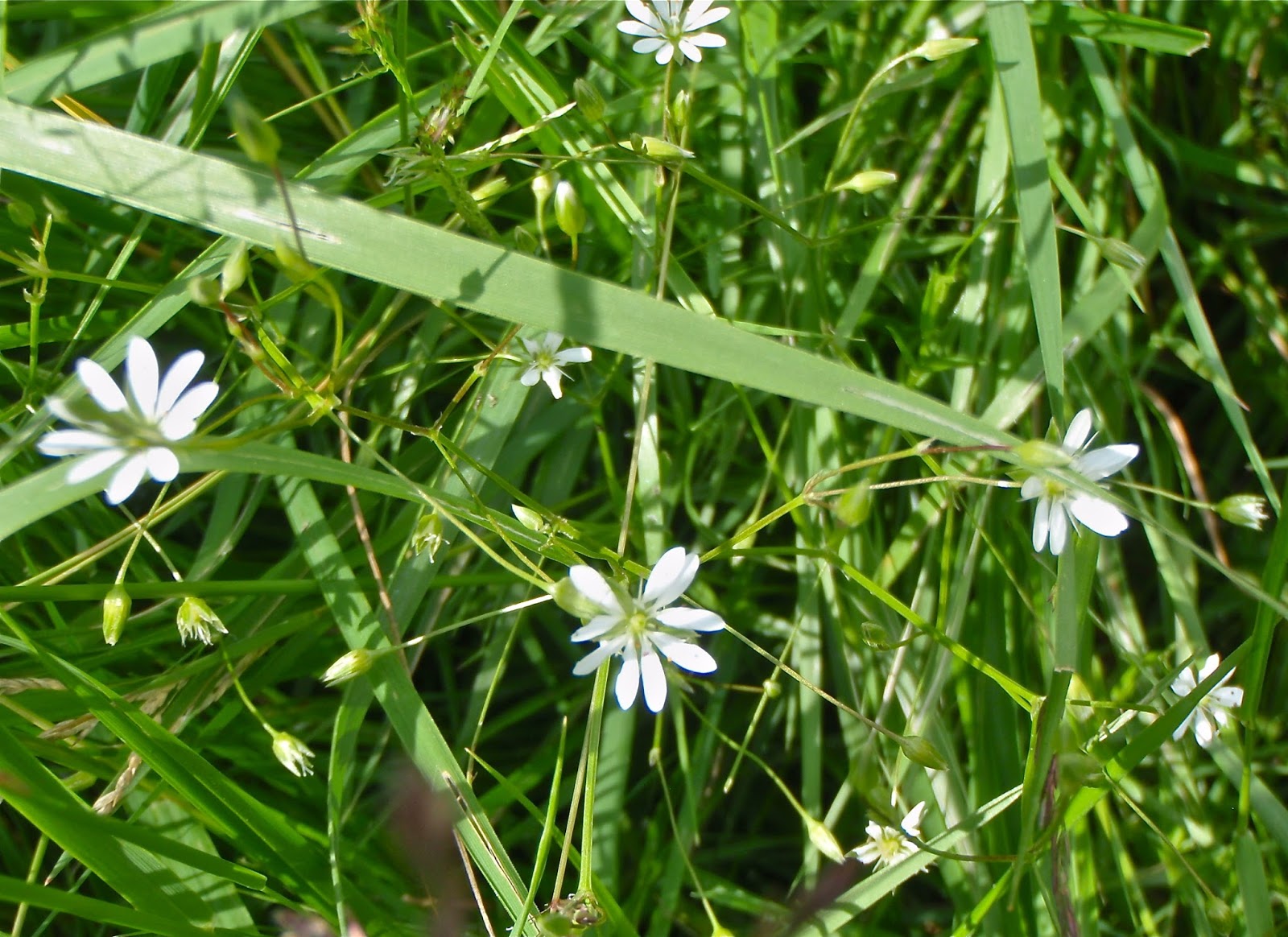
Moving on from the river bank into the wild field, the grasses were outpacing any other plants in the continuously damp weather, but hiding amongst the grasses were substantial clumps of Lesser Stitchwort:


Lesser Stichwort (Stellaria graminea) growing strongly through the meadow grasses
  
As soon as the sun appeared, bees thronged the flowering plants alongside the stony path - here a Garden Bumblebee attracted to the White Clover moving very fast from flower to flower:


Garden Bumblebee Bombus hortorum on clover


Saturday, 18 June 2016

June - summer arrives

June started this year with cold windy weather but by the 5th had become very warm with humidity increasing. On the 6th, rapid changes on the riverside were very evident, with Hawthorn blossom gone, replaced by flowering Dog Rose (Rosa canina) Meadow buttercups amongst the grasses, daisies and clovers attracting insects. The day started clear and sunny, with cloud increasing later.


Flowering Rosa canina spreading upwards, its thorny boughs
providing protection for nesting birds and the flowers attracting
bees.


Flowering Elder promising a large crop of early berries for summer visiting birds - they will be foraging here before starting off on migration, leaving the bushes stripped bare well before winter comes.

On 6th June 2016, the landscape along the river was quite different from the same time last year with grasses prevailing on the damp earth and fewer wild flowers and butterflies - but presenting no problems for most birds.
Woodpigeons (13) were not numerous today with just a few, dozing in the old trees or foraging deep in the dense foliage or on the ground with a few starlings (15).  Blackcaps (12)  burst into song at intervals along the river, in Blackthorn, Hazel and Willow stands, their young probably now fledged. Song gave away wrens (21) all along the banks, mostly seen low down on the banks, some with fledged young.
Yellow-cheeked juvenile blue tits making quiet zzzzz calls tried to attract the attention of overworked adults , flying over nettles and brambles collecting insects and caterpillars (24) whilst great tits (7) were seen carrying food to well hidden nests and young. Usually very easily seen and heard, only six robins were seen in various places, all singing, whilst most are probably occupied with second broods. Rainfall this year has been kind to them (and wrens)  allowing nest-building low down on the banks and under tree roots without destructive floods - but providing sufficient rain to keep the earth damp, allowing easy foraging for worms. Another beneficiary of these conditions has been the song thrush which also nests low down and needs damp foraging. Four were singing loudly and persistently each in its own territory today, their song echoing along the river. Blackbirds were more numerous, as usual, (20) but only about three are singing, the rest silently foraging on the ground or flying low, carrying food to young or chasing. Dunnocks (3) were difficult to see now, within low, dense undergrowth but two gave away their locations by singing. 
An early start meant that I was halfway along the river before house sparrows were waking and starting to sing but soon there were large numbers, in several hedgerow colonies singing and calling. (74), some moving to warm bramble patches and sunnier hedgerows to preen and sing. Two chaffinches were heard singing, five in total, whilst 3 greenfinches were present in a 'sparrow thicket'.
Singing goldfinches were gathered high in a maple (about 17) and looking to the sky above, three herring gulls flew over with two rooks , and a jackdaw lower over the field. Loud demanding calls suddenly shattered the peace - a family of magpies had arrived, with 3 clumsy young demanding to be fed by reluctant adults (7) and a single, silent jay flew across. Calls heard overhead came from a group of four Canada geese flying over. High thin calls form overhead branches revealed a goldcrest foraging in the canopy of a deciduous tree but three others were seen moving rapidly around in a conifer (4). 
At this time of the year nuthatches  and woodpeckers are usually quiet but today (as on preceding days), a great spotted woodpecker was heard drumming persistently in a small copse and two nuthatches were calling with a third seen flying across through the trees. A treecreeper called from an old ash tree with at least two young calling back (3) but unseen.
Down on the river a moorhen called and a smart grey wagtail flew low along the bank. In the same area a single swallow flew along the river course, where insects fill many sheltered spots.
Our visiting migrant warblers have been doing well this summer, returning to their favourite locations. Whitethroats (5) singing with short scratchy songs, grace the dense foliage, favouring low bush-like habitat with foraging space whilst Chiffchaffs (7), garden warblers (5), willow warblers (3) mostly prefer tree canopies for foraging in summer. Blackcaps seem to prefer middle heights.
Lastly about 8 swifts were making diving, swirling flights over the river course collecting insects - they will be off again soon, heading south over warmer lands, en route to Africa.

Crab Apples forming on the bank

Insects:
Although summer butterflies are still scarce, five Orange Tip butterflies were seen over the nettles and brambles, hopefully having laid their eggs on the plentiful Cuckooflower and Garlic Mustard plants along the banks and on the wild field. Just one spring Holly Blue butterfly was seen and one Red Admiral on nettles on a the steep sheltered bank where a single Large White butterfly ranged.  As it warmed up, a few Speckled Woods  were seen chasing each other in the dappled shade. Large numbers of other small insects were present, including hoverflies.
Damselflies were present over the water and ranging the banks in sheltered areas, including Common Blue, freshly emerged Beautiful Demoiselle damselflies, males and females warming up and drying out on the  river bank nettles with good numbers of male Banded Demoiselle damselflies and few females. 

Monday, 30 May 2016

Orange Tip butterflies on river patrol

This spring has seen good conditions for Orange Tip  butterflies (Anthocharis cardamines) here on along the river, and Holly Blues (Celastrina argiolus) are doing well too.
On 23rd May (see previous post for the bird species record) , males (with orange-tipped wings) were seen flying over river bank vegetation, brambles, nettles and cow-parsley and females - similar to males but without the bright orange wing-tips were ranging the riverside grasses and bank vegetation in search of Cuckooflower plants and Garlic Mustard plants with flower buds on which they will lay their eggs. They are very restless butterflies and seldom perch to bask in the sun. 
Cuckoo flower - one of the foodplants of their caterpillars has spread along the river this year and Garlic Mustard, another food plant, is also spreading, so the new generation of Orange Tips should
do well this year.


Garlic mustard in flower - buds are used by Orange tips to lay their eggs

Holly Blue butterflies are hedgerow butterflies and at this time of the year the females are searching high and low for choice Holly flower buds on which to lay their eggs. Unlike the single generation Orange tips, the Holly Blues have two generations, and can be seen from March until October, the autumn generation seeking out Ivy flower buds on which to lay eggs. There's plenty of both Holly and Ivy plants along the riverside and Holly Blues are a common sight. 

On the wild field an early Common Blue was seen where in summer a good diversity of wild flowers will appear, and along the river today a few Brimstone butterflies together with Large White butterflies, both strong flyers. 
The two species of early damselflies, Beautiful Demoiselle and Banded Demoiselle were seen,  both males and females, most freshly emerged from the river in warm undisturbed regions where reeds and grasses are growing.


Saturday, 28 May 2016

Food for Fledgelings on the Riverside

May has been a perfect month for growth with enough rainfall alternating with sunlight causing a sudden increase in invertebrates and vegetation. Birds are doing well too. After a mild winter when survival was simple for our resident birds, they faced a cold and windy early spring which caused some birds to delay nesting. Fortunately here insects began to emerge and the oaks came into leaf, with abundant caterpillars - food for nestlings.
Once fledged the young will still be fed on protein-rich insects by the parents - the riverside being a prime habitat and source of food - insects and spiders - dragonflies and damselflies included.


This immature male Beautiful Demoiselle damselfly has just emerged and has chosen a perfect place to warm up and become flight-worthy, perching on a Dock leaf.  Its wings were still wet and glistening and its body almost colourless. It would not be able to move fast in this condition and could be easy prey for a bird feeding young.

Here is a Full Report for Monday 23rd May:
The morning was fine, with a slight breeze which strengthened later bringing clouds. The river was low but flowing well through a landscape of brilliant wild spring green, and Hawthorn blossom now weighing down the branches indicating a plentiful berry autumn. The young oak on the bank is at last clad in new green leaves after a long autumn, winter and early spring still carrying its old leaves from
last year. The trees we planted are also blossoming well now.
House sparrows were the first to be heard and seen with fledged young adding to the numbers - more than 80 were seen in total in various colonies along the river, most favouring the Hawthorn as a safe place to perch. Recently-fledged sparrows were seen wedged together amongst the blossom on a Hawthorn branch, waiting to be fed whilst the adults were busy hovering and darting over the nettles on the bank, flycatching. With such a profusion of insects, many species of small bird adopt a fly catching habit at this time of the year - a sure way to gather the most food in the shortest possible time.
Four chaffinches were present amongst the trees, singing loudly, accompanied by two greenfinches high up in the canopy.
Blue tits were demonstrating their fast-flying food gathering skills, their actions so fast that only 12 were seen along the river today, darting out of their nest holes unseen and darting back with food for nestlings so quickly that their young were enjoying a constant supply of insects, no long hungry 
hours of waiting. Only 8 great tits were seen, three of them singing, as most were nesting too.
Long-tailed tits start nesting very early in order to choose nest sites which will be easy to build on, with bare twigs and thorny stems such as brambles which, by the time the nest is finished and occupied, will be completely hidden from predators by new leaf growth. Three birds were seen today, two juveniles and one foraging adult. The juveniles were quite vocal, attempting to keep in touch with each other and their siblings nearby. 
Starlings (40) were also early nesters this year,  keeping close together, juveniles and adults, foraging and roosting, the young keeping up a constant calling - easily distinguished from the songs of the adults.


Hawthorn blossom on a branch - gaps between old trees are often filled by Hawthorn.

Wrens (30) were singing loudly on the banks. I came across a new territory being defended every few meters, some quite low down in mossy areas and roots close to the water and others amongst higher undergrowth, almost all nests were invisible. There are always many more wrens on the riverside than are heard and seen at any one time as they only choose to sing or call in alarm when they need to advertise their presence. Their nesting season is a long one as they often have two broods in a season.  Blackbirds (30) were mostly foraging on damp shady grassed areas silently - or giving an alarm call but some were singing this morning. Males were more numerous, collecting food for their young, still easy work at present as the ground is damp.
They often have 2nd broods and even three broods in a season if conditions are good, finishing late in the summer. They do not observe the 'Nesting Season' extents set out by misguided or ignorant humans! Who is to say that they cannot nest in February or still be feeding young in the nest during October? Song thrushes too can have three broods or even four, given a favourable season. It's the prevailing natural conditions that dictate their actions, not mankind…
Today, six song thrushes were observed, all keeping to their local territories, three were singing loudly whilst three others were foraging silently in other places under hedgerows and on grass, probably collecting food for their young.
Goldfinches are numerous here all year round having been pushed into retreat from their original farmland habitat as it was/is taken for development. Here they feed on the seeds of plants such as dock and populate old trees and thickets anywhere nearby, providing a background of song.
Like the song thrushes, they can raise several broods throughout the summer. Today about 35 were seen and heard along the tree margin.  Robins were less visible and audible today (16), as most are  nesting, some for the second time already this year, with several young seen foraging in the dense undergrowth, well camouflaged in their speckled brown plumage.
A sudden loud alarm call from a robin very close by alerted other birds which dived for cover. I looked around for the cause, and caught sight of a sparrowhawk flying low over the canopy of leaves, heading south down the river. The highly observant robin had caught sight of it through the dense canopy - or perhaps had seen the hawk's reflection in the river. The alarm was over in a second. Other predators were more easily seen and heard: the magpies (5), gathered today in a Maple tree were noisily flapping and could not take anything by surprise whilst carrion crows (4) were seen flying over, apart from one which was perched, swaying on a Hawthorn branch, looking out for activity below. It flew off several times nd returned to the same spot, empty-beaked. In the distance, two high-flying rooks headed out and later two calling jackdaws were also seen flying across, with just a single herring gull drifting high.
Woodpigeons (18) were also seen flying over, or sitting in trees doing nothing much - is there another bird which does nothing for so much of the day? Wait - they are watching you even when they appear to be asleep - one false move and they will be off instantly, sending other birds to cover. 
One was seen pecking at new leaves on a blackthorn and two more were seen bathing in a sheltered area. Two collared doves were heard calling in the distance - much lighter and busier birds, their nests get predated quite frequently by mammals or corvids.
From the largest to the smallest - goldcrests, were fast moving, joining the warblers in the sheltered river bank Willows today as their usual conifers were becoming windswept as the breeze increased (3).   
Warblers were more difficult to spot now that the trees were in leaf but their songs usually gave them away. Blackcaps (9) were still singing loudly and beautifully from various thorn thickets and Willows, with one female giving a short burst of subsong over the river, the rest were males. 
Three garden warblers were singing too - with singing goldfinches in the background. The warblers were usually perched quite low down, easier to see once heard. The unmistakable song of the willow warbler (3) rang out - from different places in Willows along the river and it was good to see that common whitethroats (3) had returned to the Bramble patches. They usually raise two broods, like the blackcaps, using the prime areas of low tangled vegetation under clumps and on banks.
Chiffchaffs (10) seemed to be everywhere, their calls could be heard all along the river and it was still quite easy to see them as they were constantly moving from branch to branch foraging amongst the foliage, flicking the soft new leaves and twigs as they went. A dunnock was seen singing from a Maple with another seen lower down (2) and elusive treecreepers gave their presence away by calling from an old oak (2). Another woodland bird,  the nuthatch, does not call when nesting, except in alarm and there was no familiar calls from them today but a good view of one collecting food for nestlings.
Likewise the great spotted woodpecker remains quiet but one was heard drumming loudly the day before and on many previous days, so we know of its presence here.


Hawthorn on the River Bank 23rd May 2016

Under cover on a shady sheltered part of the river three young male mallard ducks were seen quietly feeding whilst overhead three more were seen flying downstream.

Last but not least: SWIFTS!

Very special and welcome birds, the last to arrive here on their long migration north, were a total of 29 swifts, seen today in the air, catching insects over the river course, and a single swallow,  an arrival from southern Africa flying low over the water to feed.

NB the record for Butterflies and damselflies for 23rd May will be on the next post.