Wednesday, 18 May 2016

Damselflies emerge in the warmth

After several days of warm weather, the river water has warmed up. The first good sign is an increase in insects flying above the surface of the water, attracting warblers and other birds hunting for food to feed their young in the nest.
Friday 13th May 2016 - after a dull start the sky soon cleared to give a warm and very sunny day. That afternoon, walking along the river bank, hoping to see butterflies, Damselflies appeared instead.
Obviously freshly emerged during the late morning, they were seen perched on the riverbank vegetation in the sun, drying out their wings. Attempts at flight were brief, just enabling them to move from one leaf to another nearby, wings glistening.
The first seen were Beautiful Demoiselle females, then a Banded Demoiselle males and a
Large Red Damselfly. Others seen briefly were so freshly emerged it was difficult to see at a distance what they were, as immature damselflies can resemble females until they acquire their adult colouring, defining the species.


A fine young male Banded Demoiselle Damselfly, warm and about to fly off the fresh Bramble leaf on the river bank


On a nearby Bramble leaf, an immature female Beautiful Demoiselle Damselfly catches the sun.


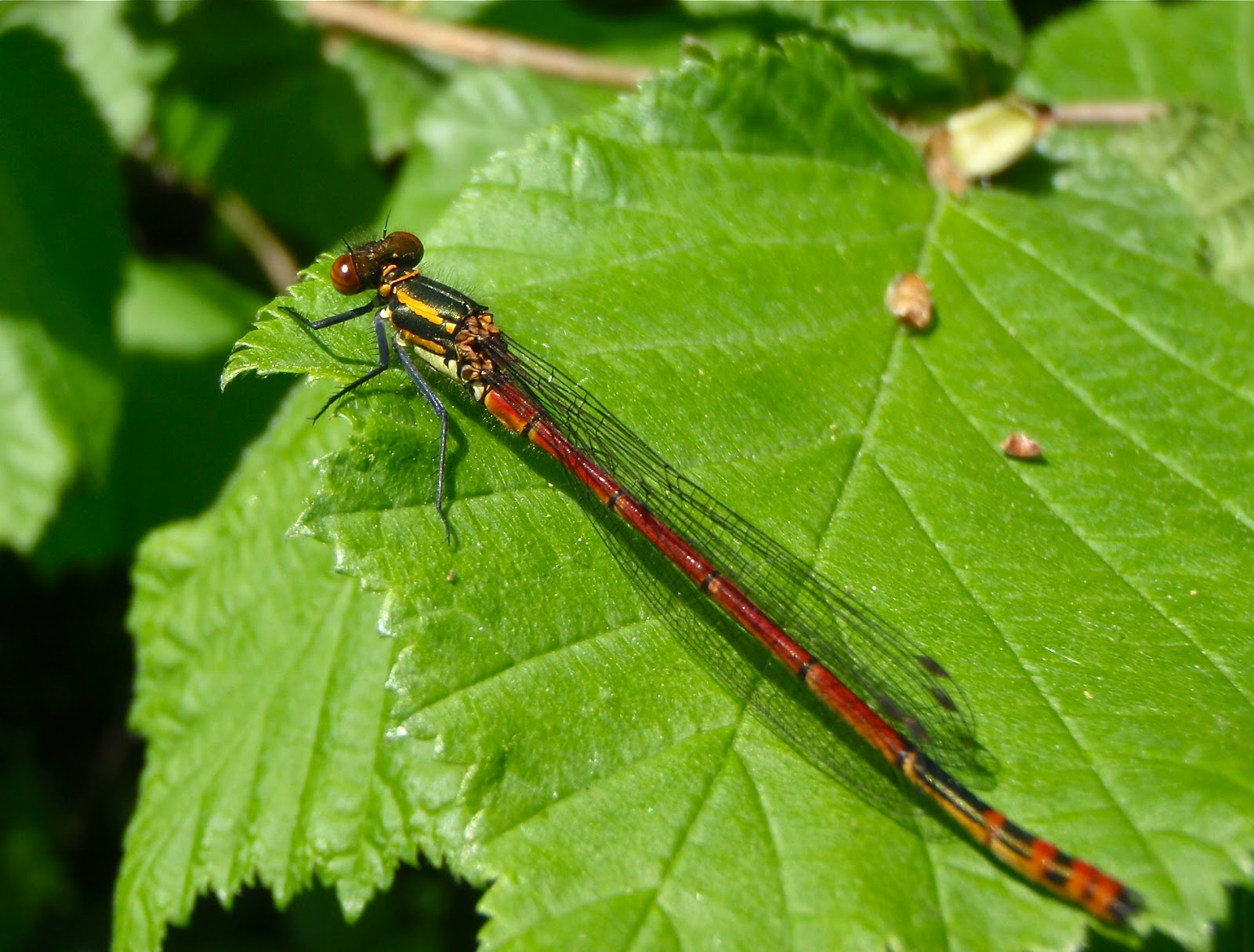
A larger species, also warming up on a Bramble leaf, a female Large Red Damselfly watches out for passing insects
A long-tailed tit was foraging in the branches overhanging the river, a blackcap sang  in chorus with blackbirds, song thrush and a garden warbler.
Orange Tip butterflies were again the most numerous but a Peacock butterfly was seen in the adjacent wild field basking on a natural footpath through the growing grasses and wild plants. 


A Peacock butterfly warming on the trodden path. 


Thursday, 12 May 2016

May brings fine days to the riverside

Sunday 1st May started with very light wispy cloud then full sun - fine weather at last and no cold wind.
Good numbers of Orange Tip butterflies, males and females were ranging over the wild field visiting clump after clump of Cuckooflower, doing very well now. The first Cuckooflowers were seen on the field in February but are now prolific, not just in the field but in places all along the river banks, attracting Orange Tip butterflies everywhere, far more than last year. This year most butterflies have been scarce so far due to the cold, wet and windy weather. A single, rather battered Comma butterfly was seen on nettles, Blackcaps were singing in the Blackthorn, a great-spotted woodpecker was seen flying across and heard calling. Wrens, robins, song thrush were busy foraging along the base of the hedgerows.

Comma butterfly warming up on nettles on the river bank


DAWN CHORUS!
At 5am on the MayDay (2nd) bank holiday, it was just becoming lighter, although uniformly overcast. The night had been warmer than of late, with no wind and a superb dawn chorus was heard echoing along the river.
Blackbirds dominated the singing at times but song thrushes, blackcaps, robins, wrens, dunnocks chiffchaffs and other warblers were all singing together in a wave of sound, the only sound audible in the landscape with no background noise - the dawn belonged to the birds.
The day itself became breezy, with rain but a hobby was seen flying fast over the river course under the  cloud.

A week later on Monday 7th May, after a few days of warm weather, the river water was heating up - and the first Damselfly of the year was seen flying low over the nettles. It was a female Beautiful Demoiselle Damselfly, freshly emerged. It stopped and perched several times in order to dry out its wings and body in order to be able to fly any distance from the water where it had emerged.
Another first for the riverside were two Speckled Wood butterflies perched on brambles close to the damselfly. More Orange Tip butterflies were investigating the Cuckooflowers and several Holly Blue butterflies were seen flying strongly along with a bright male Brimstone, high and low. A male song thrush was singing in its usually thicket whilst another foraged below. Chiffchaffs, goldfinches and chaffinches were all singing nearby.


The first Speckled Wood butterfly of the summer on fresh bramble leaves on the river bank

Saturday, 30 April 2016

April ends - and wildlife thrives despite the morning frosts and afternoon squalls

30th April 2016 - a fine frosty start, clouding over later with dark clouds banking up racing over bringing frequent squalls with icy rain. One could hear the wind and rain approaching before the riverside was plunged into darkness. After the rain, suddenly the sun would bring light and warmth but for too short a time. Initially the plan was to look for butterflies along the banks that afternoon but only one was seen, a male Orange Tip, fluttering low on the bank not daring to fly high but keeping low amongst the grasses where it could drop down onto the stalks as soon as the wind and rain returned. 
I had been walking for only two minutes before the first dark cloud raced over. Birds that were singing fell silent and flew to cover, the hawthorn now in leaf provided some shelter.
Chiffchaffs, wrens, robins and  great tits all making the most of the sun still easily seen, dropped down below the banks to get out of the swirling wind which tore Oak catkins and young leaves off the branches. The birds fell silent, even the Nuthatch which had been calling persistently. Sheltering under the Hawthorn with the noise of the approaching squall coming closer, I was startled to heard a very low pitched loud drumming from an old bare ash tree almost immediately above - a great spotted woodpecker had chosen a tree with maximum effect, quite a different sound to the usual woodland trees chosen. In the distance another great spotted woodpecker was drumming too, but without appearing from behind the tree trunks.


Wild Garlic flowering on the banks amongst Hazels and Hawthorn

The rainstorm soon cleared and I walked further along the river where a a third great spotted woodpecker flew over me into an oak, showing its fine colours, whilst the other two were still drumming in the distance. This bird was silent and probably has a nest. As the sun warmed up the leaves wet with icy rain, a blackcap started to sing, then a willow warbler was heard and a whitethroat song came from a dense bramble thicket. About 20 herring gulls flew over whilst blue tits and two long-tailed tits were busy fast-foraging before the next rainstorm hit. A song thrush foraged quietly along it's own hedgerow base in the sun, pausing now and again to spread out its tail and wings to soak up the warmth of the sun for a minute. Blackbirds and robins acted in a similar manner whilst thick-coated bumblebees ranged along the wild flowers on the banks and amongst the hedgerow blossom.
It was good to see the first crab apple blossom buds were just appearing.


Crab apple blossom just appearing in a short interlude of sunshine


Saturday, 23 April 2016

Sheltering from the Chill North Wind

Today, 23rd April was cold, with breeze straight from the Arctic, even the fast flowing river looked cold, although running lower now. Compared with last year the cold wind has delayed the appearance of butterflies along the banks but the long-saturated earth has produced abundant damp-loving flowering plants such as Wild Garlic and Cuckooflower. Many birds were singing but keeping low under the banks and verges whist others were silently foraging intensely, already having young in the nest to feed.
One very active bird was heard calling first - low down on the river bank in a sheltered spot -
a fine male grey wagtail in breeding plumage.


The fast flowing river, Blackthorn blossom attracting blackcaps, the air filled with singing chiffchaffs and song thrushes - and a great spotted woodpecker drumming in a nearby tree.

A singing whitethroat was heard nearby - a welcome return to the riverside - and later a lesser whitethroat was heard singing too, investigating territory formerly only occupied by the early arrivals -the chiffchaffs, the first of the Phylloscopus warblers - and blackcaps, the first of the Sylvia warblers. Whitethroats are also Sylvia warblers but are usually later in arriving.
The cold weather seemed to have triggered a nest-building frenzy, with house sparrows and blue tits seen collecting dry grasses and mosses to furbish of refurbish their nests, returning time and again to the same source of materials. 

Thursday, 21 April 2016

April showers and abundant wild flowers

After the March Easter storms, April started with calmer weather but with cold winds and frequent rain showers, contrasting with last year when we feared there would be an early drought.

Blackthorn Blossom on the river bank. 
Blackthorn is one of the most valued species for wildlife
throughout the year - in spring the blossom provides sustenance  for hungry blackcaps when they arrive
on our shores. If there are no ivy berries left and insects are scarce they will use the blossom nectar as an energy food. They can also be pollinators at the same time, transferring pollen from one flower to another on their beaks.
Here is the full record for Tuesday 12th April 2016 - interesting to compare it with the  record
for March, a month earlier….
The 12th April was a fine day after numerous showers the previous day, the grass was very wet with dew at first but drying up later. There was no wind. After a slow start, the brambles are now growing, with new leaves opening but growth is still slow. One of the nests being built by long-tailed tits on the river bank is still present, having survived some very severe weather, and is now fortunately being hidden from view by the new bramble growth, nettles and wild garlic. Lesser celandine flowers form a dense carpet in sunny places, on banks and ditches and wild garlic growth is prolific, also after a slow start. It was good to see Wood Anemone flowering under the old oaks.

Wood Anemone flowering under an old oak on the river bank

The ground was littered with small twigs forming 'tidemarks' where the flood waters had washed them and now oak catkins, the male flowers of the oak have been falling, blown along by recent gales.


Pollen from the Oak catkins is blown everywhere. 
On the lower right of the photo, new catkins can be seen emerging, leaving brown husks.

Wrens were everywhere along the bank, the sun attracting them to start building nests above the high water line where vegetation is growing well or under mossy banks. Most of the time is spent singing loudly, when not chasing and foraging amongst last years dry stalks washed sideways by the recent floods. Thirty-two were seen along the river. The most vocal, apart from the wrens, were the chiffchaffs, now well established in their spring territory, ceaselessly moving from branch to branch, hardly pausing, except to sing (18). Chaffinches were now singing, as usual only seen in small numbers here (6) and twenty-three Blackbirds were very busy along the banks and hedgerows, mostly nesting now and using alarm calls rather than full song although two were singing. Blue tits were numerous (36) a few calling but most were silently foraging unlike the great tits (26) which were mostly males singing loudly, conspicuous in their smart plumage. Far more subtle and melodious in song were the blackcaps (10), the males choosing blossoming Blackthorn branches or bramble arches as song posts.
Females were often close by, foraging quietly in the background.
Long-tailed tits (5) were very busy collecting insects amongst the willows and brambles in various places, singly or in pairs, as they are already nesting. A soft call from a bullfinch came from the back of a Blackthorn bush and two were seen briefly, flying out.
In the distance, a green woodpecker called, with another nearby and a third was seen up from the grass (3). There were still many robins visible (16), some singing but most were seen foraging for worms in the damp shade, nesting taking priority. The loudest song on the riverside today was composed and performed by a song thrush very close by with several other singing song thrushes in other locations along the river (7). Much quieter, a chorus of singing goldfinches could be heard from a tree, with most birds hidden from view (27 seen), occasionally joined by one or two singing starlings.
A pair of dunnocks was seen, the male singing, then several others, some chasing,some singing, were visible higher in the thickets than at other times of the year (6). Down on the river itself, quiet calls were heard - a pair of mallard, then another male was seen paddling fast downstream (3)
House sparrows were fortunately present in good numbers (about 70), in brambles and hedgerows, some singing, some bickering, with short noisy fights breaking out, soon settled.  I watched one fight -a bundle of birds with claws locked and wings flapping wildly tumbled heads over heels down a steep bank and came to a halt just above the water's edge where they sorted themselves out, quickly flying off in different directions.
Buzzards have been very visible recently and 12th April was no exception, with one seen circling overhead, joined by another - they drifted off, followed by a third.   Only three herring gulls were seen today,  whilst thirty-five wood pigeons were gracing the riverside, in trees or foraging on the grass and scrape, some pecking at the Hawthorn buds.
Some broken eggshells on the ground indicated that a nest had been raided, the culprits probably magpies (3 were seen) and the nest probably that of a pair of collard doves nearby - although carrion crows could have been responsible (4 seen in the air). 
Suddenly the silent killer,  a sparrow hawk,  flew fast and low across and along the river, one bird which is very seldom heard and waits unseen low on the bank until it's time to attack - any unwary bird can be the prey from sparrows to wood pigeons.
  Nuthatches however are almost always heard, they are extremely vigilant and will warn anyone approaching with loud 'go away' calls - three were seen and heard today along the river.
Starlings, often gathered together on a field away from the river, were today quite active (42) mostly flying over to feed on the riverside grasses and verges.
Hearing a noise, I looked up to see two jays sitting together on the bough directly overhead - a smart pair, wiping their beaks then continuing to hunt for insects under the layers of lichen in the forks of branches. A third was seen on another tree. 
It was good to hear the song of a skylark over the field - so high up it was almost invisible. In another location a low flying kestrel showed it's fine colours, gliding and turning, not hovering, as there was not even a breeze.
On such a rare fine day, butterflies were flying but not in large numbers yet. 3 Brimstone butterflies, 4 Commas and one Holly Blue were seen. We will have to wait for more sustained fine weather this spring.


Cuckooflower on the river bank - appearing in many places this year
waiting for the Orange Tip butterflies to appear.



Thursday, 31 March 2016

Riverside Wildlife withstands the Storm

The fierce storm that shot through from west to east on the night of Sunday 27th March 2016 did not 
do much damage, felling only one poplar tree. Floodwaters spread out across the natural river bed as usual, filling the traditional river bed, and flowing onto the wild fields, the vegetation, undergrowth and trees attenuating the flow. By the end of Monday 28th it was almost back to normal, Birds were singing and foraging, happy with the very soggy ground conditions,  with raptors taking full advantage of the disturbance, the flood waters having sent small mammals and other ground prey fleeing to higher banks.


The old hollow ash tree which had fallen several weeks ago presents no barrier to the immense strength of the flow of the water
Many birds had used this tree to nest in, the trunk and branches were full of holes - but the birds had already sourced new nest sites.


Sunday, 27 March 2016

Ponds spring to life in March

16th March 2016 - Whilst the river rushes past, nearby ponds offer calm water, warming up in the sun, with aquatic plants providing shelter and shade where needed for wildlife. Peripheral vegetation, grasses, shrubs, scrub, tree roots and stones have provided shelter for overwintering amphibians which, when conditions are just right, find their way back to the ponds.
Suddenly the water was teeming with life. Different ponds, depending on their location, were showing several different stages of life, all on the same day.
 A small patch of frogspawn was visible in a one pond, then one common frog peered up from the water to look around and was soon joined by several others, males and females.


Common frog (Rana temporaria) - just one of many in the pond

It was a cold day but warm in sheltered areas but the exposed ground was drying out in the wind.
A larger pond close to the river held huge quantities of frog spawn, being in a brighter place, perhaps it was warming up faster this spring, so was a first choice for some frogs.


 A corner of the large pond filled with frog spawn

Frantic movement just under the surface of this pond in a sunny area revealed thousands of tiny tadpoles thrashing around the spawn clumps to make space for themselves and to start feeding on algae…..


Thousands of newly hatched tadpoles on the pond. 
Many will be eaten before they become frogs, and frogs themselves
are predated by several bird species such as Grey Heron - so whilst still in the pond they seek deeper water where they are not so easily seen.
The surviving froglets will move out of the water in early summer and spend the rest of the time away from the pond, hidden in secret damp locations where they feed on flies and other insects, snails, slugs and worms. Eventually they will return to a pond to breed. Given good habitat, they can live for may years, hibernating in winter under old rotting logs and leaves or stones.
It is therefore very important to protect their terrestrial habitat, not just the ponds where they breed and spawn - and in the case of new ponds, provide extensive undisturbed habitat for them on damp land as well.